
TESS has released its most comprehensive all-sky mosaic, plotting about 6,000 candidate exoplanets identified through Sept. 2025. The map covers 96 observational sectors collected since the mission's April 2018 launch and highlights roughly 700 confirmed planets. Recent highlights include an unusual super-Earth system with a highly eccentric companion and evidence of a planetary collision that created a debris cloud. The expanding TESS dataset continues to reveal surprises across exoplanet science and stellar astronomy.
TESS Releases Most Complete All‑Sky Map Yet — Pinpoints ~6,000 Candidate Exoplanets
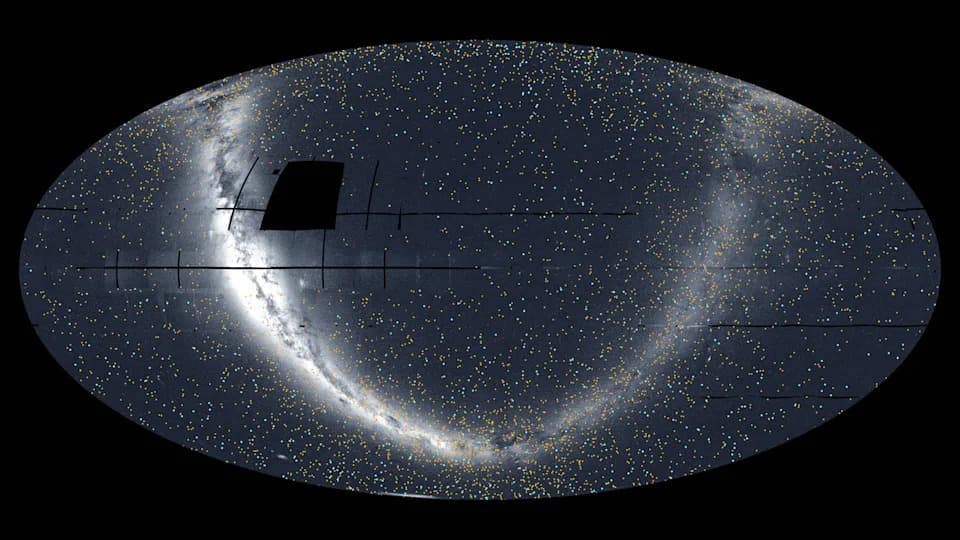
This view of the whole sky was constructed from 96 TESS sectors. By Sept 2025, TESS had discovered 679 exoplanets (blue dots) and 5,165 candidates (orange dots). . | Credit: NASA/MIT/TESS and Veselin Kostov (University of Maryland College Park)
NASA's Transiting Exoplanet Survey Satellite (TESS) has published its most complete view of the sky above Earth to date, revealing the locations of roughly 6,000 candidate worlds beyond our solar system. The catalog combines both confirmed exoplanets and thousands of candidates identified by the mission through September 2025, the end of TESS's second mission extension.
TESS launched from Space Launch Complex 40 at Cape Canaveral in April 2018. The spacecraft uses four cameras to monitor the sky in sectors: each sector contains tens of thousands of stars and is observed for about a month before TESS moves on. The new all-sky mosaic is built from 96 sectors observed between April 2018 and September 2025.
The mosaic marks about 700 confirmed exoplanets (shown as blue dots on the map) and roughly 5,300 candidate worlds (shown as orange dots). Confirmed discoveries include a wide variety of exotic worlds — from planets being stripped apart by their host stars to planets scarred by extreme volcanism — while the candidates point to a far richer population still awaiting confirmation.
Notable Recent Discoveries
In 2025, TESS identified a planetary system with an unusual architecture: a super-Earth accompanied by a companion on a highly elliptical, tilted orbit unlike typical systems. That same year, the mission found evidence that two planets collided, producing a cloud of debris in front of their star. Studying such collisions can help scientists understand dramatic events in the early history of planetary systems, including the giant impact thought to have helped form Earth's Moon.
"Over the last eight years, TESS has become a fire hose of exoplanet science," said Rebekah Hounsell, a TESS associate project scientist at NASA’s Goddard Space Flight Center. "It's helped us find planets of all different sizes, from tiny Mercury-like ones to those larger than Jupiter. Some of them are even in the habitable zone, where liquid water might be possible on the surface."
"The more we dig into the large TESS dataset, especially using automated algorithms, the more surprises we find," said Allison Youngblood, the TESS project scientist at NASA Goddard. "In addition to planets, TESS has helped us study rivers of young stars, observe dynamic galactic behavior, and monitor asteroids near Earth. As TESS fills in more of the night sky, there's no knowing what it might see next."
Beyond the headline numbers, the TESS dataset continues to be a rich resource for astronomers worldwide: confirming planets, revealing rare system architectures, tracing stellar populations, and helping detect and track near‑Earth objects. With more data and improved analysis techniques, the mission is likely to produce many more surprises.
Help us improve.





















