Viral social posts claimed 5G towers can "engineer" weather such as storms and droughts. Experts say there is no physical mechanism or credible evidence to support this, and the circulated graphic itself notes it is not endorsed by any scientific body. Scientists add that the energy from cellular networks is negligible compared with the solar energy that drives weather, alleged particle spraying would be detectable, and atmospheric winds overwhelm any effects from radio signals.
Experts Debunk Viral Claim That 5G Towers Can Control the Weather
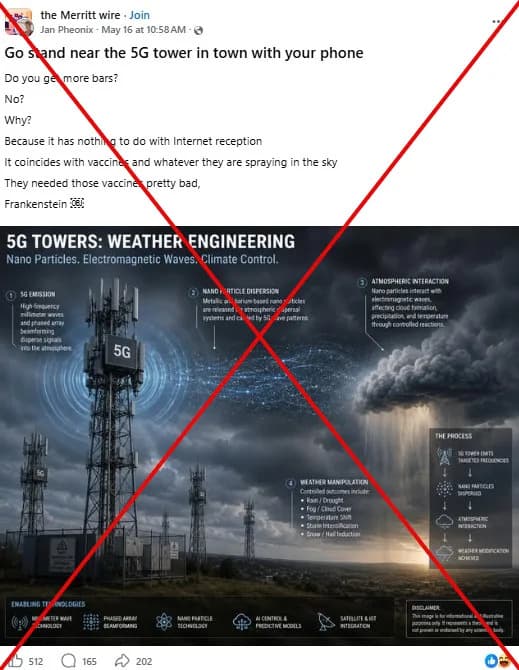
A screenshot of a Facebook post taken May 19, 2026
A graphic circulating on social media claimed that 5G cell towers can be used to "engineer" weather—triggering droughts, storms and hail. Physics and climate scientists contacted by AFP say these assertions are unsupported by basic physics and lack any credible scientific evidence. The image itself even carries a disclaimer saying it is not endorsed by any recognized scientific body.
What the Graphic Claimed
The graphic, headlined "5G TOWERS: WEATHER ENGINEERING," was posted to a Facebook group for Merritt, British Columbia on May 16, 2026 and has since appeared on other Facebook pages and X. It suggests that radio-frequency waves, metallic or barium nanoparticles and cell-tower infrastructure can be combined to manipulate weather patterns.
Why Experts Reject the Theory
No Known Physical Mechanism. "Electromagnetic signals of the power and frequency range of 5G wireless communications cannot cause any significant changes to weather on any scale," said Jack Singal, a physics professor at the University of Richmond.
Energy Scale Is Tiny. The energy emitted by mobile networks is negligible compared with the solar energy that drives the atmosphere. Andrew Dessler, a climate physicist and director of the Texas Center for Extreme Weather, told AFP: "Absolutely not" when asked whether 5G could trigger storms or drought.
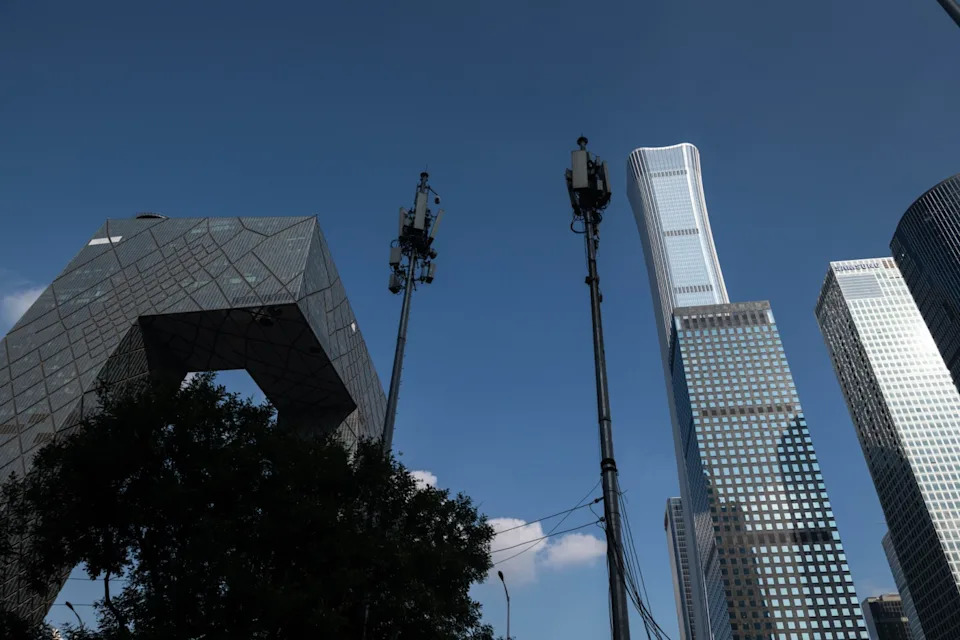
Two 5G towers are pictured in Beijing in 2020NICOLAS ASFOURIAFP(NICOLAS ASFOURI / AFP)
No Credible Scientific Evidence. There is no reputable peer-reviewed literature supporting the mechanisms depicted in the image. Dessler and other experts say the graphic offers no viable pathway by which radio-frequency emissions could change large-scale weather patterns.
Particles, If Present, Are Not Being Used As Claimed. Claims that metallic or barium nanoparticles are being deliberately sprayed into the atmosphere are not supported by atmospheric measurements. Stephen Holler, a physics professor at Fordham University, noted such particles typically remain aloft for only days and any sustained program of dispersal would show up in observations.
Wavelengths and Atmospheric Forces Make Control Implausible. 5G wavelengths are far larger than tiny airborne particles, so the waves would pass through without significant absorption. Steven Cummer, an engineering professor at Duke University, added that in real atmospheric conditions, wind and turbulence far outweigh any forces produced by telecom signals, making manipulation of particles effectively impossible.
"The global warming and other climate change impacts we see are the result of greenhouse gas emissions — not cell-phone networks," Holler said.
Context and Previous Misinformation
This is part of a broader set of long-running conspiracy theories linking wireless technology to health and environmental harms. AFP and other fact-checkers have previously debunked claims that wireless signals activate pathogens or spread disease. Major health organizations have found no evidence that 5G exposure causes adverse health effects.
In short, scientists say the viral graphic is misleading: it misstates the physics, ignores energy scales, and lacks empirical support. The best-established drivers of climate and weather change remain greenhouse gas emissions and natural atmospheric processes.
Help us improve.