
James Webb has delivered a detailed new infrared image of the barred spiral Messier 77 (the Squid Galaxy), showing a brilliantly glowing core and pronounced rays. The intense central emission is powered by a supermassive black hole accreting gas, making M77 an active (Seyfert) galaxy, according to NASA. The linear rays visible in the picture are optical/diffraction effects introduced by the telescope and image processing, not direct structures driven by the black hole. Overall, Webb’s image highlights both the galaxy’s energetic nucleus and the dust‑rich structures around it.
James Webb Reveals Messier 77: A Black Hole Lights Up the Squid Galaxy
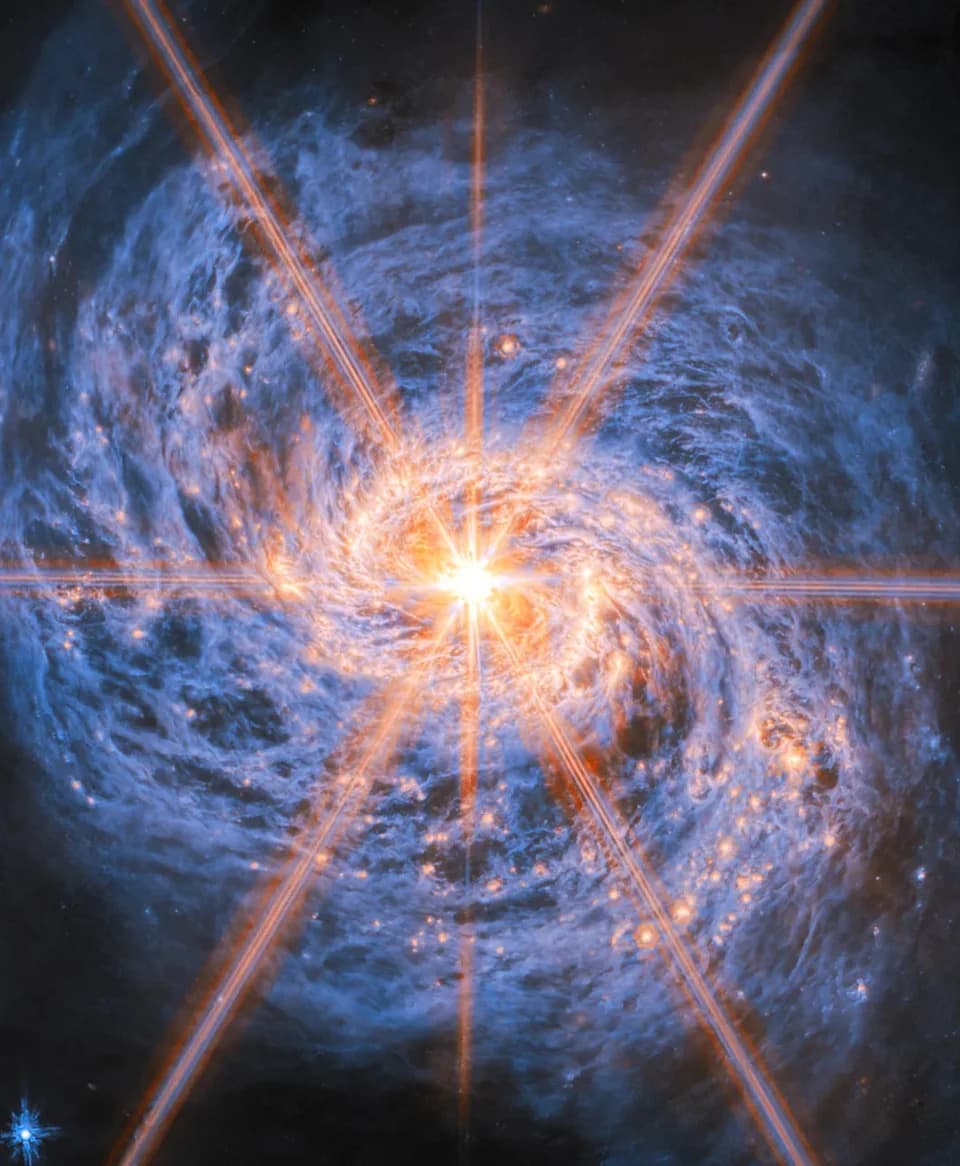
The galaxy M77 shines in a new image captured by the James Webb Space Telescope. | Credit: ESA/Webb, NASA & CSA, A. Leroy
Is this a distant galaxy or the poster for a sci‑fi blockbuster? A new image from NASA's James Webb Space Telescope captures the barred spiral galaxy Messier 77 (M77) in striking detail, revealing a brilliantly glowing core with beams of light radiating outward.
Messier 77, nicknamed the Squid Galaxy and also cataloged as NGC 1068, lies about 47 million light‑years away in the constellation Cetus. With an apparent magnitude near 9.6, M77 is within reach of dedicated amateur astronomers using a small telescope.
This luminous central region is powered by an active galactic nucleus — a supermassive black hole accreting gas. As inflowing material heats up, it emits intense radiation that lights the galaxy's core, making the nucleus appear exceptionally bright in Webb’s infrared view. M77 is a well‑known Seyfert galaxy, meaning its nucleus is unusually active compared with typical spiral galaxies.
According to NASA, the linear rays radiating from the nucleus in the Webb image are not direct physical jets from the black hole but an optical effect introduced by the telescope and image processing.
Those striking rays are best explained as diffraction and scattering effects produced by the telescope’s optics (and sometimes enhanced by image processing), which can create linear artifacts around very bright sources. Beyond the glow and rays, Webb’s sensitivity to infrared light highlights swirling lanes of dust and clouds of gas in the galaxy’s disk, offering a vivid look at the structures feeding the active core.
Whether you’re a backyard observer or a professional astronomer, Webb’s new portrait of Messier 77 is a dramatic reminder of how black holes shape the galaxies that host them — and how powerful telescopes reveal both cosmic truth and charming visual artifacts.
Help us improve.





















