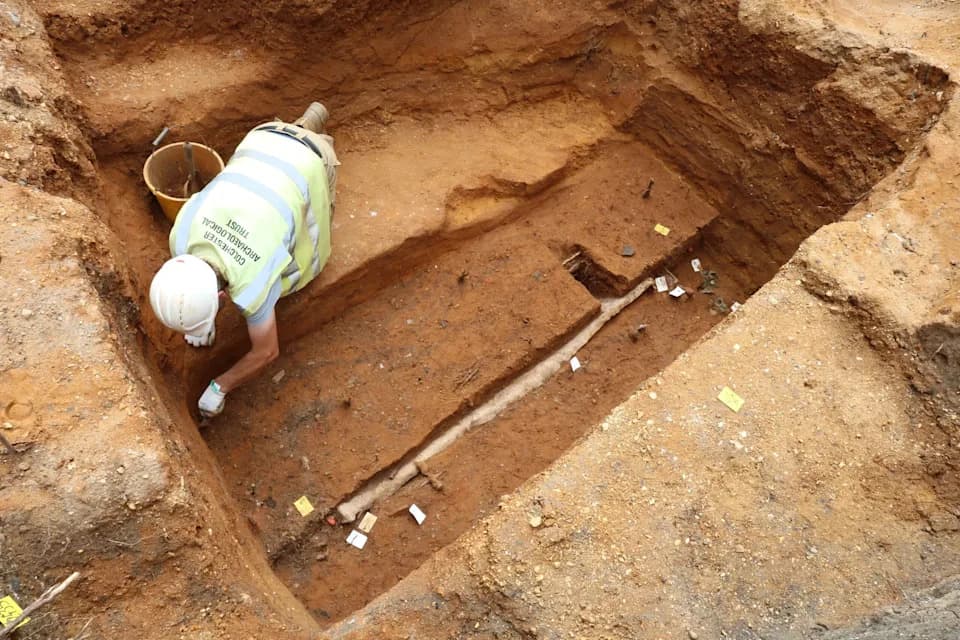
An ornate Roman‑era lead coffin excavated in Colchester, England, has revealed the remains of a young, high‑status woman buried with distinctive grave goods and imported substances that point to wealth and long‑distance trade links.
"This is one of the most fascinating Roman burials we have worked on in Colchester in recent years,"
said Adam Wightman, Director of Archaeology at Colchester Archaeological Trust, in a statement. He noted that the coffin, the grave goods and the scientific analyses together make the burial especially compelling.
The woman was aged in her late 20s or 30s when she died. Archaeologists believe the burial most likely dates to the late Roman period (roughly the late 3rd to early 5th century A.D.), when Roman Britain retained strong cultural and trade connections across the empire.
Inside the decorated lead coffin investigators found a carefully staged assemblage of items: jet hairpins, a group of rare glass flasks and other personal objects. These goods signal an elevated social status and deliberate funerary display.
Scientific tests also identified exotic resins — including frankincense from Boswellia trees — among the burial materials. Frankincense was widely traded across Africa, the Middle East and South Asia and was valued in antiquity for ritual and medicinal uses, so its presence suggests access to imported luxury goods.
Gypsum was present in the coffin, indicating the body may have been coated with liquid gypsum (a plaster‑like paste) prior to interment. In well‑preserved examples, such gypsum layers can form a cast that preserves the outline of the deceased — a dramatic and uncommon preservation state reported in other Roman British burials.
Context and Significance
The burial was uncovered in 2023 during archaeological work on the site of a former hospital being redeveloped for housing. Excavation work was carried out by Tetra Tech Consulting Limited in partnership with Colchester Archaeological Trust. Robert Masefield of Tetra Tech described the find as "the most spectacular" he has seen in the area and said it shows the woman was cherished by her family and community.
The lead coffin and its contents are scheduled to go on public display at Colchester's Roman Circus Visitor Centre from May 16, 2026, giving researchers and the public an opportunity to study and appreciate the burial and its material culture.
Why This Matters: The combination of a lead coffin, imported resins, rare glassware and gypsum treatment highlights the wealth, trade connections and funerary practices available to an elite individual in late Roman Britain, and adds an important local example to wider studies of Roman provincial burial rites.