
Health officials are tracing passengers and contacts after a hantavirus-related outbreak on a cruise ship that has killed three people. Five infections have been confirmed and fewer than a dozen people developed symptoms, though many passengers may have been exposed. Authorities in multiple countries are isolating and monitoring potential contacts while scientists sequence the Andes virus to check for mutations and better understand transmission.
How Health Officials Are Tracing Contacts After a Hantavirus Outbreak on a Cruise Ship
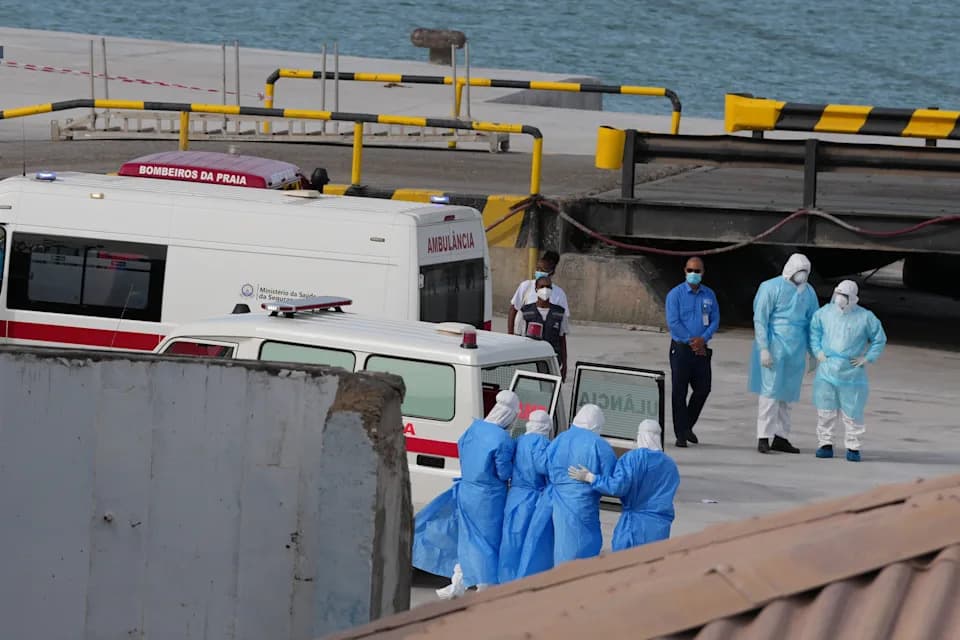
Health workers in protective gear evacuate patients from the MV Hondius cruise ship at a port in Praia, Cape Verde, Wednesday, May 6, 2026. (AP Photo/Misper Apawu)(ASSOCIATED PRESS)
Health officials worldwide are racing to trace and monitor passengers and other contacts after a hantavirus-linked outbreak aboard a cruise ship that has killed three people. Although hantaviruses rarely spread directly between people, the virus implicated in this incident—the Andes virus—has been associated with uncommon person-to-person transmission, so investigators are taking extra precautions.
Contact Tracing: Purpose and Challenges
Why contact tracing matters: Officials aim to identify anyone who may have been exposed, alert them, monitor for symptoms, and prevent further transmission should new cases appear. This helps contain risks before they grow into larger clusters.
Why it’s difficult: Passengers travel, socialize, and visit crowded venues, which multiplies potential exposures. In this outbreak, fewer than a dozen people are believed to have shown symptoms and five infections have been laboratory-confirmed, but many more passengers may have been exposed.
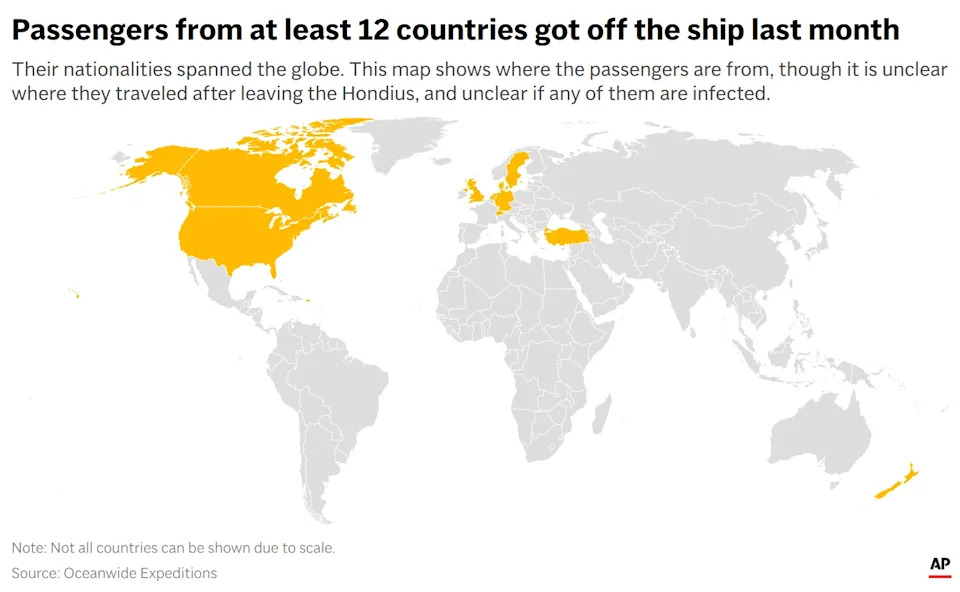
Map showing the nationalities of passengers who left the Hondius at St. Helena on April 24. (AP Digital Embed)(ASSOCIATED PRESS)
Who Is Being Monitored
About 140 people remain aboard the cruise ship as it sails toward the Canary Islands; none of those onboard have been reported ill. Public health teams are prioritizing outreach to dozens of passengers who left the ship roughly two weeks after a passenger died—before authorities knew hantavirus was the cause. Those individuals came from at least 12 countries, including several U.S. states (Arizona, California, Georgia and Texas).
Specific measures reported by countries and jurisdictions include:
- St. Helena: Officials are monitoring a small group labeled "higher-risk contacts" and have advised a 45-day isolation period.
- United Kingdom: Two passengers who flew home mid-journey are self-isolating and asymptomatic; a small number of their contacts are also self-isolating.
- Singapore: Two men who disembarked at St. Helena and later returned to Singapore were tested and isolated at the National Centre for Infectious Diseases.
- United States: States such as Texas and Arizona say they are monitoring passengers who returned; Arizona began a 42-day monitoring period after notification from the CDC.
- Canada: Two passengers in Ontario were advised to self-isolate after returning home.
What Scientists Are Doing
Researchers are sequencing the virus’s genome to determine whether any mutations might affect how easily it spreads. The Andes virus is endemic to parts of South America and is primarily associated with exposure to aerosolized rodent droppings or urine. But in rare clusters, Andes has been linked to person-to-person transmission, which is why teams are examining viral samples and patterns of contact closely.
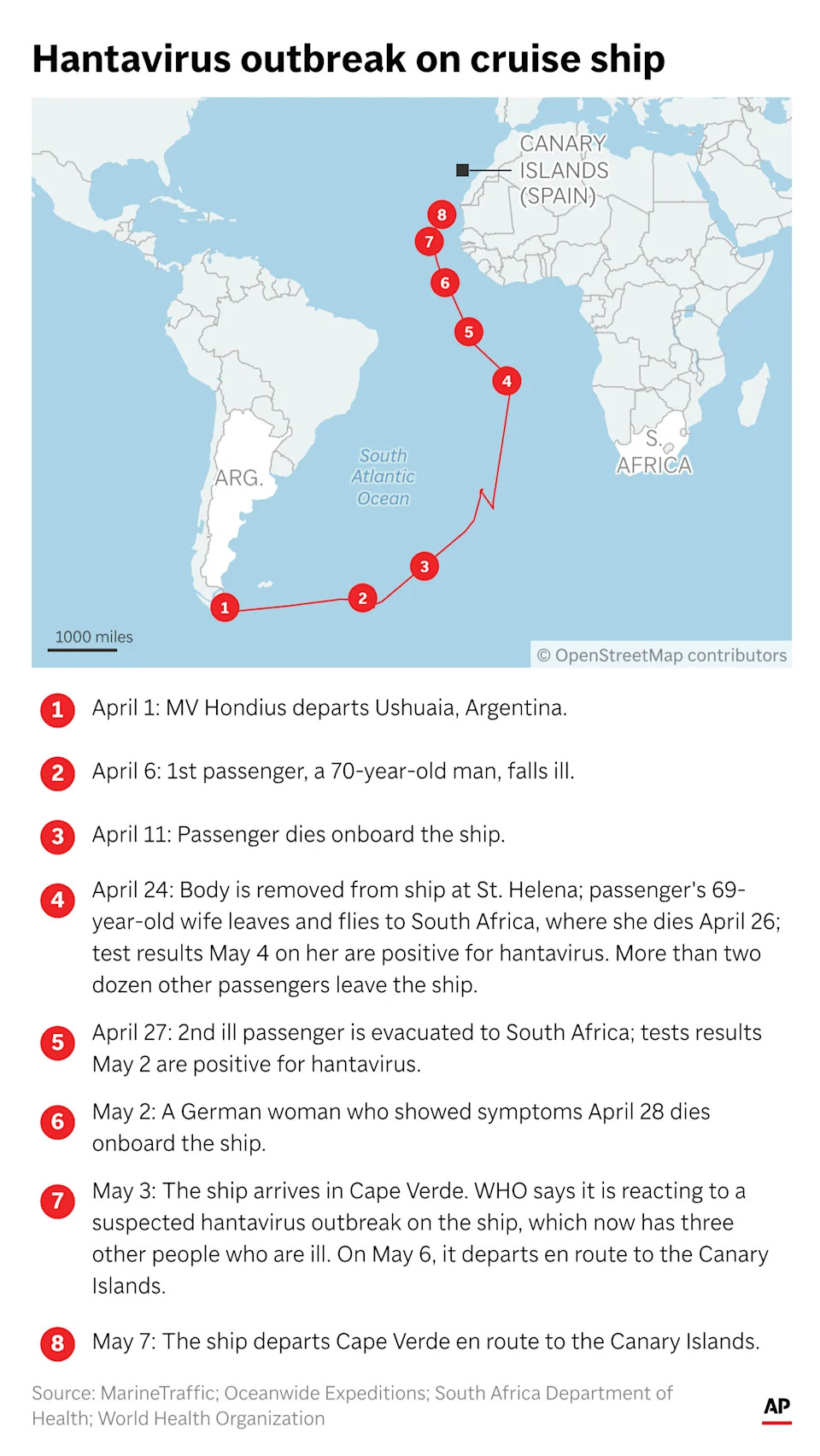
A hantavirus outbreak aboard a cruise ship in the South Atlantic has sickened several people aboard. Three people have died. (AP Digital Embed)(ASSOCIATED PRESS)
Experts believe infected people are most likely to be infectious when symptomatic. If person-to-person spread occurs, it is thought to happen via small respiratory droplets emitted when an infected person talks, coughs or sneezes. Argentine investigators are also looking into an early cluster possibly linked to a birdwatching trip near Ushuaia.
Bottom Line
Contact tracing and genomic analysis are ongoing. Public health authorities are balancing caution with the understanding that most hantavirus infections arise from rodent exposure rather than sustained human-to-human spread. Officials advise anyone who may have been exposed to follow local public health instructions, self-monitor for symptoms, and seek prompt medical care if symptoms develop.
Reporting contributions: AP journalists in Buenos Aires, Cape Town, Toronto, London, Madrid, Albuquerque and Dallas. The Associated Press Health and Science Department receives support from the Howard Hughes Medical Institute and the Robert Wood Johnson Foundation; the AP is solely responsible for this content.
Help us improve.





















