
Dunkleosteus was a heavily armored placoderm and an apex predator of the Late Devonian (≈382–358 Ma). Biomechanical models estimate bite forces up to ~4,400–5,000 N and indicate rapid jaw opening that likely aided prey capture. A 2023 reassessment revised typical adult length to ~3.4 m (largest ≈4 m), correcting earlier shark-based overestimates. Its extinction aligns with the Late Devonian environmental crises and this case underscores how scientific methods are continually refined.
Dunkleosteus Revisited: The Armored Predator Behind the Devonian Myth
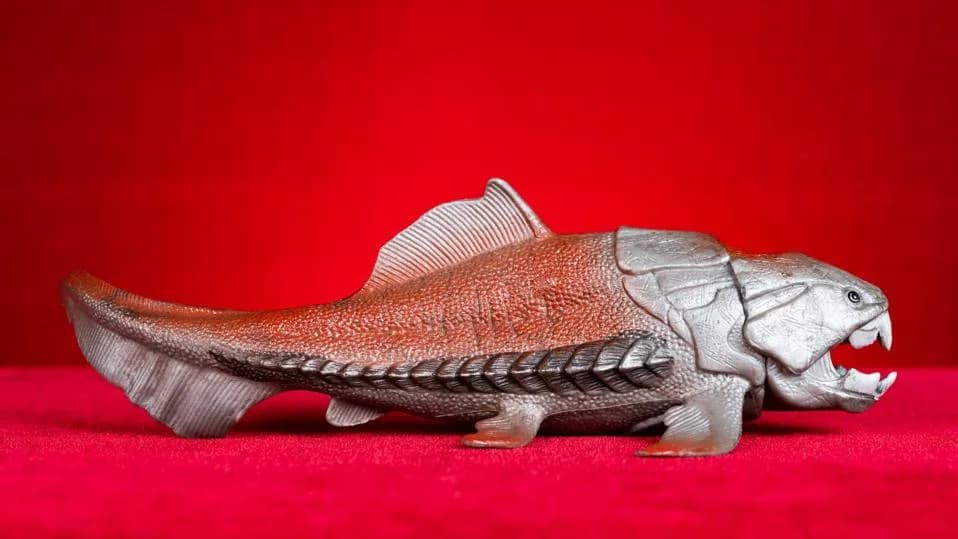
Dunkleosteus ruled a restless Devonian ocean, where armor met innovation. Here’s how modern science is rewriting the story of this iconic predator.getty
Dunkleosteus was one of the most distinctive predators of the Late Devonian seas—an armored placoderm built for force and efficiency. Modern biomechanical and comparative studies have sharpened our picture of this animal, correcting long-held misconceptions about its size while confirming its role as an apex predator of its time.
An Unusual Predator of the “Age of Fishes”
Dunkleosteus lived during the Late Devonian, roughly 382–358 million years ago, when early jawed vertebrates diversified into many ecological roles. Fossils from what are now North America, Europe and North Africa indicate it occupied broad, shallow marine environments where early reefs, placoderms, primitive sharks and lobe-finned fishes formed dynamic food webs.
Anatomy, Armor and Feeding
As a placoderm, Dunkleosteus had heavy dermal bony plates that formed a rigid shield around its head and thorax. Those interlocking plates worked with the skull and jaw apparatus to stabilize the head during feeding and to resist the high forces produced by its bite.
Biomechanical reconstructions (notably a 2007 study in Biology Letters) estimated bite forces of roughly 4,400 newtons at the jaw tip and over 5,000 newtons near the rear of the jaws—values comparable to large modern crocodiles and among the most powerful bites inferred for fish. The jaws lacked true teeth; instead the animal had self-sharpening bony plates that acted as durable cutting blades. Modeling also suggests very rapid jaw opening, which likely produced some suction to help capture struggling prey before the powerful bite processed it.
Size: From Bus-Sized Monster To Compact Powerhouse
For decades popular reconstructions exaggerated Dunkleosteus’s length, sometimes placing it at 5–10 m. A 2023 study in Diversity by Russell Engelman evaluated shark-based scaling methods and showed those proxies do not translate reliably to placoderms. Revised estimates place most adults at around 3.4 m (≈11 ft), with the largest individuals a bit over 4 m (≈13 ft). That makes Dunkleosteus more comparable in length to a large modern great white shark—compact but powerfully built—rather than a bus-sized leviathan.
Extinction and Ecological Context
Dunkleosteus did not survive the Late Devonian extinction intervals (approximately 372–359 million years ago). These events were a prolonged series of environmental disturbances—widespread ocean anoxia and marked climate shifts—that restructured marine ecosystems. Large, specialized apex predators are especially vulnerable when the base of the food web collapses, and placoderms disappeared from the fossil record by the close of the Devonian.
Why This Reassessment Matters
Beyond restoring a more accurate size estimate, the study of Dunkleosteus illustrates how scientific methods evolve. It highlights the danger of applying scaling models untested across distant evolutionary lineages and celebrates how new data and approaches refine long-standing narratives. Fossils rarely give complete answers; they provide fragments from which scientists build, test and revise hypotheses.
Sources: Key studies referenced include a 2007 biomechanical analysis (Biology Letters), a 2023 body-size reassessment (Diversity, Russell Engelman) and a 2024 synthesis in Paleontologia Electronica.
Help us improve.





















