
Anil Menon, a former NASA flight surgeon and SpaceX medical director, was selected as a NASA astronaut in 2021 and will launch from Kazakhstan this July aboard a Russian Soyuz for an expected eight-month stay on the ISS. He brings experience across NASA, Roscosmos and SpaceX and emphasizes NASA’s role in bridging international approaches to exploration. Menon warns of unexpected blood-clotting risks in microgravity as crews diversify, and he says next-generation commercial stations should boost scientific throughput and enable orbital manufacturing.
Anil Menon — Flight Surgeon, SpaceX Doctor, NASA Astronaut — Finally Headed to Orbit on Soyuz
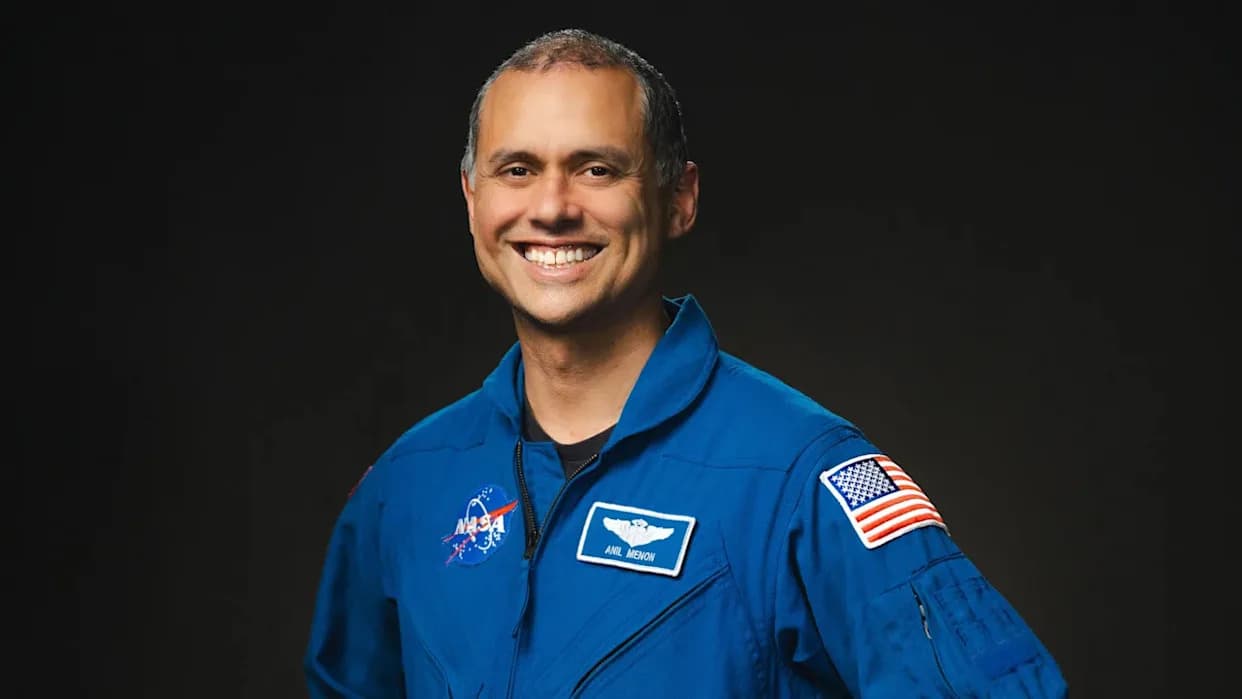
Anil Menon has spent his career shaping modern human spaceflight — and this July he will finally ride to orbit himself. A former NASA flight surgeon who became SpaceX’s medical director in 2018, Menon was selected as a NASA astronaut in 2021 and has trained for years for a long-duration mission to the International Space Station (ISS).
Alongside those roles, Menon has served in the Air Force Reserve and worked as an emergency-room physician. He also supported his wife, Anna Menon, who flew on a private space mission in 2024 and later was selected as a NASA astronaut.
This summer Menon will travel to Kazakhstan — the staging ground for many Russian launches — to join two cosmonauts aboard a Russian Soyuz spacecraft for an expected eight-month stay on the ISS.
“NASA kind of bridges the gap between some of these different cultures and synthesizes it,” Menon says. “As we look at the moon, everyone is going to pursue that as well. I think that NASA is this great synergy for all of that.”
Comparing the Soyuz and Crew Dragon
Menon highlights the cultural and engineering contrasts between the long-established Russian Soyuz and SpaceX’s Crew Dragon. The Soyuz traces its design back to early human spaceflight: many systems and interfaces are intentionally simple and highly reliable. Menon notes the low‑tech but robust design decisions, such as a rubber pressure seal for suits secured with bands instead of zippers or complex locking mechanisms.
By contrast, SpaceX’s Crew Dragon reflects a newer engineering approach: large touchscreens, automated procedures and richer real-time data for crews. Menon says both approaches work — they just represent different ways to solve the same problems, with Crew Dragon pushing automation and reusability and Soyuz emphasizing tried-and-true reliability.
Medical Unknowns: What Still Worries Space Physicians
As a physician, Menon says the most important change in space medicine is the widening pool of people who will travel to orbit. As commercial missions open opportunities for more diverse crews — including people with prior medical histories — new medical questions arise.
One concrete, pressing concern Menon highlights is unexpected blood clotting observed in microgravity. He explains the classical clotting contributors — injury, stasis (blood pooling or reduced flow), and hypercoagulability (a higher propensity to clot) — and notes that microgravity introduces elements of stasis that can increase clot risk. Combined with common Earth-based risk factors (for example, certain medications or medical history), the risk of deep vein thrombosis (DVT), pulmonary embolism (PE) or even stroke may rise in space. Understanding, preventing, and treating these events is a priority as crew diversity and flight cadence increase.
Potential Benefits of Microgravity
Menon also points out potential quality-of-life benefits. In microgravity, mobility limitations that affect people on Earth can be mitigated — tasks that require walking or bearing weight on Earth can be performed differently in orbit. That functional change can open opportunities for people with disabilities to participate more fully in spaceflight.
What Next-Generation Commercial Stations Should Do
Looking beyond the ISS, Menon argues future commercial space stations should prioritize higher scientific throughput, easier real-time feedback for experimenters, and streamlined access for researchers and industry. He emphasizes orbital manufacturing — for instance, fabricating advanced semiconductors or experimenting with space‑grade materials — as a key driver of an orbital economy. Early stations can act as testbeds for technologies such as space-based data centers, helping to mature systems until they are ready for broader deployment.
Those focused, high-yield activities — coupled with improved logistics for science — will help create jobs and accelerate capabilities needed for longer missions to the Moon and Mars.
This interview with Fast Company has been edited for clarity and length.
Help us improve.





















