
NASA’s Orion crew module Integrity returned to Kennedy Space Center on April 28, four weeks after launching on Artemis 2. Technicians will perform de-servicing to recover hardware, offload hazards, and remove the heat shield for detailed analysis. Artemis 2 carried four astronauts, flew behind the Moon on April 6, and splashed down off San Diego on April 10 — the first human mission beyond Earth orbit since 1972. Preparations for Artemis 3 (targeted for late 2027) are underway, with major SLS and Orion work already in progress.
Welcome Home, Integrity: Artemis 2’s Orion Capsule Returns to Kennedy Space Center After Historic Moon Flight
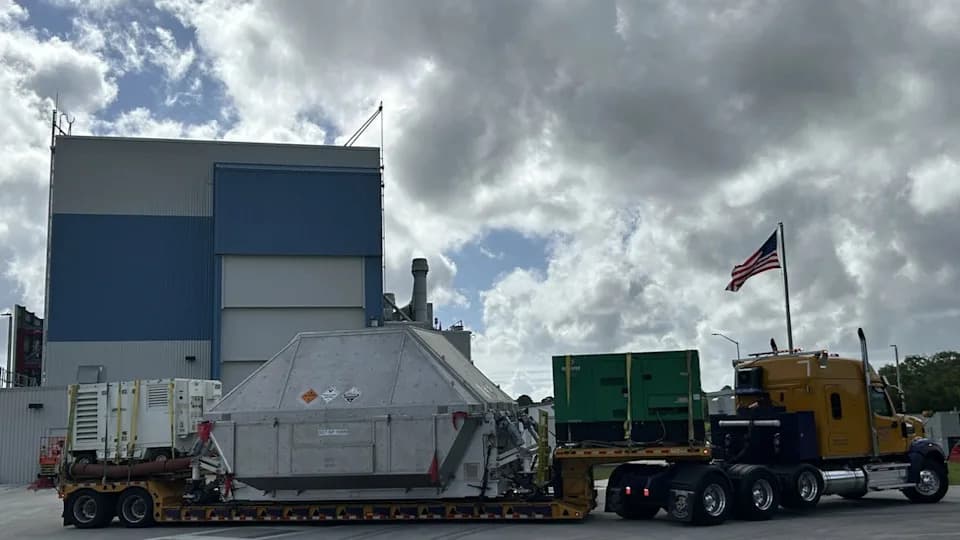
NASA's Orion spacecraft for the agency’s Artemis 2 mission arrives at the Kennedy Space Center Multi Payload Processing Facility in Florida on Tuesday, April 28, 2026. | Credit: NASA/Tiffany Fairley
NASA’s Orion crew module, nicknamed Integrity, returned to Kennedy Space Center (KSC) on April 28, about four weeks after launching from Pad 39B as part of the Artemis 2 mission.
Post-Flight Work at KSC
Integrity has been moved to KSC’s Multi-Processing Payload Facility, where engineers and technicians will begin formal de-servicing operations. These activities will recover hardware, download and analyze onboard data, and remove potential hazards such as excess propellant to make the vehicle safe for detailed inspection.
De-servicing steps include removing payloads from the crew module, extracting avionics boxes for reuse, and taking off Orion’s heat shield and other components for laboratory analysis to better understand how the vehicle performed during flight.
Artemis 2 Mission Highlights
Artemis 2 launched on April 1 atop a Space Launch System (SLS) rocket, carrying four astronauts: NASA’s Reid Wiseman, Victor Glover and Christina Koch, and Jeremy Hansen of the Canadian Space Agency. The crew flew behind the far side of the Moon on April 6, reaching a greater distance from Earth than any humans have traveled, and splashed down off the coast of San Diego on April 10.
The mission marks the first crewed flight beyond low Earth orbit since Apollo 17 in 1972 and provides valuable data and hands-on experience for the Artemis program’s next steps.
Looking Ahead: Artemis 3 Preparations
While teams study Artemis 2 telemetry and hardware, NASA is pressing forward with Artemis 3, currently targeted for late 2027. Artemis 3 will remain in Earth orbit to exercise rendezvous and docking procedures between Orion and one or more commercially developed lunar landers — notably SpaceX’s Starship and Blue Origin’s Blue Moon.
Key Artemis 3 hardware is already arriving and undergoing tests at KSC: the top 80% of the SLS core stage arrived from NASA’s Michoud Assembly Facility on April 27, and technicians are preparing to mate it with the engine section. Work on Artemis 3’s Orion is also progressing — all 186 Avcoat blocks for its upgraded heat shield have been installed, cured and inspected, and teams have completed thermal-cycle testing and ultrasonic inspections. The Orion service module has passed thermal-cycle testing, solar-array deployment checks, and adapter-cone installation; integration with the launch abort system is planned later this year.
Why this matters: The de-servicing and analysis of Integrity will help refine procedures, improve hardware, and reduce risks for future Artemis missions that aim to return humans to the lunar surface.
Help us improve.





















