
The month of May opens and closes with full moons, and both are micromoons — full moons that occur when the moon is near apogee. The May 31 full moon is also a blue moon and will be the most distant full moon of 2026 at about 252,360 miles; its peak illumination for Illinois is around 3:45 a.m. CT. The May 1 full moon reaches peak illumination at about 12:23 p.m. CT. True blue-colored moons are rare and usually require large amounts of atmospheric particles; most blue-moon photos are enhanced or filtered.
Blue Micromoon Lights Up Illinois in May — When to See Peak Illumination
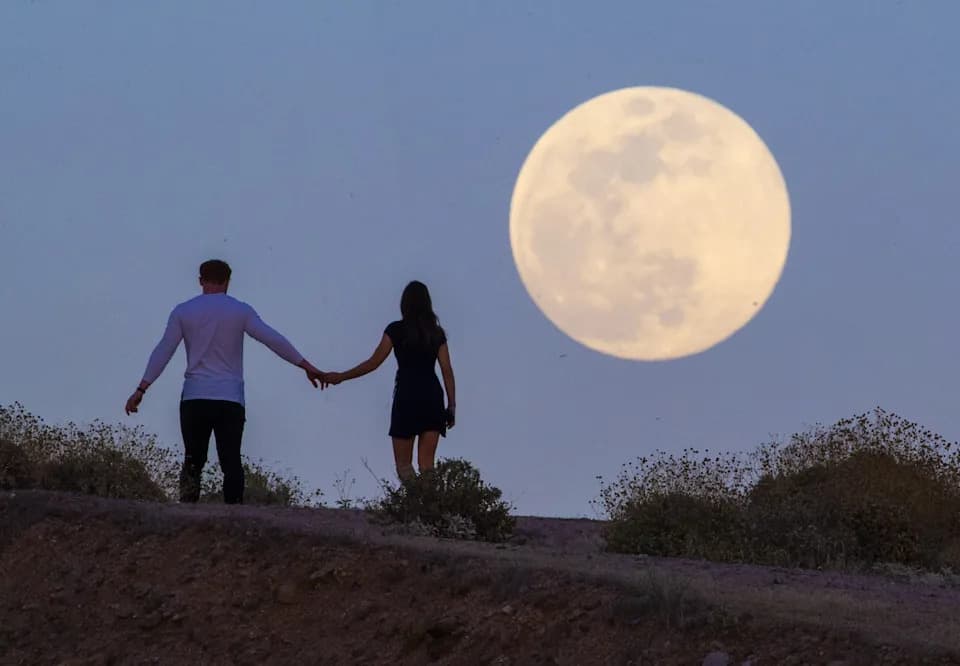
Clint and Kaylee Frazier walk over a hill as a super flower moon rises over Fountain Hills on May 6, 2020. The appearance of abundant flowers at this time inspired the name of this moon.
Next month opens and closes with full moons, giving Illinois residents two chances to watch a full Flower Moon — and the second one will be a rare blue moon. Both May full moons are also micromoons, meaning each full phase occurs when the moon is near its farthest point from Earth.
What Is a Micromoon and a Blue Moon?
Micromoon: The moon's orbit is elliptical, so its distance from Earth varies. When a full moon occurs near apogee (the moon's farthest point), astronomers call it a micromoon (also called a minimoon or apogee moon). Micromoons typically happen about two to three times a year.
Blue Moon: The term "blue moon" has two popular definitions; either it’s the second full moon in a calendar month or an extra full moon in a season. May 2026 features the year’s only blue moon — the second full moon of the month.
Distances and Timing
EarthSky reports that the May 31 full moon will be the most distant full moon of 2026, about 252,360 miles from Earth. For comparison, NASA gives the moon’s average distance as roughly 238,855 miles.
Peak illumination is the instant the moon, Earth and sun are aligned so the moon is as fully lit as it will be. Astronomers calculate that instant by the moon’s orbital position, not by local appearance — so the calculated peak can occur when the moon is below the horizon for a particular observer. Even so, the moon often appears essentially full for several days around peak (about 97–99% brightness).
Peak Illumination Times for Illinois (Central Time)
- May 1: Peak illumination about 12:23 p.m. CT (afternoon astronomical instant).
- May 31 (Blue Micromoon): Peak illumination about 3:45 a.m. CT.
Moon Phases in May
- Full Moon: May 1
- Last Quarter: May 9
- New Moon: May 16
- First Quarter: May 23
- Full Moon (Blue Moon): May 31
Will the Moon Actually Look Blue?
Despite the name, a blue moon rarely appears blue to the eye. Photos that show a vividly blue moon are usually edited or taken with color filters. Truly blue-tinted moons are exceptionally rare and normally require unusual atmospheric conditions — large amounts of dust or particles from major wildfires or volcanic eruptions that selectively scatter red light.
Viewing Tips
For precise local moonrise and moonset times, use the Old Farmer’s Almanac moon calculators by entering your ZIP code. Check local weather forecasts before heading outside: as of the latest report, the National Weather Service predicted partly cloudy skies for the evening of May 1 with lows near 37°F in central Illinois and about 40°F in Chicago, but Midwest conditions can change quickly.
If you want help locating stars, planets or constellations while observing, try these free astronomy apps:
- SkyView Lite (iPhone, Android)
- Star Walk 2 (iPhone, Android)
- Star Chart (iPhone, Android)
- NASA App (iPhone, Android)
Looking ahead: The next named full moon after May will be the Strawberry Moon on June 29. The next seasonal blue moon is expected in May 2027, and the next monthly blue moon will be in December 2028.
Sources: EarthSky, Time and Date, NASA, Old Farmer’s Almanac, National Weather Service. This article originally appeared in the Journal Star: "May 2026 full moons: Peak illumination in Illinois, weather forecast."
Help us improve.





















