
New theoretical research suggests decaying dark matter could have supplied tiny energy injections that altered primordial hydrogen chemistry, making the direct collapse of gas clouds into black-hole seeds much more likely. This mechanism could help explain supermassive black holes observed by JWST as early as ~500 million years after the Big Bang. The authors single out a narrow hypothetical dark-matter mass range (~24–27 eV) and published their results on April 14 in the Journal of Cosmology and Astroparticle Physics.
Did Decaying Dark Matter Help Form the Universe’s Earliest Supermassive Black Holes?
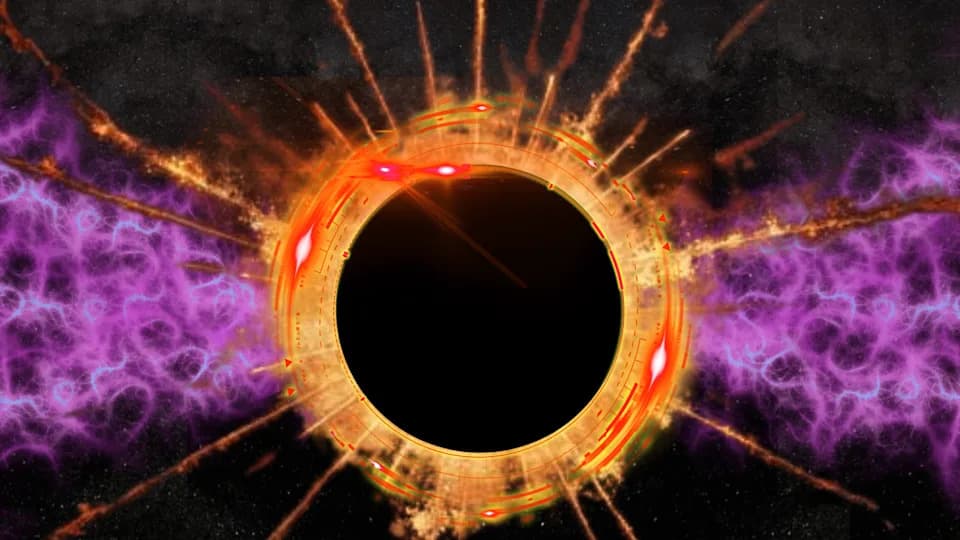
An illustration of a supermassive black hole against a background of dark matter. | Credit: Robert Lea (created with Canva)
New theoretical work suggests that tiny amounts of energy released by decaying dark matter could have helped create the supermassive black holes that the James Webb Space Telescope (JWST) has found when the universe was less than 1 billion years old.
Since JWST began returning data in 2022, astronomers have identified supermassive black holes as early as roughly 500 million years after the Big Bang. That timing poses a problem: conventional growth channels — repeated mergers and steady accretion — are generally thought to require on the order of 1 billion years for black holes to grow to millions or billions of solar masses.
To resolve this discrepancy, researchers Yash Aggarwal and Flip Tanedo propose that the decay of certain dark-matter particles could inject very small amounts of energy into primordial hydrogen gas. That energy can alter the gas chemistry and temperature in a way that makes the direct collapse route — where massive gas clouds collapse directly into black-hole seeds without first forming stars — far more likely in many more places than previously expected.
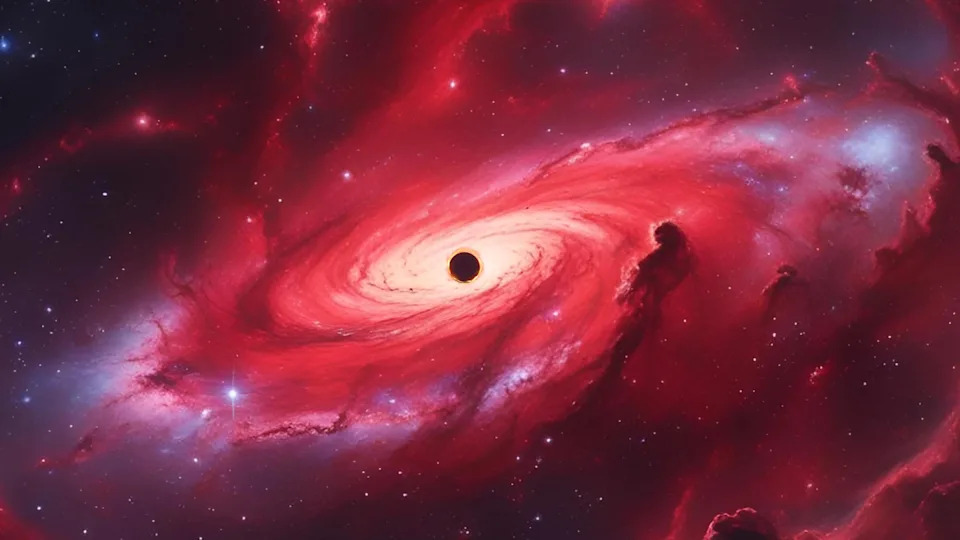
An illustration shows a direct collapse black hole forming at the heart of a Little Red Dot. | Credit: Robert Lea (created with Canva)
“Our study suggests that decaying dark matter could profoundly reshape the evolution of the first stars and galaxies, with widespread effects across the universe,” said Yash Aggarwal (University of California, Riverside). “With the JWST now revealing more supermassive black holes in the early universe, this mechanism may help bridge the gap between theory and observation.”
Dark matter makes up roughly 85% of the matter in the universe but does not interact with light, so its composition remains unknown. Candidate particles span an enormous mass range and include some that are unstable and can decay, releasing minute amounts of energy. Aggarwal and Tanedo estimate that the energy required to "supercharge" a primordial gas cloud is extraordinarily small — about a billion-trillionth of the energy stored in a single AA battery (roughly 10-21 of that energy) — and could plausibly be supplied by decaying particles of the right mass.
The authors identify a narrow hypothetical mass window — roughly 24 to 27 electronvolts (eV) — for dark-matter particles that would efficiently produce the necessary heating and chemical changes to boost direct collapse. This mass range is far lighter than many popular dark-matter candidates and would imply different particle physics and cosmological behaviors if confirmed.
“The first galaxies are essentially balls of pristine hydrogen gas whose chemistry is incredibly sensitive to atomic-scale energy injection,” said Flip Tanedo. “These are the properties that we want for a dark matter detector — the signature of these ‘detectors’ might be the supermassive black holes that we see today.”
The paper, published April 14 in the Journal of Cosmology and Astroparticle Physics, combines inputs from particle physics, cosmology and astrophysics to suggest that a small, well-timed energy injection from decaying dark matter could make early direct-collapse black holes significantly more common than in standard scenarios. The idea remains theoretical and will require further modeling and observational tests, including more JWST data and other probes of early-universe chemistry, before it can be confirmed.
Help us improve.





















