
New data reveal a third compact gas clump (G2t), forming a G1‑2‑3 streamer whose orbits align too closely to be coincidental. The streamer traces back to the massive contact binary IRS 16SW, and hydrodynamical simulations show that slow stellar winds (300–400 km/s) can fragment into clumps that fall inward toward Sagittarius A*. G2t is predicted to reach pericenter in mid‑2031, providing a clear test of the scenario.
Massive Binary Star May Feed the Milky Way’s Central Black Hole With Episodic Gas Clumps
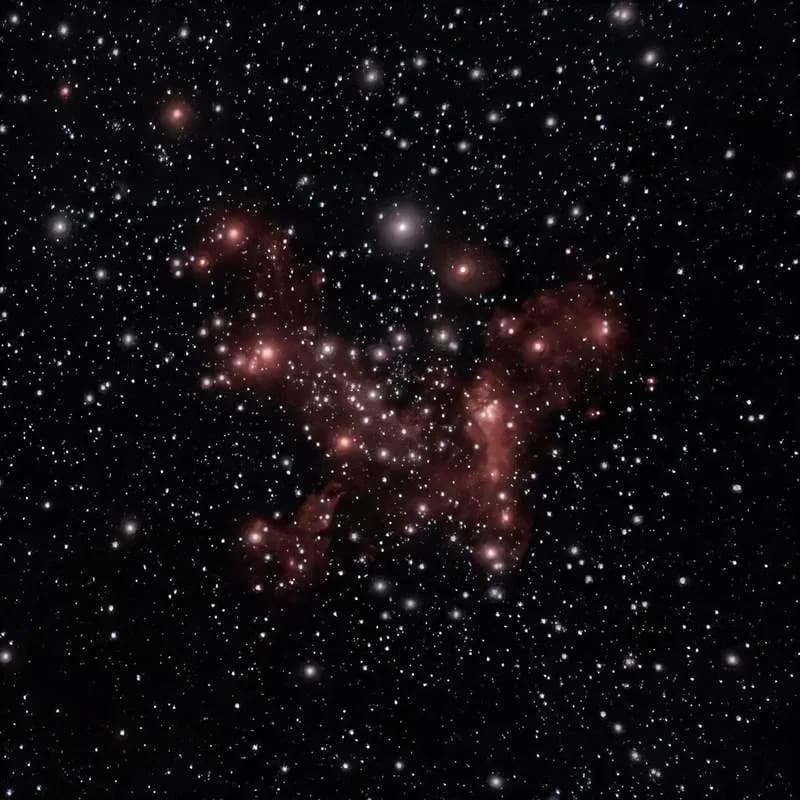
The picture shows the dynamic environment around the supermassive black hole at the Milky Way's center, featuring the newly discovered gas cloud G2t alongside previously known clouds G1 and G2, whose similar orbits suggest a common origin from the star system IRS16SW. (CREDIT: ESO/D. Ribeiro for the MPE GC team)
A chain of compact gas clumps near the Milky Way’s central black hole now appears to form a coherent streamer that may be supplying material to Sagittarius A* (Sgr A*). New observations and hydrodynamical simulations link the clumps to the massive contact binary IRS 16SW and suggest that episodic fragments produced by the system’s stellar wind could fall inward and intermittently feed the black hole.
Observations: A Coherent Streamer
The first well-studied object in this group, G2, was identified in 2012 as a dusty, ionized gas condensation (hydrogen and helium emission) with a temperature near 600 K and an estimated mass no larger than about three Earth masses. G2 was tidally stretched as it followed a highly elongated orbit and passed close to Sgr A* in 2014. Archival data later revealed G1, which travels on a very similar path roughly 12 years ahead of G2, and deeper imaging exposed a faint tail tracing the same route.
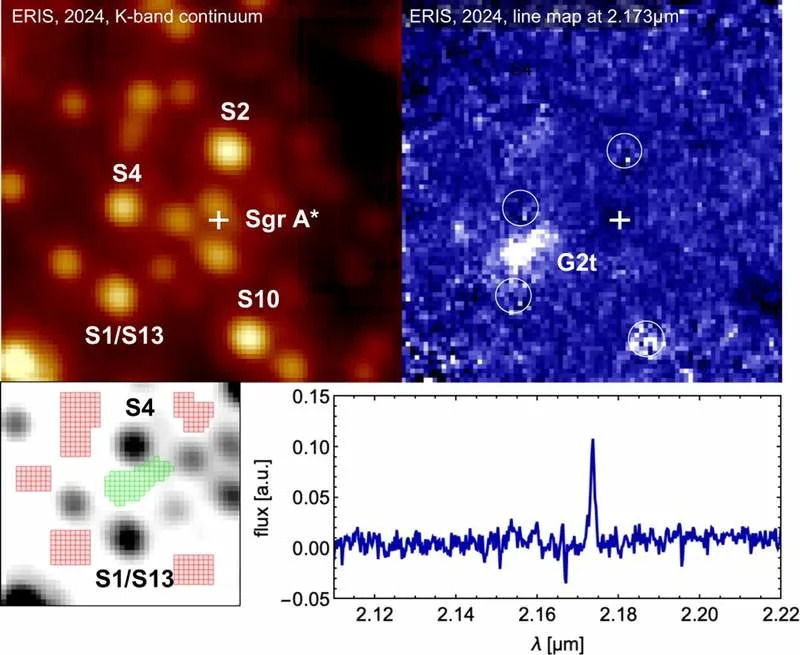
G2t in the ERIS integral-field data from June/July 2024. Top left: continuum image showing the S-stars. Top right: Background-subtracted line map centered at 2.173 µm, corresponding to Brackett-γ + 1000 km/s. G2t stands out. Bottom left: example of a pixel selection (on – green, off – red) for extracting the G2t spectrum overlaid on the continuum map. Bottom right: Resulting spectrum showing a strong emission line at 2.173 µm. (CREDIT: Astronomy & Astrophysics)
Recent adaptive-optics-assisted infrared spectroscopy with the SINFONI and ERIS instruments, using the hydrogen Brackett-γ line, shows that the faint tail has condensed into a third compact clump (designated G2t), and that G1, G2 and G2t share nearly identical orbital orientation and eccentric shape. The authors estimate the probability of three unrelated objects aligning this closely at about 2 × 10⁻⁶ for a 15° agreement in orbital plane and ellipse orientation — a random coincidence is therefore extremely unlikely.
Source Tracing: IRS 16SW
When the ensemble is treated as a single structure (the “G1‑2‑3 streamer”), its backward-projected path in position and radial velocity points toward IRS 16SW, a massive contact binary in the clockwise disk of young stars around Sgr A*. The fitted orbital phases and angular drift between the clumps match IRS 16SW’s motion: the angular separation rate between successive clumps is 0.74 ± 0.07 degrees per year, and G2t’s pericenter is predicted for mid-2031 (17.6 ± 0.3 years after G2’s pericenter).
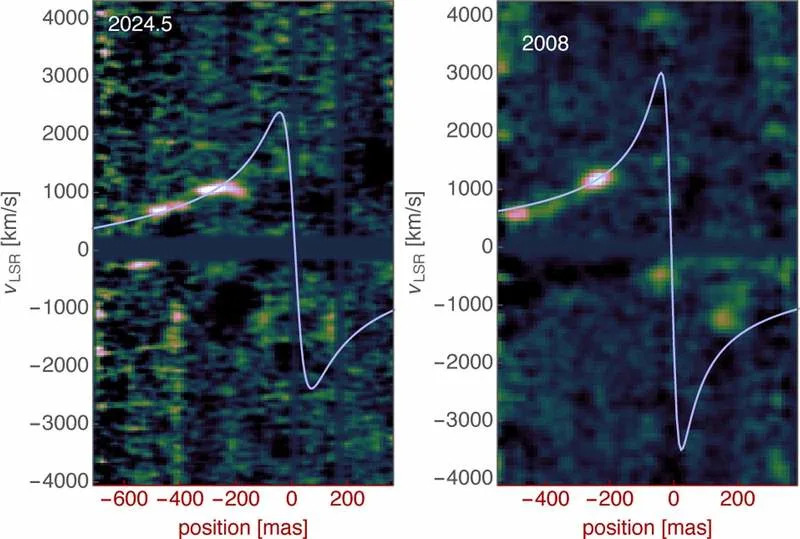
Left: position–velocity diagram extracted from the June/July-2024 data cube, using a curved slit along the orbital trace of G2t. The emission of G2t is concentrated around (−300 mas, +1000km/s). Right: same diagram for G2 extracted from the 2008 data cube for comparison. (CREDIT: Astronomy & Astrophysics)
Hydrodynamical Modeling: How Clumps Form
To probe a formation mechanism, the team ran hydrodynamical simulations of a population of mass-losing stars in the Galactic center and represented IRS 16SW with wind speeds of 300, 400 and 600 km/s. Rather than assuming gas simply coasts inward, these models follow interactions between the stellar wind and the ambient medium. When the wind is sufficiently slow (300–400 km/s), the bow shock around the source becomes unstable and fragments into filaments and compact clumps. Some fragments lose angular momentum or speed and are redirected onto more radial, inward trajectories toward Sgr A*.
In the 300 km/s run the simulation produced roughly 20 clumps inside the inner arcsecond with masses above about 3 Earth masses; the 400 km/s case also yielded comparable fragments, while the 600 km/s run did not. These results provide a plausible channel for forming the observed G1‑2‑3 streamer, especially if clump formation becomes more efficient near the binary’s pericenter where ambient densities are higher.
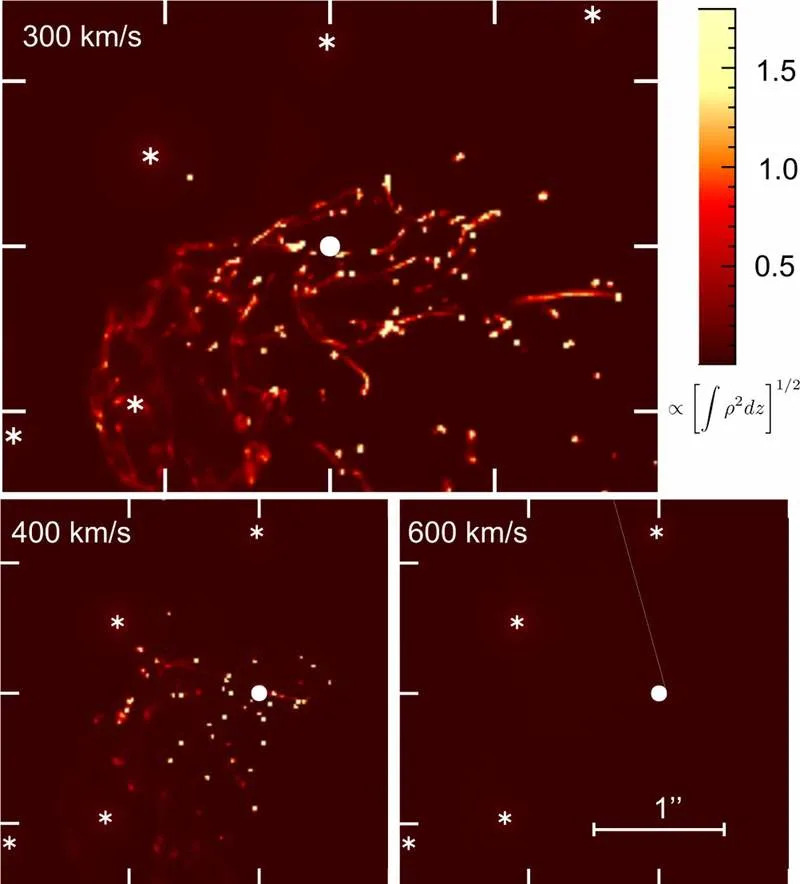
Snapshots of the hydrodynamic simulations of the Wolf-Rayet stars (white asterisks) feeding Sgr A* (white disk) in the central parsec. The maps show density squared integrated along the line of sight in square-root scale, that is, [∫ρ2dz]1/2, i.e., the expected Brackett-γ flux. (CREDIT: Astronomy & Astrophysics)
Caveats and Next Steps
The authors emphasize that the case is not closed. In the large-scale simulations IRS 16SW was approximated as a single mass-losing source rather than modeled in full binary detail. Clump identification can depend on numerical method and resolution, and additional, higher-fidelity simulations (and observations) are needed to test robustness. Observationally, the streamer disfavors alternatives in which the clumps are self-gravitating stars with envelopes: G2 appears only in the L band (not in K band) and is tidally stretched, and the gas clouds would require an intermediate-mass black hole to be gravitationally bound at these scales — a scenario other work has ruled out at these radii.
Why This Matters
Instead of a steady, diffuse inflow, compact clumps produced episodically by a stellar source like IRS 16SW offer a concrete mechanism for delivering fuel to Sgr A*. An inward arrival of roughly one Earth mass per decade could sustain the black hole’s current low level of activity, so this streamer model helps explain variability on multi-decade to century timescales. The next clear observational test is G2t’s predicted pericenter passage in mid‑2031.
Reference: The study is published in Astronomy & Astrophysics.
Help us improve.





















