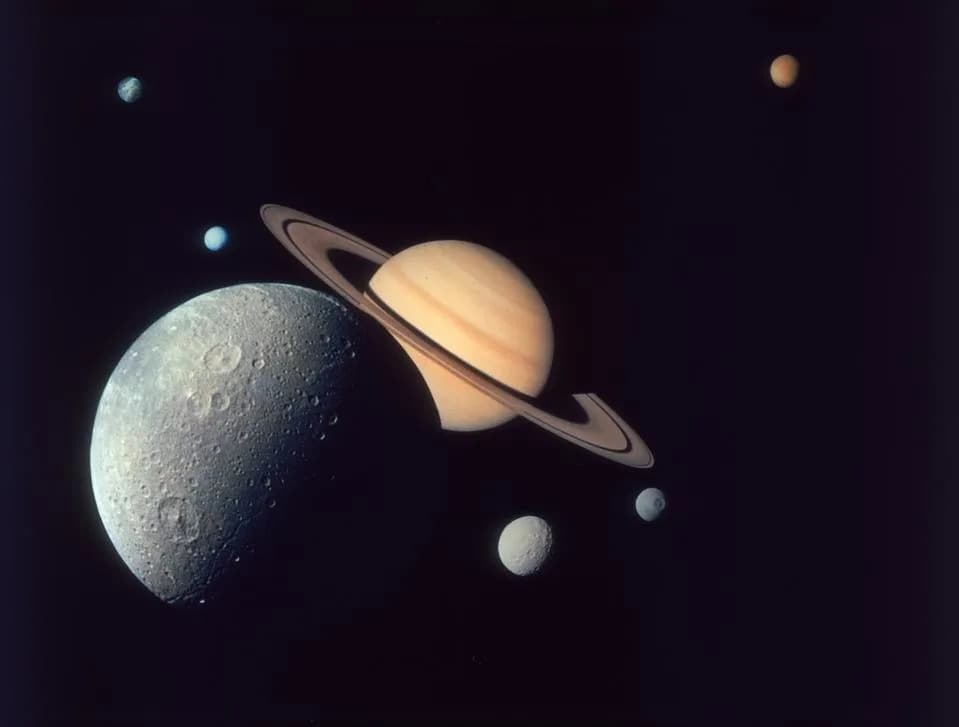
A new study identifies 45 rocky exoplanets inside their stars' habitable zones as top candidates in the search for life, using ESA Gaia and NASA Exoplanet Archive data. Key targets include Proxima Centauri b (4.2 ly), TRAPPIST-1f (≈41 ly), Kepler-186f (≈500 ly), and LHS 1140 b (≈48 ly). The researchers mapped habitable-zone boundaries across different star types and flagged planets near inner/outer edges and on unusual orbits. The ranked list is intended to guide follow-up observations with JWST and the Nancy Grace Roman Space Telescope.
45 Rocky Exoplanets Could Host Life — A Ranked Shortlist for JWST and Roman

An artist's impression of a theoretical planet orbiting a redder star, which could cause microbes and plants on the planet's surface to reflect very different colours from Earth's green forests.Gillis Lowry
A new international study has produced a ranked shortlist of 45 rocky exoplanets that fall inside their stars' habitable zones and are therefore promising targets in the search for life. The research, published in the Monthly Notices of the Royal Astronomical Society, draws on observations from ESA's Gaia mission and records in NASA's Exoplanet Archive to narrow more than 6,000 known exoplanets to a focused set of candidates.
How the List Was Built
Led by Professor Lisa Kaltenegger of Cornell University, the team evaluated stellar and orbital data to identify rocky worlds receiving stellar energy levels consistent with the potential for liquid water on their surfaces — the classic definition of a habitable zone. The analysis also mapped how habitable-zone boundaries shift with stellar type: cooler, redder stars emit different wavelengths that warm planetary atmospheres in different ways, moving the inner and outer edges of where liquid water could persist.
Notable Candidates
The shortlist includes familiar and lesser-known targets at a range of distances: Proxima Centauri b (about 4.2 light-years), TRAPPIST-1f (≈41 light-years), and Kepler-186f (≈500 light-years). Other examples are TOI-715 b (≈137 light-years) and LHS 1140 b (≈48 light-years). The TRAPPIST-1 system is especially important: planets d, e, f and g are all highlighted as high-priority targets for follow-up studies because of their sizes and locations within the habitable zone.
“Our paper reveals where you should travel to find life if we ever built a ‘Hail Mary’ spacecraft,”
Professor Kaltenegger said, referencing the Hollywood film about a decades-long mission to seek life beyond Earth. She noted that some planets depicted in fiction, like Tau Ceti and 40 Eridani A, do not appear on their shortlist.
Extending the Boundaries of Habitability
The researchers also flagged planets near the inner and outer bounds of the habitable zone and those on unusual orbits. Studying these extremes helps refine models of how much heat or cold a rocky world can tolerate and still support life. As co-author Abigail Bohl explained:
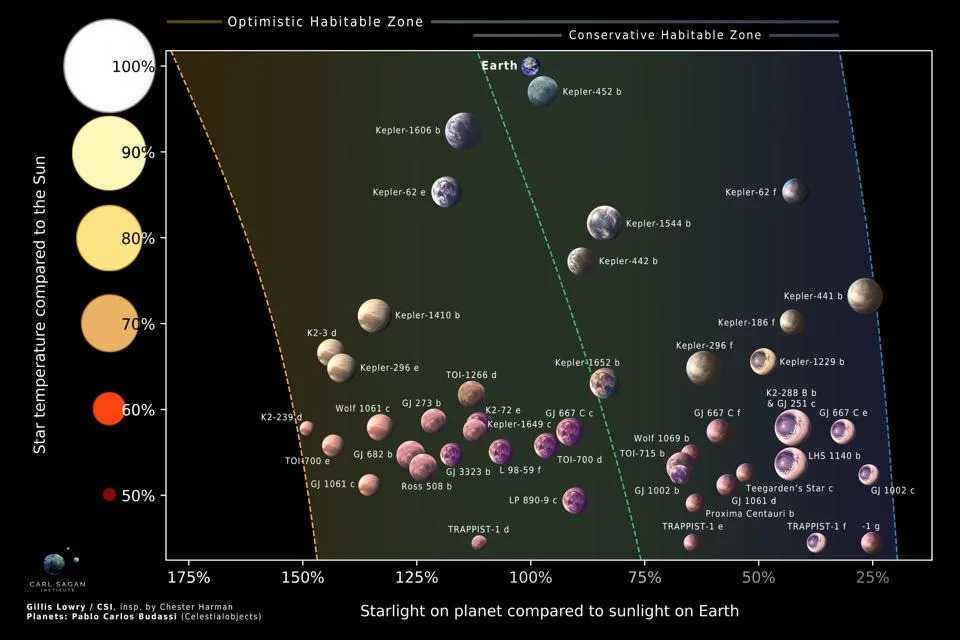
A diagram depicting habitable zone boundaries across star type with rocky exoplanets from Bohl et al. (2026). The boundaries of the habitable zone shift based on star colour, since different wavelengths of light will heat a planet's atmosphere differently.Gillis Lowry / Pablo Carlos Budassi
“We know Earth is habitable while Venus and Mars are not. We can use our Solar System as a reference to search for exoplanets that receive stellar energy between what Venus and Mars get.”
Contributing researcher Gillis Lowry added that the list aims to prioritize targets for observation: “While it’s difficult to say exactly what makes a world more likely to host life, identifying where to look is the essential first step.”
Why This Matters
This ranked shortlist provides a practical guide for current and upcoming facilities to focus limited observing time on the most promising rocky worlds. The team specifically mentions the James Webb Space Telescope (JWST) and the upcoming Nancy Grace Roman Space Telescope as instruments that could follow up on atmospheric signatures, surface conditions, or other biosignature indicators.
Wishing you clear skies and wide eyes.
This article was originally published on Forbes.com.
Help us improve.