
3I/ATLAS, the third interstellar object observed in our solar system, was discovered in July 2025 and is now leaving the system. Observations show it released water equivalent to about 70 Olympic pools per day and contains an exceptionally high deuterium fraction — ~30× that of typical comets and ~40× that of Earth’s oceans. Sensitive measurements with MDM Observatory and ALMA distinguished normal H2O from deuterated HDO for the first time on an interstellar object. The isotope ratio points to formation at temperatures below about 30 K, indicating planetary systems can form under very different conditions than our own.
Interstellar Comet 3I/ATLAS Spewed Water Equal to 70 Olympic Pools Per Day — Exceptionally Deuterium‑Rich
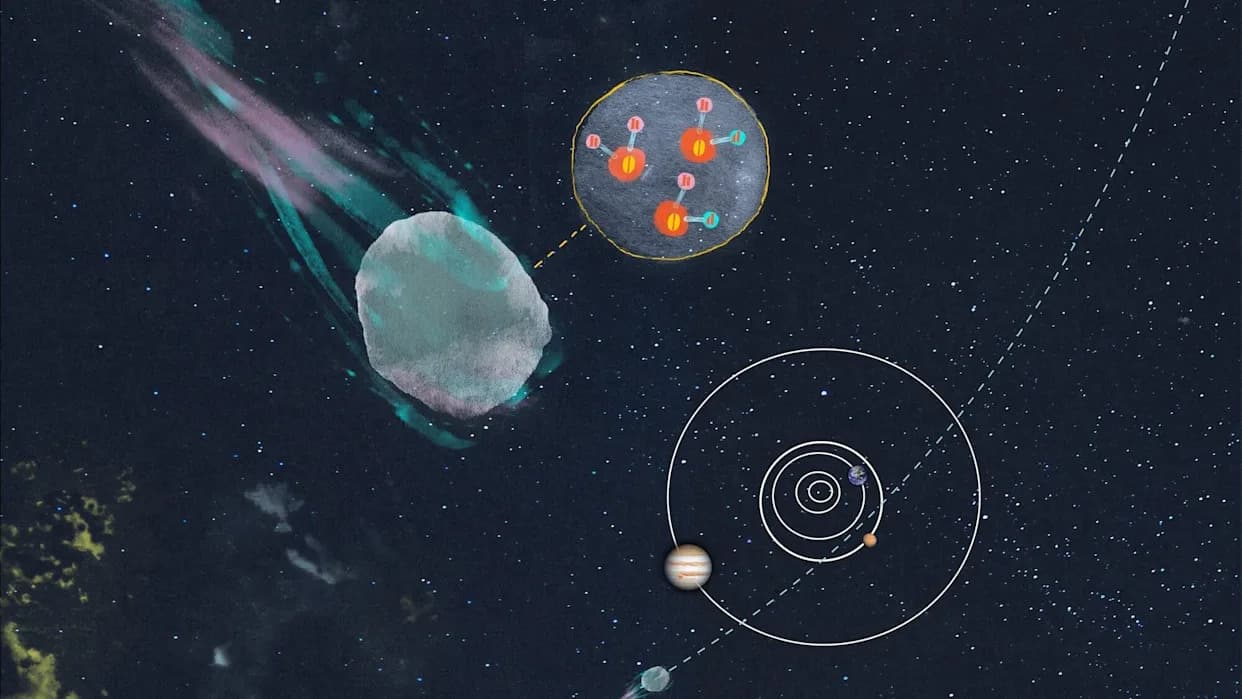
A new study of the interstellar comet 3I/ATLAS led by the University of Michigan shows that its water has a remarkably high content of deuterium. This form of hydrogen is comparatively less abundant in our solar system, enabling researchers to glean new insights about other planetary processes at work in our galaxy.
Astronomers quickly recognized in July 2025 that 3I/ATLAS was not a native solar‑system comet. As only the third confirmed interstellar object observed passing through our system, it provided a rare, time-limited opportunity to study material that likely formed under very different conditions from those around the Sun.
Although 3I/ATLAS is now receding from Earth and leaving the solar system, observers have already collected detailed measurements. The comet — the fastest ever recorded — is pockmarked with icy vents and leaves a dusty tail rich in methanol and cyanide.
Earlier this month the European Space Agency reported that 3I/ATLAS was ejecting water at a rate equivalent to about 70 Olympic-size swimming pools per day (roughly 175,000 m³, or about 175 million liters daily). University of Michigan researchers then showed that much of that water carries an unusually large fraction of deuterium, a heavy hydrogen isotope that contains an extra neutron.
Luis Salazar Manzano, a University of Michigan astronomer and co-author of the study in Nature Astronomy, said the measurements indicate a formation environment far colder than the one that produced our solar system.
“The amount of deuterium with respect to ordinary hydrogen in water is higher than anything we’ve seen before in other planetary systems and planetary comets,”
The team reports that 3I/ATLAS has roughly 30 times the deuterium fraction measured in typical solar‑system comets and about 40 times the deuterium concentration of Earth’s oceans. Making those isotopic measurements required exceptionally sensitive instruments: the researchers used telescopes at the MDM Observatory in Arizona and collaborated with the Atacama Large Millimeter/submillimeter Array (ALMA) in Chile. ALMA’s spectral precision allowed the team to distinguish ordinary H2O from deuterated water (HDO) and derive accurate abundance ratios — a first for an interstellar object.
High deuterium enrichment points to formation at very low temperatures, below roughly 30 K (about -243 °C / -406 °F), and likely in a low‑radiation environment. As the study’s authors explain, deuterium becomes enhanced in gas and ice through chemical pathways that operate efficiently at such frigid temperatures, consistent with formation either in a prestellar molecular cloud or the distant outer regions of a protoplanetary disk.
Teresa Paneque-Carreño, a co-author on the paper, emphasized the broader implication: “This is proof that whatever the conditions were that led to the creation of our solar system are not ubiquitous throughout space. That may sound obvious, but it’s one of those things that you need to prove.”
The combination of extreme speed, active volatile outgassing, and unprecedented deuterium enrichment makes 3I/ATLAS a unique probe of the variety of planetary‑system formation environments across the Milky Way.
Help us improve.





















