
Comet 3I/Atlas likely originated in a frigid, isolated region of the Milky Way and may be as old as 11 billion years. ALMA observations detected very high deuterium levels in the comet’s water, indicating formation in much colder conditions than our solar neighborhood. Discovered last summer, the object passed Mars in October and made its closest approach to Earth in December before continuing beyond Jupiter. The findings appear in Nature Astronomy.
Interstellar Relic 3I/Atlas Traced to a Frigid, Isolated Corner of the Milky Way
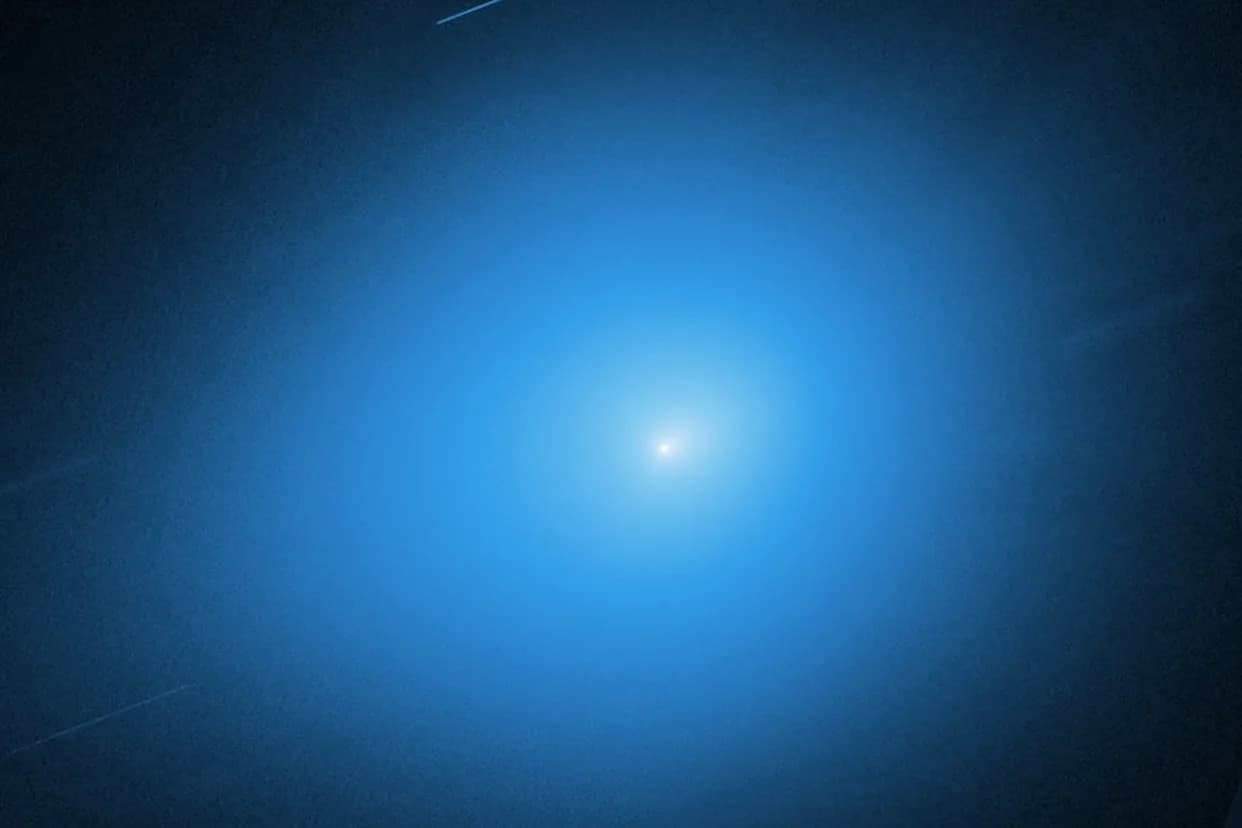
FILE - This image, provided by NASA, shows the interstellar comet 3I/Atlas captured by the Hubble Space Telescope on Nov. 30, 2025, about 178 million miles (286 million kilometers) from Earth. (NASA, ESA, STScI, D. Jewitt (UCLA), M.-T. Hui (Shanghai Astronomical Observatory), J. DePasquale (STScI) via AP, File)(ASSOCIATED PRESS)
Scientists report that Comet 3I/Atlas — the third confirmed interstellar visitor to our solar system — most likely formed in a very cold, isolated region of the Milky Way that had not yet developed a full planetary system.
A team led by the University of Michigan used the ALMA observatory in Chile’s Atacama Desert to study the comet last fall. Their observations, published in Nature Astronomy, revealed unusually high concentrations of deuterium (heavy hydrogen) in the comet’s water. That chemical signature points to formation in much colder conditions than those in our own stellar neighborhood and likely before the host star in that system had formed, said University of Michigan scientist Teresa Paneque-Carreno.
Researchers estimate the comet could be as old as 11 billion years — more than twice the age of the Sun — making 3I/Atlas possibly the oldest interstellar object yet observed. The icy body was discovered last summer, allowing NASA, the European Space Agency and other observatories to target it as it sped past Mars in October and made its closest approach to Earth in December. It has since passed Jupiter and is receding from the Sun, now detectable primarily with professional instruments.
Hubble Space Telescope images place the nucleus size between about a quarter-mile and 3.5 miles (roughly 440 meters to 5.6 kilometers). The comet is moving away from us at roughly 137,000 mph (220,000 kph).
Why Deuterium Matters
Deuterium-enriched water is a fingerprint of extremely cold formation environments. In such regions, chemical reactions and the capture of heavy hydrogen into ices are favored. Paneque-Carreno noted that while the Sun likely formed in a region with nearby newborn stars, the star that originally hosted 3I/Atlas may have been more solitary, producing less heating and preserving much colder ices.
'Linking these puzzle pieces together may give an idea of how planet-forming conditions were at these early times,' Paneque-Carreno said in an email.
The first two known interstellar visitors were ʻOumuamua in 2017 and Comet 2I/Borisov in 2019. Together with 3I/Atlas, they offer rare direct samples of material formed around other stars and in different eras of our galaxy's history.
Help us improve.





















