
China on April 22 condemned the Japanese prime minister's offerings and other officials' visits to the Yasukuni shrine, calling the acts 'negative' and saying they 'grossly trample on human conscience.' A Beijing foreign ministry spokesperson said China was 'very indignant' and strongly condemned the behaviour. The Yasukuni shrine honours Japan's war dead, including figures convicted at the Tokyo Trials, and its associations with wartime aggression make such visits diplomatically sensitive across Asia.
China Condemns Japanese Leaders' Yasukuni Shrine Visits, Calls Actions 'Heinous'
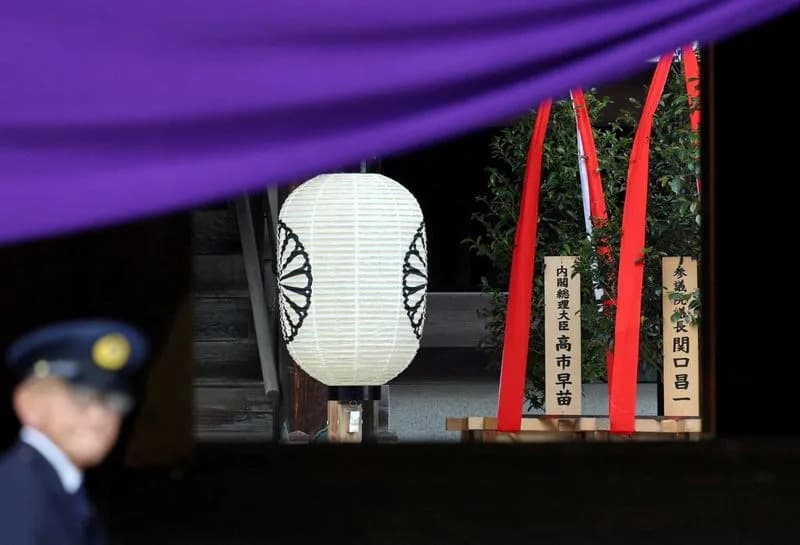
A wooden plaque showing the name of Japan's Prime Minister Sanae Takaichi is placed near a Masakaki tree that Takaichi sent as a ritual offering for the war dead at Yasukuni Shrine, seen by China and South Korea as a symbol of Japan's past militarism, during the shrine's biannual festival held in the spring and autumn, in Tokyo, Japan, April 21, 2026. REUTERS/Issei Kato
BEIJING, April 22 — China on Wednesday strongly criticised the Japanese prime minister's offerings at the Yasukuni shrine and visits by other Japanese officials, saying the acts offended human conscience and risked escalating regional tensions.
Beijing's foreign ministry said at a regular briefing that Japan's 'negative actions' concerning the shrine 'grossly trample on human conscience' and that China was 'very indignant at these heinous acts and strongly condemns them'.
Why the Shrine Is Controversial
The Yasukuni shrine honours Japan's war dead. It also enshrines a number of wartime leaders who were convicted of war crimes by the International Military Tribunal for the Far East (the Tokyo Trials). Because of those associations, visits and official offerings at Yasukuni are viewed by some of Japan's Asian neighbours as a symbol of Japan's wartime aggression and can provoke strong diplomatic reactions.
Regional Impact
Such visits have repeatedly strained ties between Tokyo and neighbouring countries, particularly China and South Korea, where memories of Japan's wartime conduct remain sensitive. Beijing's latest statement underscores how ritual acts at historic sites can have outsized political and diplomatic consequences in East Asia.
Reporting by Ethan Wang and Liz Lee; Editing by Himani Sarkar. Source: Reuters.
Help us improve.





















