
Astronomers have reconstructed the TOI‑201 system, revealing a super‑Earth, a warm Jupiter and a distant brown dwarf whose tilted, eccentric orbit is actively reshaping the inner planets’ orbits. The brown dwarf (≈15.7 MJ, ~7.9‑year period) appears to drive observable transit‑timing shifts and mutual orbital tilts. The team used spectroscopy, transit photometry, TTVs and Hipparcos/Gaia astrometry; the next brown‑dwarf transit is predicted for 26 March 2031, offering a rare chance to test Kozai‑like dynamical scenarios.
Strange Hidden Forces Are Reshaping a Rare Three-Body Exoplanet System
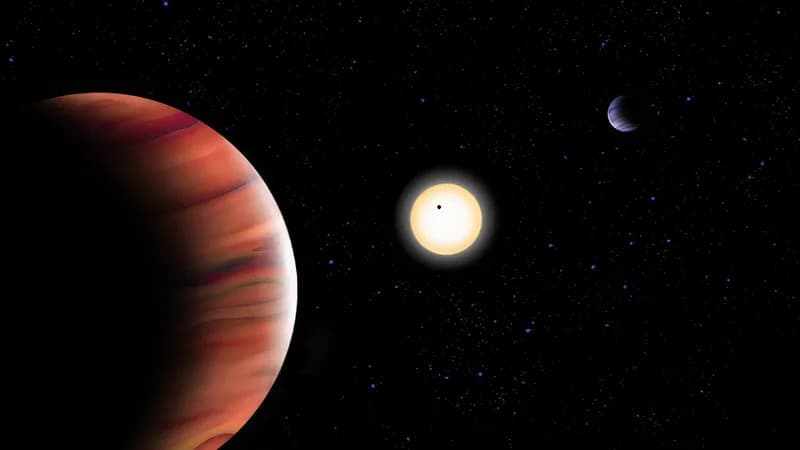
Astronomers confirmed three bodies in TOI-201, a rare exoplanet system changing in real time. An artist rendering of the system. (CREDIT: Tedi Vick)
Astronomers have mapped a compact, dynamically active three-body system around the bright F‑type star TOI‑201 and found orbits that are visibly changing on human timescales. The system hosts a close rocky super‑Earth, a warm Jupiter, and a distant, massive brown dwarf whose gravity is actively tilting and nudging the inner planets.
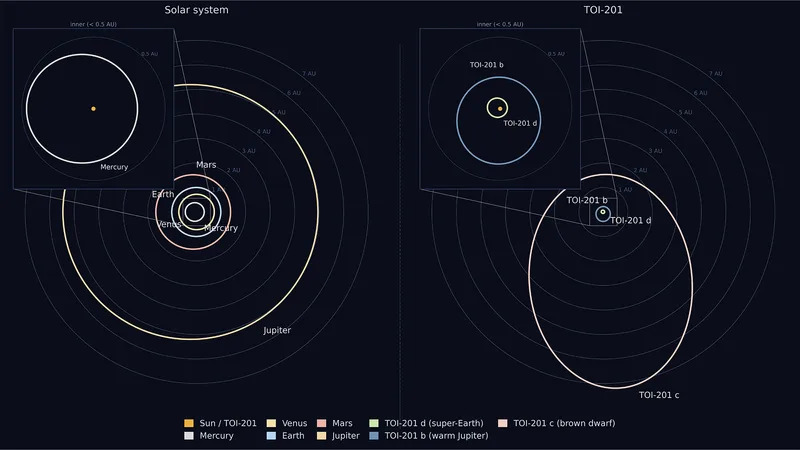
Orbital architecture of the TOI-201 system compared to our Solar system. The diagram shows the orbits of the three known companions of TOI-201 drawn to scale alongside the four inner solar system planets and Jupiter. The orbits of the warm Jupiter, TOI-201 b, and super-Earth, TOI-201 d, both lie within the orbit of Mercury, while the highly eccentric orbit of the brown dwarf, TOI-201 c, brings it closer in than Mars and further out than Jupiter. (CREDIT: Ismael Mireles)
A Strange Three-Body Family
The inner world, TOI‑201 d, is a super‑Earth roughly 1.39 times Earth’s radius and about 5.8 Earth masses, completing an orbit every 5.85 days — far too close for liquid water. TOI‑201 b is a warm Jupiter of roughly half Jupiter’s mass on a 53‑day orbit. Farther out, TOI‑201 c is a massive companion of ≈15.7 Jupiter masses on a highly eccentric orbit with a period of about 2,890 days (~7.9 years), making it the longest‑period transiting object found so far by TESS.
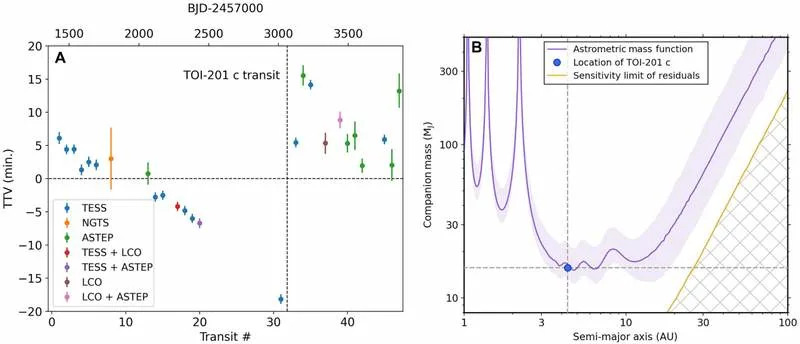
(A) TTVs for TOI-201 b from TESS and ground-based facilities showing a gradual decline followed by a sudden discontinuity at the time of the outer companion’s transit. (B) The astrometric acceleration observed in Hipparcos-Gaia astrometry is consistent with the properties of the ≈15 MJ outer companion, and otherwise places limits on more massive companions in the system. (CREDIT: Science Advances)
Why The System Is Unusual
TOI‑201 c’s eccentric, tilted orbit swings it sometimes closer to the star than Mars is to the Sun and at other times beyond Jupiter’s distance. Those extremes, combined with mutual tilts among the orbital planes, create a time‑dependent gravitational dance: the planets tug each other into new orientations and alter transit geometry on decades‑to‑centuries timescales.
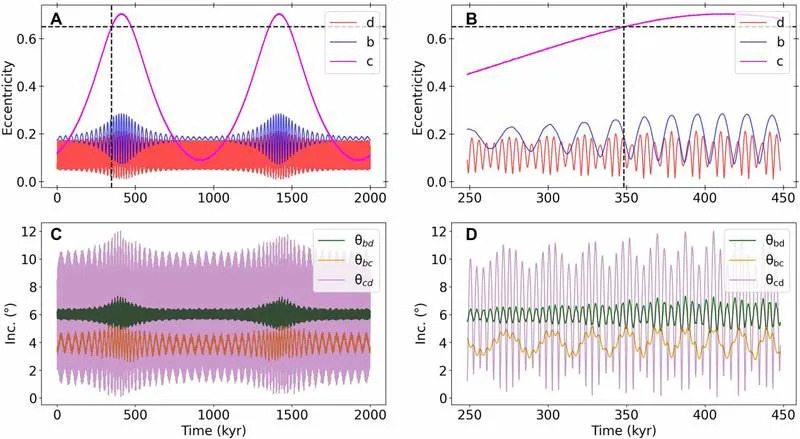
Dynamical evolution of vZLK simulation, which replicates the observed system architectures. (CREDIT: Science Advances)
“This is one of only a handful of systems where planetary orbits can be watched actively changing on human timescales,” said Ismael Mireles, lead author and PhD candidate at the University of New Mexico.
How the Team Worked It Out
The researchers combined four complementary techniques to reconstruct the three‑dimensional architecture: high‑precision spectroscopy (radial velocities) to measure masses and stellar reflex motion; transit photometry to detect and time transits; transit‑timing variations (TTVs) to reveal mutual interactions; and astrometry (Hipparcos and Gaia) to trace tiny movements of the star.
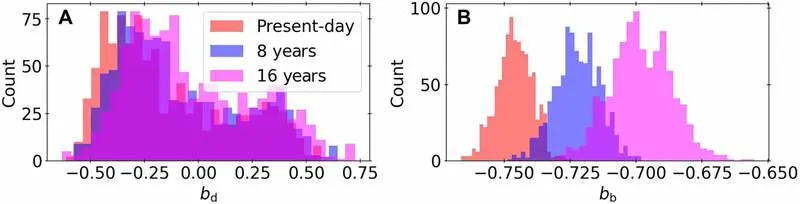
Short-term evolution of the impact parameters of the two inner planets for 1000 integrations of the posteriors. (CREDIT: Science Advances)
Data came from multiple spectrographs (CORALIE, HARPS, PFS, archival FEROS, and MINERVA‑Australis) and from ground‑based photometry including ASTEP at Concordia and telescopes in the Las Cumbres Observatory Global Telescope network across Chile, Australia and South Africa. Antarctic coverage was particularly valuable for monitoring a system with long and infrequent events.
Dynamics, Hypotheses and the Road Ahead
Simulations suggest the system is broadly stable, though the inner super‑Earth could face instability on million‑year timescales. The most plausible explanation for the current tilts is von Zeipel–Lidov–Kozai oscillations driven by an unseen, distant stellar companion, though disk interactions, a recent stellar flyby, and planet–planet scattering were examined and found unlikely or only rarely explanatory. The Kozai‑like scenario remains a working hypothesis that requires further observations to confirm.
Notably, the brown dwarf’s transit coincided with a disruption in TOI‑201 b’s transit timing: after that event the warm Jupiter began transiting about 30 minutes later than predicted — a clear sign the outer object is dynamically interacting with the inner planets rather than being inert.
Why This Matters
Most exoplanet systems appear as static snapshots. TOI‑201 is a rare, time‑evolving laboratory that lets astronomers observe how a warm Jupiter, a super‑Earth and a massive outer companion can mutually sculpt their orbits over observable intervals. Over the next centuries the system’s transit geometry will change: the super‑Earth is expected to stop transiting in roughly 200 years, the warm Jupiter a few hundred years later, and the brown dwarf after that, with the system returning to a transiting configuration on multi‑thousand‑year timescales.
The next predicted transit of TOI‑201 c is on 26 March 2031, a crucial opportunity for coordinated global and citizen‑science observations to test dynamical models and the presence of any additional companions. The results are published in Science Advances.
Help us improve.





















