
Genetic analysis of 78 individuals from the Imdang‑Joyeong burial complex (Three‑Kingdoms period) reveals evidence of ritual human sacrifice (sunjang) and close‑kin marriage. The burials fall into 13 family trees and include 54 related pairs, with at least three graves containing sacrificed parents and children. Five individuals showed runs of homozygosity consistent with parents who were close relatives, including one case (IMD003) consistent with first‑cousin parentage. Burial patterns suggest many adult women remained near maternal kin, indicating localized marriage networks tied to social status.
Ancient DNA Reveals Family Sacrifice and Close‑Kin Marriage at Imdang‑Joyeong (1,600‑Year‑Old Korean Burial Complex)
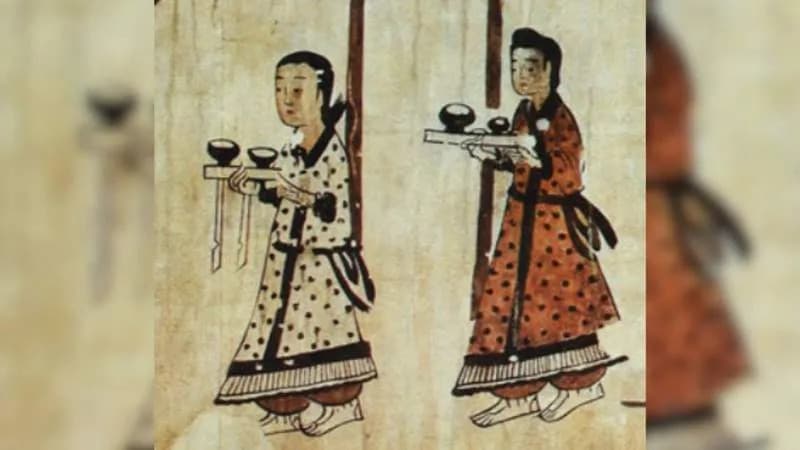
The women
DNA recovered from human remains at the Imdang-Joyeong burial complex in Gyeongsan City provides new genetic evidence that the community practiced ritual human sacrifice and close‑kin marriage about 1,600 years ago, researchers report in Science Advances. The site dates to the Three‑Kingdoms period (circa 57 BCE–668 CE) and is well known for sunjang—the ritual killing of servants to be interred with social superiors.
What the Study Analyzed
Researchers extracted and analyzed ancient DNA from 78 individuals across 44 graves. Genetic reconstruction placed those burials into 13 distinct family trees distributed across two burial areas within the complex. The team identified 54 pairs of related individuals, including 11 first‑degree pairs (parents–children or siblings), 23 second‑degree pairs (grandparents, aunts, uncles) and at least 20 more distant kin relationships.
Direct Evidence of Ritual Sacrifice
At least 20 tombs at Imdang-Joyeong contain a grave owner plus one or more individuals believed to have been killed to accompany them. Genetic data confirmed that entire nuclear families were sometimes sacrificed together: the authors report at least three instances where parents and children were killed and placed in the same grave. The researchers note that recurring relatedness among sacrificial individuals across generations may indicate families who served as sacrificial retainers to the elite over multiple generations.
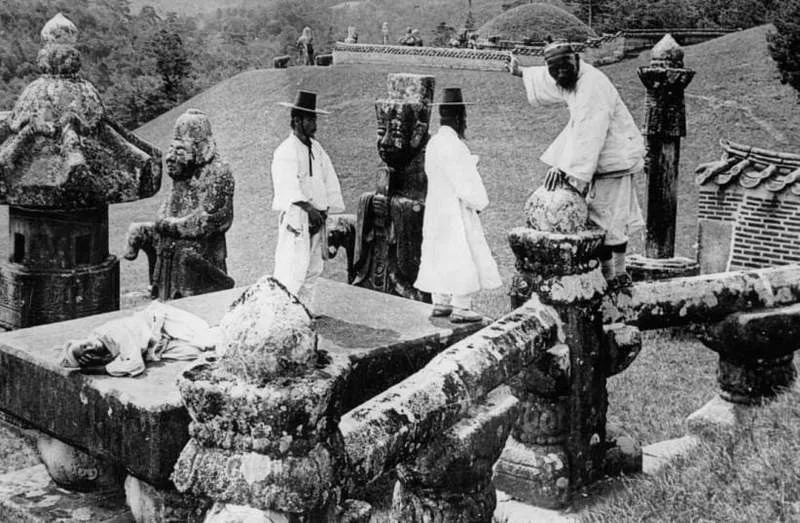
File photo: On this Korean altar human sacrifices were offered, Korea. Photograph taken around 1935. (credit: Imagno/Getty Images)
Signs of Inbreeding and Social Endogamy
The team measured long runs of identical DNA known as runs of homozygosity (ROH) to detect offspring of closely related parents. Five individuals showed ROH patterns consistent with close‑kin parentage; one individual, labeled IMD003, had ROH lengths consistent with parents who were first cousins or closer. Crucially, these inbreeding signatures were found among both elite grave owners and among sacrificial individuals, suggesting intracommunity marriage practices probably tied to social status and local endogamy.
Implications for Mobility and Family Structure
Burial patterns also indicate that many adult women were interred with their maternal relatives, implying that women commonly remained near their birth families rather than moving away after marriage. This contrasts with some European archaeological models and supports the idea of local, status‑based marriage networks at Imdang‑Joyeong.
"Genetic relatedness among sacrificial individuals over generations may suggest the presence of families that served as sacrificial individuals for the grave owner class for consecutive generations," the authors write.
Why It Matters
This study combines archaeology and genetics to illuminate social hierarchy, marriage practices, and ritual behavior in a Korean community of the Three‑Kingdoms period. By documenting both familial sacrifice and close‑kin marriage, the research reveals complex social structures in which hereditary roles and restricted marriage networks likely reinforced status and local cohesion.
Help us improve.





















