
Purdue announced the final two members of its Purdue 1 mission, completing a five-person crew set to fly in 2027 with partner Virgin Galactic. The team will conduct experiments on liquid behavior in microgravity, a topic with practical implications for spacecraft systems. Veteran astronaut Beth Moses will also collect continuous biometric data while wearing a sensor-equipped suit. The crew will spend the coming year training together and building team cohesion ahead of launch.
Purdue Finalizes Crew for Purdue 1 Mission; Launch Set for 2027
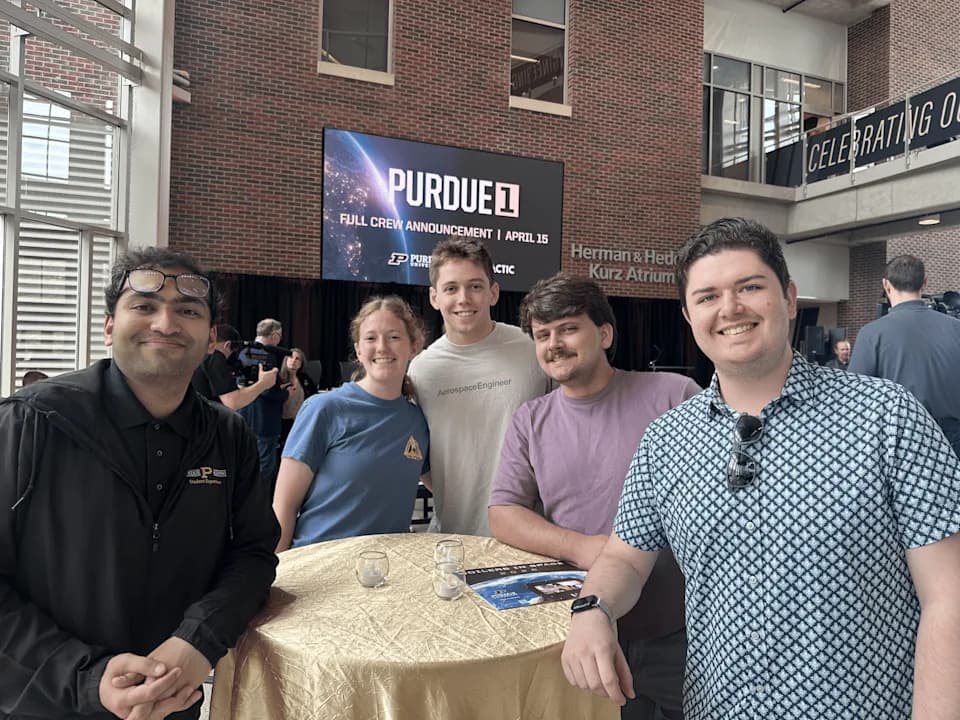
Working alongside Abby Mizzi and Steven Collicott, Purdue students responsible for zero gravity liquid research await the Purdue 1 panel to begin. Left to right are Sayantan Mukhuti, Cora Walker, Greyson Oling, Colin Podojil and Jack Devine.
WEST LAFAYETTE, Ind. — Purdue University announced the final two crewmembers for its university-led Purdue 1 mission on Wednesday, bringing the full five-person team together for the first time as the project moves toward a planned 2027 launch in partnership with Virgin Galactic.
The names were revealed during a campus panel in the Neil Armstrong Hall of Engineering, where students, faculty and alumni greeted the full crew with loud applause.
The newly announced crewmembers are Beth Moses, a six-time veteran astronaut and associate professor of engineering practice at Purdue, and Florence Stahura, a retired senior research scientist and a 1992 Purdue graduate. They joined the original trio: Steven Collicott, professor in the School of Aeronautics and Astronautics; Jason Williamson, a 1997 Purdue alumnus and senior vice president at Dunaway; and Abby Mizzi, a Purdue master's student in aeronautical and astronautical engineering.
Of the five slated to fly, four are new to spaceflight; Moses is the mission's only crew member with prior orbital experience. Stahura said she was "just pure excitement" when informed of her selection and described joining the team as an "unbelievable" honor and a renewed sense of purpose because the flight emphasizes research with practical applications.
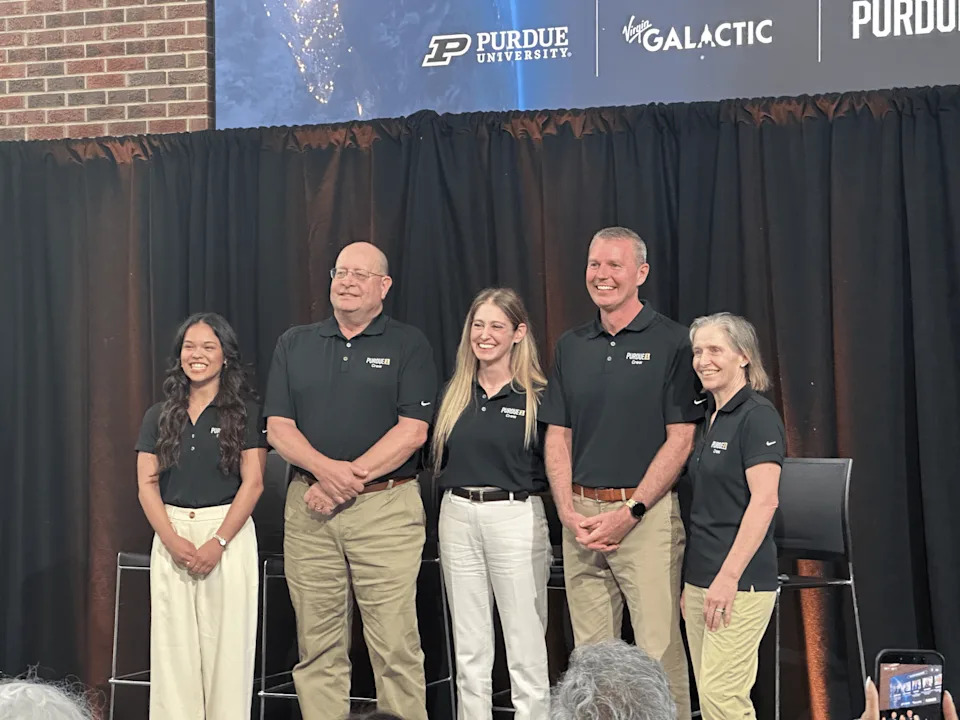
Boilermakers got to see the entire Purdue 1 crew together after the final two members were announced Wednesday. Left to right are Abby Mizzi, Steven Collicott, Beth Moses, Jason Williamson and Florence Stahura.
Research Focus: Fluids And Human Health
A primary objective of Purdue 1 will be controlled experiments on how liquids behave in microgravity. While fluid "sloshing" may sound trivial, researchers say it can affect tank drainage, spacecraft stability and other systems critical to long-duration missions.
"(The research) will help us better understand how liquids slosh around in those conditions and how tank drainage and surface tensions of liquids … can impact different aspects of space flight," said graduate student Sayantan Mukhuti, who works with Collicott and Mizzi.
Alongside the fluid dynamics experiments, Beth Moses will lead a biomedical study in which she will wear a specialized suit outfitted with biosensors to record continuous physiological data. Moses described the garment as using cutting-edge instrumentation and joked it would make her a "human pin cushion." That biometric data will help inform crew health monitoring for future flights.
Team Preparation And Timeline
With months remaining before the scheduled 2027 launch, the crew will begin joint training to develop the technical skills needed for microgravity operations and to build interpersonal trust. Some teammates already collaborate regularly; others will use the coming year to become mission-ready together.
"We are super excited now that we're a fully made, invested crew," Williamson said. "We will do some training together and continue to build on the trust that we've already established, and that'll go a long way."
The Purdue 1 mission represents a milestone as a university-chartered flight that combines hands-on student involvement with applied research aimed at advancing the safety and reliability of future space travel.
Help us improve.





















