
Scientists using the James Webb Space Telescope studied TOI-5205, a Jupiter-sized exoplanet orbiting a small M-dwarf about 280 light years away, and found unexpected elemental contrasts. Spectra from three transits indicate methane and hydrogen sulfide in the atmosphere, which appears metal-poor relative to its host star. Interior models imply the planet's deep bulk is roughly 100 times richer in heavy elements than its atmosphere — a result that challenges standard models of giant-planet formation around low-mass stars.
Faraway 'Jupiter' Around Red Dwarf Defies Planet-Formation Theories
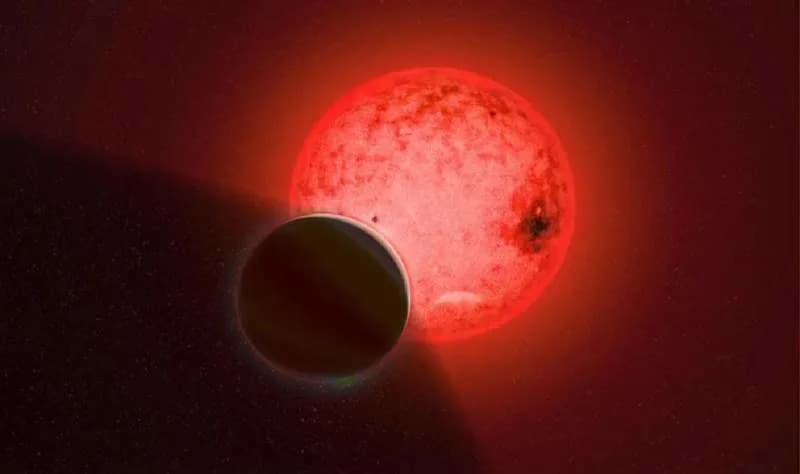
Artist’s conception of the gas giant planet TOI-5205 b orbiting a small, cool red dwarf star. Katherine Cain/Carnegie Science/dpa
A distant Jupiter-sized world orbiting a small red dwarf is forcing astronomers to rethink how giant planets form. Using the James Webb Space Telescope (JWST), an international team has found that TOI-5205 — about 280 light years from Earth — shows surprising differences between its observable atmosphere and its deep interior.
Unexpected Composition
The JWST spectra suggest the planet's atmosphere contains methane and hydrogen sulfide but has a lower concentration of heavy elements (relative to hydrogen) than expected. Remarkably, the atmosphere appears to have lower metallicity than its host star, while interior models indicate the planet's bulk may be roughly 100 times richer in heavy elements than the observable atmosphere.
How The Discovery Was Made
Researchers from the University of Birmingham, NASA, Carnegie Science, the University of Zurich, Pennsylvania State University and the Academia Sinica Institute of Astronomy and Astrophysics analysed JWST data from three transits of TOI-5205 across its M-dwarf host. By combining spectral retrievals with sophisticated models of planetary interiors, the team characterized both the atmospheric composition and inferred the planet's deep, unseen bulk composition.
What Researchers Say
'These findings have implications for our understanding of the giant planet formation process that occurs early in a star's lifespan,' said Anjali Piette, assistant professor in astronomy at the University of Birmingham.
'These results suggest a very carbon-rich, oxygen-poor planetary atmosphere,' added Shubham Kanodia of Carnegie Science.
Why This Matters
Standard core-accretion models predict that massive gas giants are uncommon around low-mass M-dwarf stars, and that a planet's metallicity should broadly reflect its host star. TOI-5205's mismatched atmospheric and interior metallicity challenges these assumptions and provides a rare natural laboratory to test alternative formation pathways or post-formation processes that can alter observable atmospheric abundances.
Distance And Perspective
TOI-5205 lies roughly 280 light years from Earth. For context, one light year equals about 9.46 trillion kilometres (almost 5.9 trillion miles). The study appears in The Astronomical Journal and relies on JWST observations taken since its 2021 launch.
Help us improve.





















