
Ghrist and Cooperband created a new “impossible” object — the impossible Klein ladder — by combining Penrose-style stairs, a Möbius-type twist and the topology of a Klein bottle. Locally each path looks and feels consistent, but globally loops can flip orientation or change perceived height. Crucially, the order of loops matters: performing two loops in different sequences produces different outcomes (a nonabelian effect), a behavior not seen before in visual paradoxes.
Mathematicians Build an ‘Impossible’ Klein Ladder — A New Nonabelian Visual Paradox
Robert Ghrist
Mathematicians Robert Ghrist (University of Pennsylvania) and Zoe Cooperband (U.S. Naval Research Laboratory) have developed a mathematical classification for visual paradoxes and used it to design a previously unseen “impossible” object. Their construction blends ideas from the Penrose stairs, the Möbius strip and the Klein bottle to produce a continuous, multilevel staircase with locally plausible geometry but globally contradictory behavior.
Local Consistency, Global Contradiction
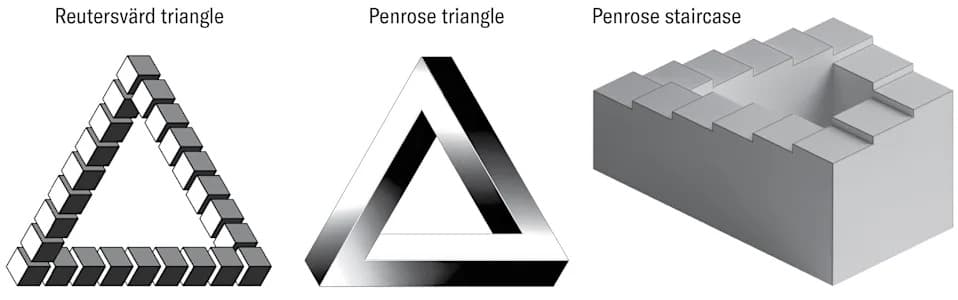
Impossible objects look convincing in a single small region but fail to exist as coherent three-dimensional shapes. The Penrose triangle and Penrose stairs are classic examples: every small piece looks normal, yet traveling around the whole figure produces a contradiction. Ghrist and Cooperband formalize that intuition with a classification that treats these drawings as perceptual spaces that are locally consistent but globally inconsistent.
From Penrose to Cylinder to Möbius to Klein
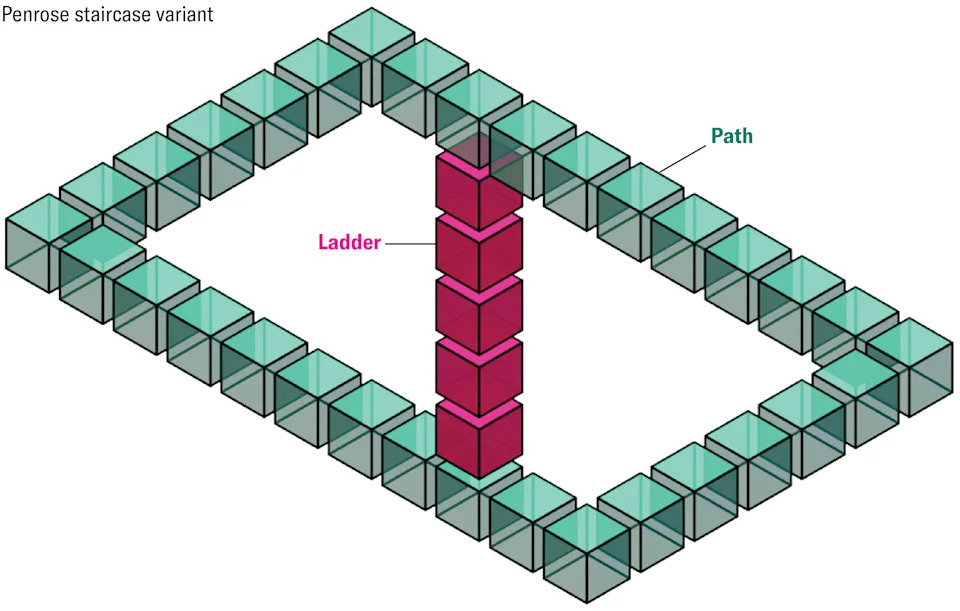
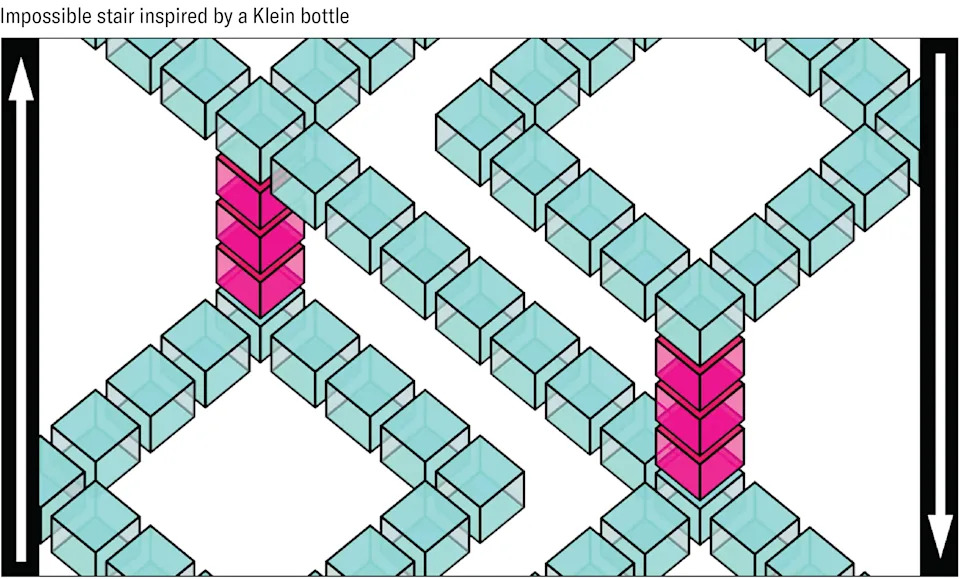
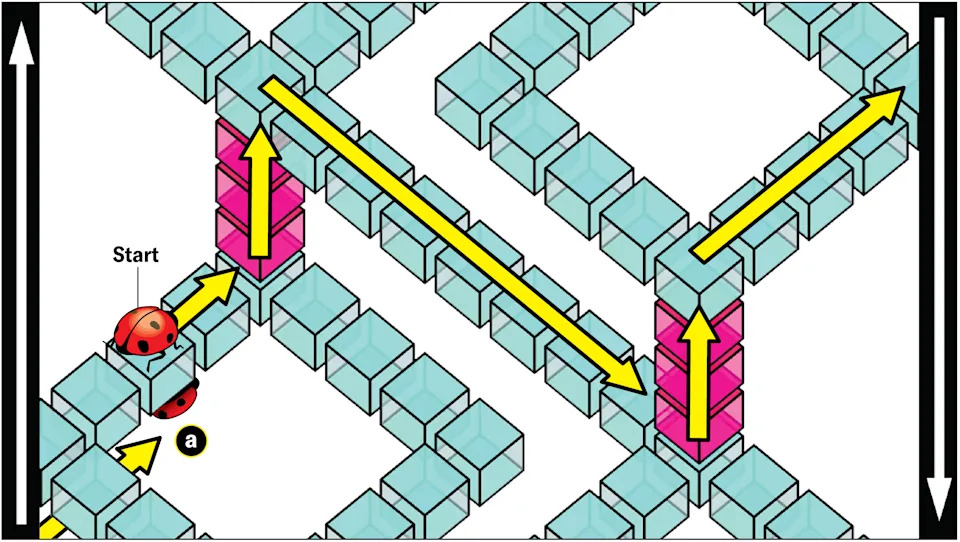
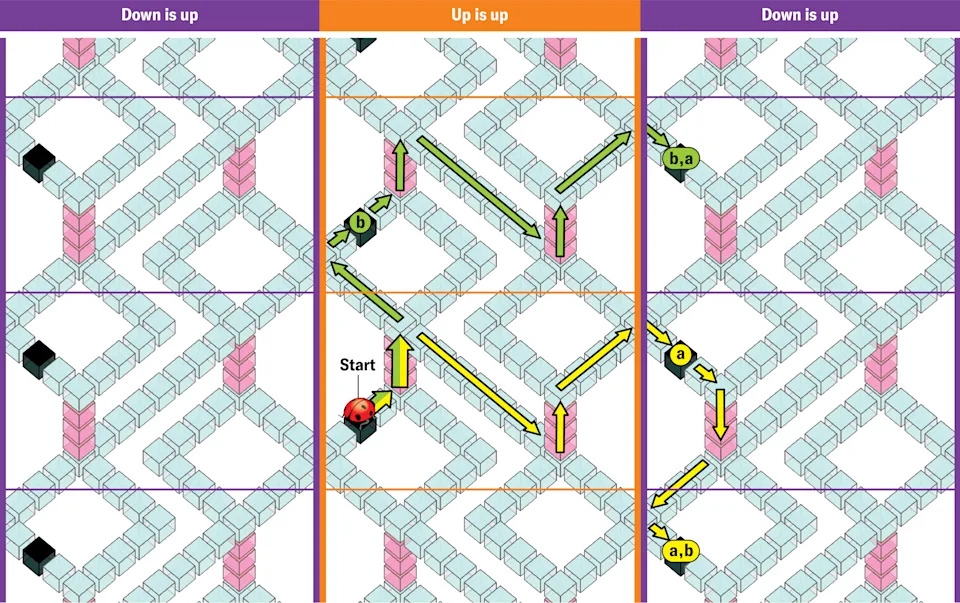
The researchers start with a variant of the Penrose staircase. Along one route in their design — shown in their diagrams as a blue path — an insect walking continuously would feel like it is moving on level ground, while taking a ladder that links opposite sides feels like climbing to a higher elevation. Each local segment is coherent, but the full network cannot be embedded in ordinary three-dimensional space without contradiction.
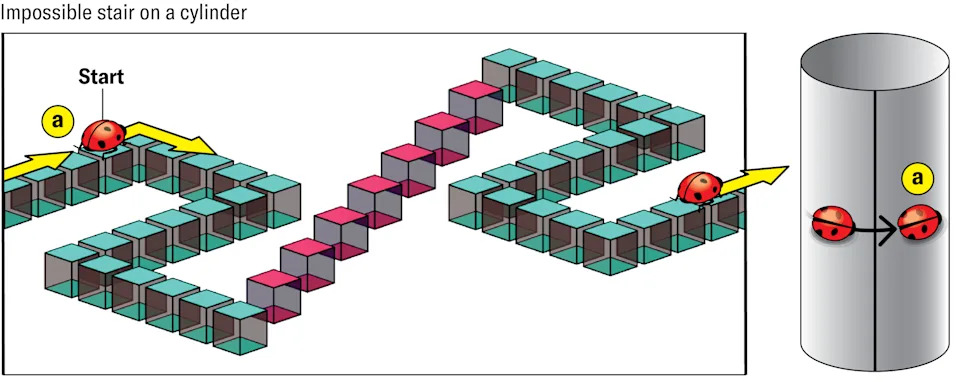
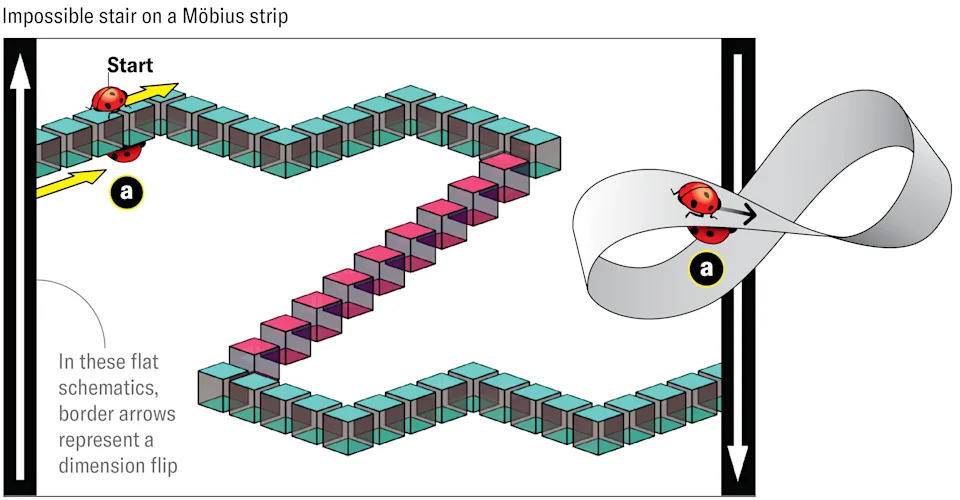
They then imagine straightening a rectangular loop and gluing its left and right edges to form a cylinder: a traveller who walks repeatedly to the right returns to the starting location with no change in orientation. By introducing a half-twist before joining the ends — the classic Möbius trick — a full circuit flips the traveller’s sense of “up.” Combining these behaviors leads to a construction modeled on the Klein bottle, a nonorientable surface first described by Felix Klein in 1882.
The Impossible Klein Ladder
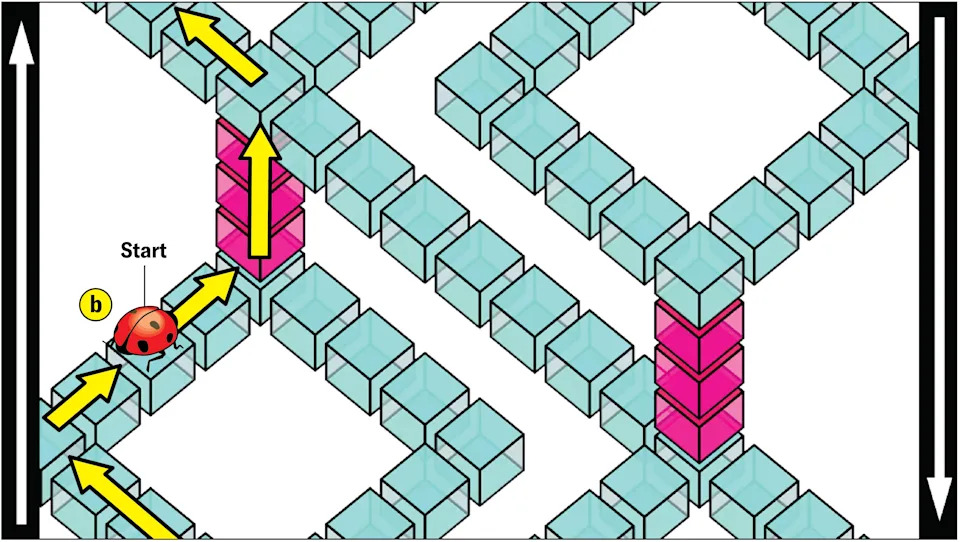
The resulting “impossible Klein ladder” mixes cylinder-like and Möbius-like effects so that different loops through the structure have different consequences for orientation and perceived height. Crossing a vertical seam acts like a Möbius reflection and flips the bug’s orientation: what was “up” becomes “down.” Crossing a horizontal seam behaves like the cylinder and preserves orientation.
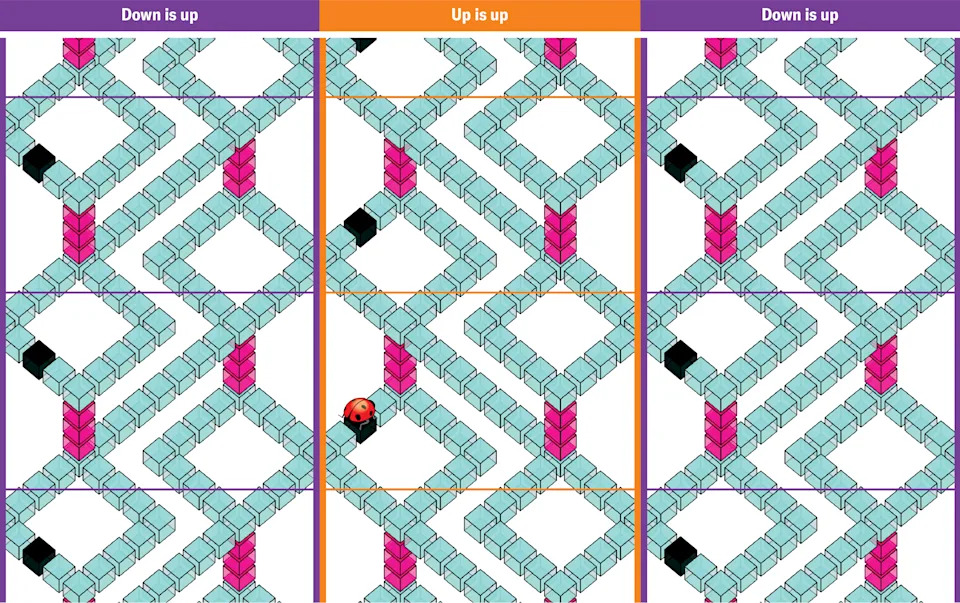
Because the two kinds of loops interact, the order in which a traveller performs them matters. If the bug takes a reflecting horizontal loop first and then a vertical loop, the net result differs from doing the vertical loop first and then the horizontal one. This order dependence means the construction is nonabelian: combined operations do not commute. As Ghrist notes, nonabelian phenomena are common in mathematics, but they have not previously appeared in a visual paradox of this kind.
How to Visualize It
The authors present an “unwrapped” perceptual tiling that helps explain the experience. The central column of tiles corresponds to unflipped orientations; shifting into side columns corresponds to reflected states where up and down are inverted. Multiple tiles can represent the same nominal location even though absolute height and orientation are not globally consistent. The tiling makes clear why the sequence of loops changes the traveller’s outcome.
“The essence of a paradox is: you walk around a loop, and something has changed. It’s a mismatch between where you are and where you thought you were.” — Robert Ghrist
This work expands the taxonomy of impossible objects by introducing topology-driven, order-dependent effects that have no analogue in classic drawings such as the Penrose stairs. The impossible Klein ladder is a striking example of how topology and perception combine to produce new kinds of visual paradoxes.
Robert Ghrist
Robert Ghrist
Robert Ghrist
Robert Ghrist
Robert Ghrist
Robert Ghrist
Robert Ghrist
Robert Ghrist
Help us improve.





















