
Researchers using the COLIBRE cosmological simulations show that large galaxies observed by JWST in the early Universe can form within the standard cosmological model when simulations include cold gas physics, detailed chemistry, and realistic feedback. The most complex runs used about 72 million CPU hours and model dust as three composition types in two size bins, which affects molecule formation and radiation transport. COLIBRE reproduces many observed galaxy properties but still cannot yet explain JWST's enigmatic "Little Red Dots," leaving a key question for future study.
Missing Ingredient in Early-Universe Simulations Explains How Galaxies Formed
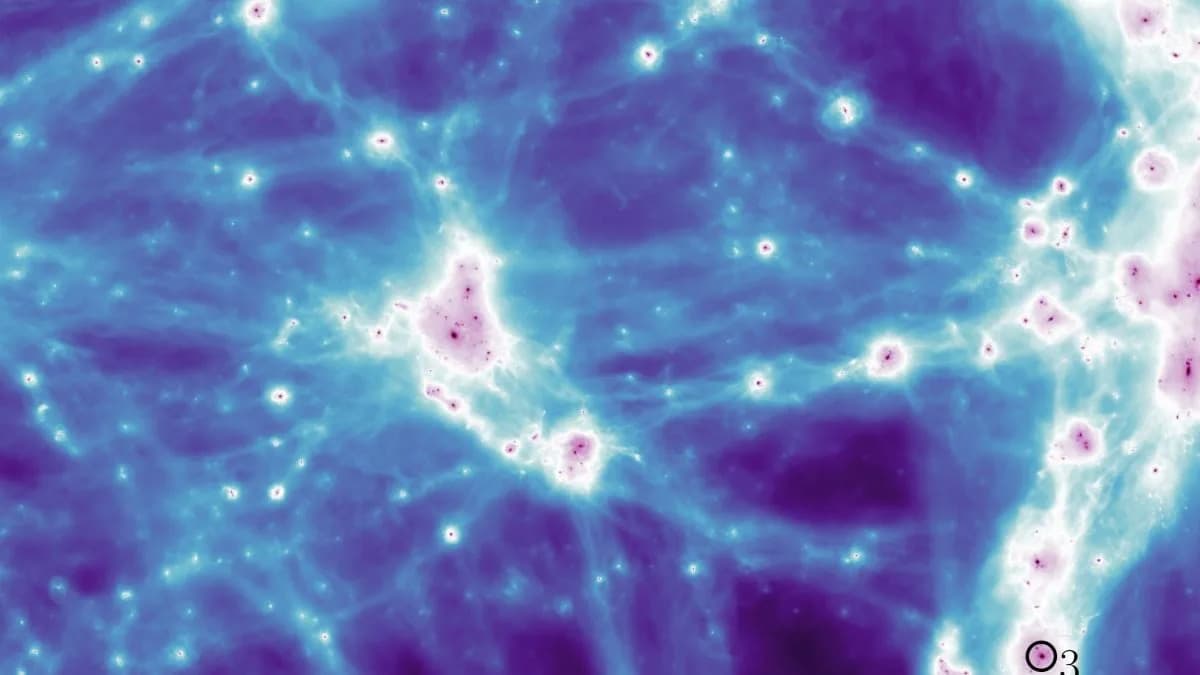
A snapshot of the simulation. (Schaye et al., 2026)
Scientists have taken a major step toward resolving how the first galaxies assembled from the primordial matter left after the Big Bang by running more realistic, higher-resolution cosmological simulations that include previously neglected physics.
YouTube Thumbnail
For hundreds of millions of years after the Big Bang, the Universe cooled from a hot, diffuse plasma into the first concentrated systems of stars and galaxies. That epoch — the Cosmic Dawn — cannot be observed directly, so researchers recreate it inside supercomputers using numerical models that capture the relevant physics. To reduce computational cost, many earlier large-scale simulations used simplified prescriptions for gas, dust, chemistry and energetic feedback from stars and black holes.
YouTube Thumbnail
The COLIBRE cosmological simulation project set out to close some of those gaps by modelling cold, dusty gas, richer chemistry and more realistic feedback processes. The largest runs consumed roughly 72 million CPU hours, reflecting the added complexity of the new physics.

Subscribe to ScienceAlert's free fact-checked newsletter
What COLIBRE Adds
Crucially, COLIBRE includes a detailed treatment of the cold interstellar gas from which stars form and a dust model in which grains appear in three composition types and two size bins. Dust matters: it catalyses the formation of molecules from free atoms and alters how radiation propagates by absorbing and scattering specific wavelengths, which in turn affects cooling, star formation and observable galaxy properties.
"Some early JWST results were thought to challenge the standard cosmological model," says astronomer Evgenii Chaikin of Leiden University. "Once key physical processes are represented more realistically, the model is consistent with what we see."
When evolved forward, the COLIBRE simulations produced a synthetic population of galaxies whose numbers, brightnesses, colours and sizes closely match deep observational surveys — including surprisingly large galaxies detected by the James Webb Space Telescope earlier in cosmic history than many expected.
"It is exhilarating to see 'galaxies' come out of our computer that look indistinguishable from the real thing and share many of the properties that astronomers measure in real data," says physicist Carlos Frenk of Durham University. "What is most remarkable is that we are able to produce this synthetic Universe purely by solving the relevant equations of physics in the expanding Universe."
Open Questions
Despite bringing simulations closer to observations, COLIBRE does not yet explain every puzzling JWST finding. Notably, it has not reproduced the so-called "Little Red Dots" — compact, very red sources found in some JWST deep fields. Proposed explanations range from very massive stars to exotic black-hole–star systems, but none are definitive. The persistence of these objects highlights remaining gaps and points the way for future work.
The results, published in the Monthly Notices of the Royal Astronomical Society, demonstrate that including cold gas physics, a multi-component dust model and more realistic feedback can reconcile many early JWST observations with the standard cosmological framework and move us closer to a faithful account of the Cosmic Dawn.
Help us improve.





















