
More than six weeks into Israel’s campaign against Iran, Prime Minister Benjamin Netanyahu has struggled to convert military advantages into lasting political gains. Heavy Israeli and U.S. strikes have degraded adversaries but not neutralised Iran, Hamas or Hezbollah. Polls show a fall in public support for Netanyahu and only 10% of Israelis view the campaign as successful; the operation has cost an estimated $11.5 billion.
Netanyahu’s Iran Campaign Hasn’t Delivered Political Victory Despite Massive Firepower
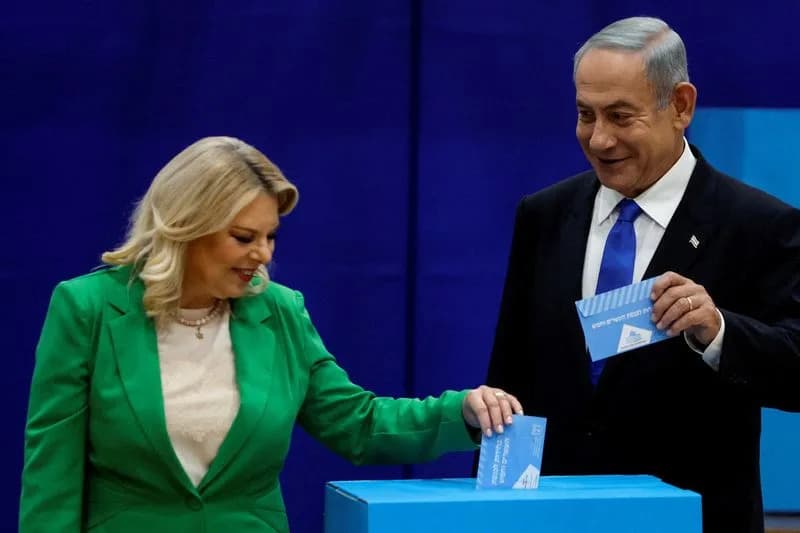
FILE PHOTO: Former Israeli Prime Minister Benjamin Netanyahu stands next to his wife Sara as they cast their ballots on the day of Israel's general election in a polling station in Jerusalem November 1, 2022. REUTERS/Ammar Awad/File Photo
The war against Iran was promoted by Israel as a potential defining triumph that would cement Prime Minister Benjamin Netanyahu’s legacy. More than six weeks into the campaign, however, military superiority has not translated into the decisive political gains Netanyahu sought.
Military Gains, Strategic Limits
Israeli and U.S. strikes have inflicted operational damage across multiple fronts, but none of Israel’s adversaries have been fully neutralised. Iran remains intact and defiant: it still holds nuclear material, has demonstrated credible missile capability and exerts influence over the Strait of Hormuz, a crucial route that carries roughly a fifth of global oil shipments.
Meanwhile, Palestinian Islamist group Hamas has not been dismantled in Gaza, and Lebanon-based, Iran-backed Hezbollah continues to launch rockets into northern Israel.
Political Backlash At Home
Netanyahu, 76, has paid a growing political price. Polling shows public support slipping: an April 11 survey by Hebrew University’s Agam Labs found backing for the prime minister at about 34%, down from roughly 40% at the start of the campaign, and only 10% of respondents judged the war successful. More than half rated his leadership poorly.
"Netanyahu is not winning. This war is a strategic failure," said Danny Citrinowicz, a senior researcher on Iran at Israel’s Institute for National Security Studies. "There is a gap between what he promised at the start of the campaign and where we ended up."
Questions About Strategy
Analysts say the campaign—largely reliant on airpower—has produced tactical and operational results but not a coherent, lasting strategic endgame. The assumption that targeted strikes and superior jets alone could force regime change or collapse Iran’s posture in the region has been challenged by the resilience of Iran’s political and military structures.
Former advisers and analysts have also questioned the long-term value of targeted assassinations. While some senior figures have been killed, such strikes often create replacements and can harden rather than soften an adversary’s resolve.
Diplomacy, Costs And Regional Consequences
Israeli officials and Western sources said Prime Minister Netanyahu learned late of a Pakistan-brokered ceasefire plan, prompting accusations that he had been sidelined in diplomatic discussions. Netanyahu has publicly sought to rebut any perception that he was excluded.
The campaign has also carried a heavy price tag. Israel’s finance ministry estimates the operation’s budgetary cost at about $11.5 billion, a large share of which went to defense spending. With legislative elections scheduled by late October, the domestic political stakes are rising.
Regional diplomats and experts warn of broader consequences. Washington faces a new reality in which Iran appears able to survive confrontations and threaten Gulf infrastructure or shipping through influence over the Strait of Hormuz. Gulf states, meanwhile, may be forced to balance the risk of heightened confrontation with Iran against the imperative of keeping the strait open.
Outlook
Unless a clear strategic endgame is defined, diplomats say Netanyahu’s political position is likely to remain precarious. The campaign’s tactical successes have not yet produced the decisive outcome or domestic political resurgence Netanyahu sought, while regional tensions and economic costs continue to mount.
Help us improve.





















