
Iran has denounced a US maritime blockade of its ports as a 'grave violation' of sovereignty, calling the move unlawful and a threat to international peace. The blockade was ordered by US President Donald Trump after failed peace talks and took effect at 1400 GMT despite a recently agreed two-week ceasefire. UN Secretary-General Antonio Guterres urged all parties to respect freedom of navigation in the Strait of Hormuz, a vital route carrying about one-fifth of the world's oil and gas.
Iran Brands US Maritime Blockade a 'Grave Violation' of Sovereignty — UN Warns of Escalation
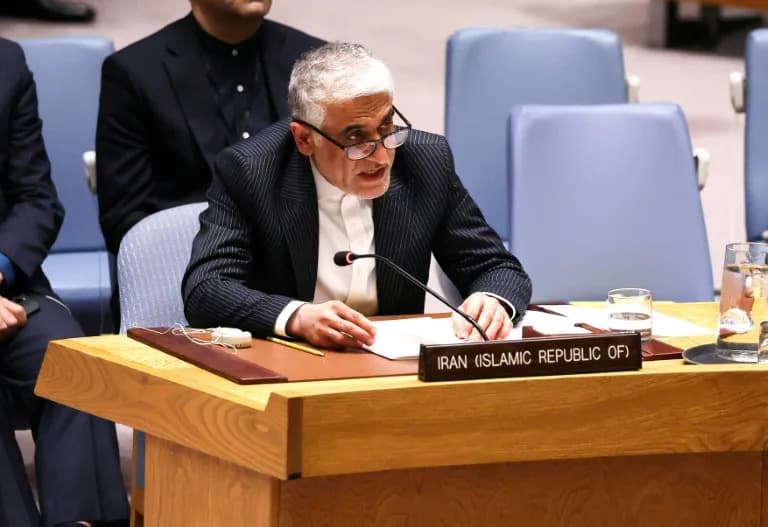
Iran's Ambassador to the United Nations Amir Saeid Iravani is calling on the US to end any threatened blockade and for Gulf countries to stop hosting US military bases (TIMOTHY A. CLARY)(TIMOTHY A. CLARY/AFP/AFP)
Iran on Monday condemned a US-imposed maritime blockade around its ports as a 'grave violation' of its sovereignty, warning the move risks escalating tensions in an already volatile region. The protest came as bitter rhetoric from Washington and Tehran undermined a fragile truce and prompted renewed international concern over freedom of navigation in the Strait of Hormuz.
The Diplomatic Exchange
In a letter to UN Secretary-General Antonio Guterres seen by AFP, Iran's ambassador to the United Nations, Amir Saeid Iravani, wrote that 'the imposition of a maritime blockade constitutes a grave violation of the sovereignty and territorial integrity of the Islamic Republic of Iran.' He described the action as 'unlawful' and said it 'constitutes a serious violation of the fundamental principles of the international law of the sea.'
'The unlawful blockade poses a grave threat to international peace and security and obviously exacerbates the risk of escalation in an already highly volatile region,' Iravani wrote.
US Action and Immediate Impact
US President Donald Trump ordered the blockade on Sunday after peace talks failed over the weekend. The directive instructed that ships entering or leaving Iranian ports and coastal areas in the Gulf be stopped, and warned that any Iranian attack boats challenging the blockade would be destroyed. The measure took effect at 1400 GMT on Monday, even though Washington and Tehran had previously agreed to a two-week ceasefire.
International Response
UN Secretary-General Antonio Guterres urged 'all parties' to respect freedom of navigation in the Strait of Hormuz after Iran and subsequently the United States moved to restrict passage through the strategically sensitive waterway. The strait carries roughly one-fifth of global oil and gas flows and has become a key flashpoint as both countries seek leverage during ceasefire negotiations.
Mediator states, including Pakistan and Qatar, continued to call for the ceasefire to be honored while diplomatic efforts proceed. In a separate letter, the Iranian UN envoy also called on Middle Eastern countries hosting US military bases to 'cease their internationally wrongful acts' and demanded compensation from Bahrain, Saudi Arabia, Qatar, the United Arab Emirates and Jordan for 'material and moral damage sustained.'
What Comes Next
The blockade increases the risk of maritime incidents and broader escalation. Diplomats are under pressure to restart talks and secure guarantees for freedom of navigation to avoid disruption to global energy supplies and to reduce the chance of military confrontation in the Gulf.
Help us improve.





















