
Overview: ACLED recorded at least 7,700 missile, drone, rocket and bomb strike events between Feb. 28 and Apr. 8. About three-quarters of those strikes hit sites in Iran or Lebanon. Roughly 40% of strikes targeted Iran (only about one-third clearly hit military or IRGC-linked sites), while Lebanon accounted for about one-third, most attributed to Israeli operations. Energy facilities were heavily targeted and sustained damage in roughly 40% of such incidents.
ACLED Analysis: Iran and Lebanon Took Nearly 75% Of Missile and Drone Strikes In Middle East War
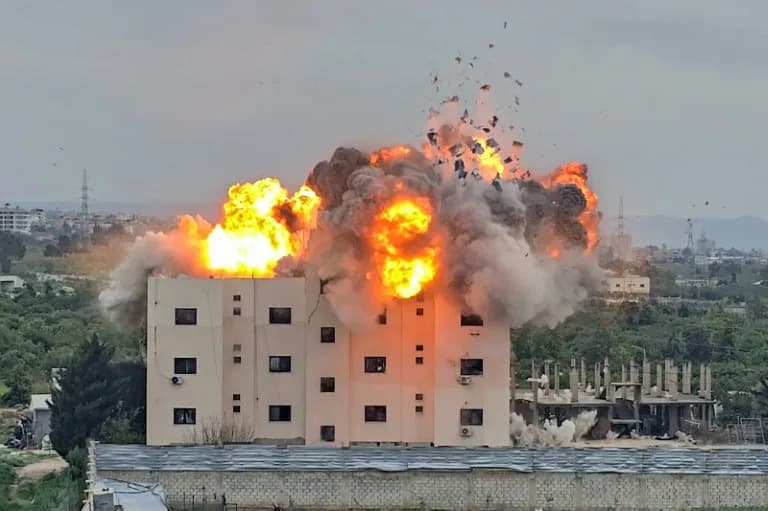
An Israeli airstike hits a building in Lebanon, in the southern village of Abbasiyyeh, on March 13 (KAWNAT HAJU)(KAWNAT HAJU/AFP/AFP)
An AFP analysis of data from ACLED, the U.S.-based conflict monitoring group, finds that roughly three-quarters of recorded airstrikes in the recent Middle East war struck sites in Iran or Lebanon. ACLED logged at least 7,700 strike events — including missile, drone, rocket and bomb launches or series of strikes — from the outbreak of hostilities on Feb. 28 through Apr. 8, when a fragile ceasefire between Tehran and Washington came into effect.
Data And Scope
ACLED compiled and vetted incidents from sources it considers reliable, including news reports, social media, institutions and other NGOs. Its tally includes attacks that were intercepted and should not be treated as an exhaustive catalogue of the conflict; in many cases the intended target or the responsible actor could not be independently verified.
Iran
About 40% of recorded strikes were directed at targets in Iran, most of them attributed to the Israeli military. AFP's breakdown shows that only around one-third of strikes on Iran could be clearly identified as hitting military sites or facilities linked to the Islamic Revolutionary Guard Corps (IRGC). Another roughly one-third had no identified target. The two days immediately before the ceasefire, Apr. 6 and 7, saw the highest daily totals.
Lebanon
Lebanon accounted for roughly one-third of the documented attacks (ACLED data through Apr. 3). The vast majority were carried out by Israeli forces following a Hezbollah offensive that began on Mar. 2; nearly 10% of the strikes in Lebanon were attributed to Hezbollah attacks on Israeli positions in southern Lebanon. Israel has said the two-week ceasefire between the U.S. and Iran does not apply to Lebanon and has continued operations there.
Israel
About one in seven recorded attacks — roughly 14% — targeted Israel. Most of those were intercepted. ACLED's data indicate launches against Israel came in nearly equal measure from Iran and from Hezbollah.
Other Countries And Regions
Outside the Levant, Iranian-linked launches chiefly targeted Gulf states: the United Arab Emirates, Kuwait, Saudi Arabia and Bahrain took the brunt of those strikes. In Iraq, ACLED found that around 40% of recorded attacks were aimed at Kurdish groups and about 20% at U.S. interests. Qatar and Oman experienced fewer incidents.
In Syria, ACLED recorded roughly 100 incidents, many connected to Iranian missiles and drones intercepted by Israeli forces. Several dozen similar interception events were recorded in the West Bank and Jordan. NATO intercepted four missile launches over Turkey to protect the Incirlik airbase, where U.S. troops are stationed.
Most Common Targets
Bridges and access roads were frequent objectives: Israeli strikes targeted about 15 bridges or approaches in Lebanon and about 20 in Iran. Attacks on Iranian energy infrastructure intensified during the conflict's second and third weeks and again in the week of the ceasefire announcement. Iran's major petrochemical complex at Assalouyeh — struck in mid-March — was hit again on Apr. 6, and numerous fuel depots were damaged.
ACLED also reported four strike events near Iran's sole nuclear power plant at Bushehr. Among Gulf oil producers, Saudi Arabia and the United Arab Emirates saw the most attacks on oil infrastructure, followed by Kuwait. Across the dataset, strikes on energy infrastructure caused damage in roughly 40% of recorded cases.
Military bases hosting U.S. personnel were targeted approximately 50 times in total, primarily during the conflict's first two weeks.
Limitations And Context
ACLED's dataset is a valuable, independently compiled resource, but it has limitations: some events are reported only by single sources, many launches were intercepted and attribution in real time can be uncertain. Numbers and percentages should therefore be read as best-available estimates rather than definitive counts.
Help us improve.





















