
Professor Anu Ojha used an inflatable globe, a length of string wrapped ten times, and a scaled Moon ball at The Royal Institution to demonstrate the true distance between Earth and the Moon. On April 6, 2026, NASA's Orion reached about 252,756 miles from Earth during Artemis II, which orbited but did not land. On Ojha's scale the Kármán line (100 km) is 1 mm, the ISS orbit (~400 km) is a finger-width, and the Moon is roughly 1,000 times farther than the ISS. The demo highlights why lunar missions are far more challenging than trips to low Earth orbit.
Professor Uses Globe, String and a Ball to Reveal Just How Far the Moon Really Is
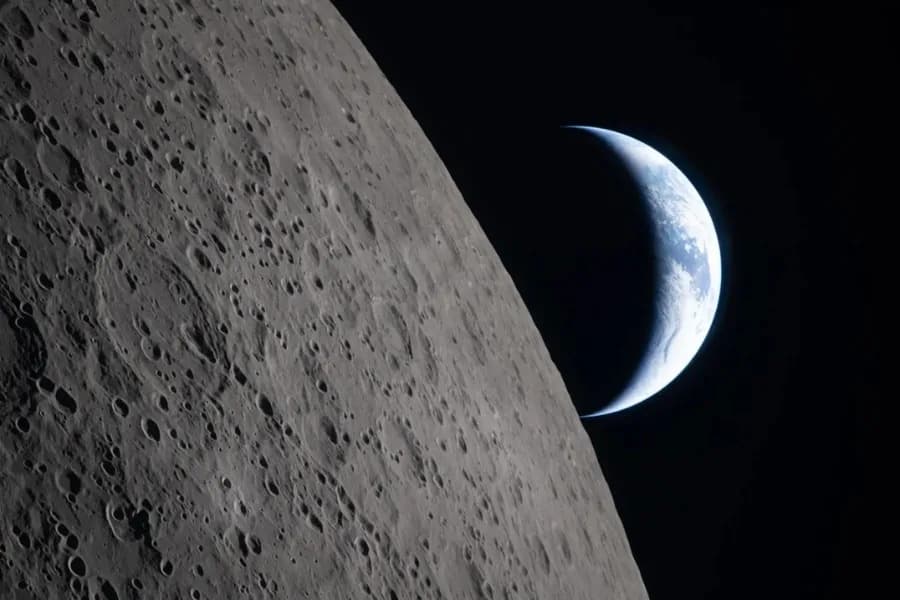
How far away is the Moon from Earth, really?
On April 6, 2026, NASA's Orion spacecraft carried four astronauts to a record distance from Earth—about 252,756 miles—while on the Artemis II mission. The crew did not land on the Moon, but their flight around it renewed public interest in how vast even nearby space is. At The Royal Institution, Professor Anu Ojha offered a simple, memorable demonstration to make that scale tangible.
Ojha began by reminding the audience that the Moon's distance from Earth varies because its orbit is elliptical. As a rule of thumb he used for the demonstration: the average distance to the Moon is roughly equal to ten times Earth's circumference.
He used an inflatable globe to represent Earth, wrapped the same length of string around it ten times, and attached a ball sized in correct scale to the string's end. "It's about the same size as Australia or Canada or China," he said of the Moon model, "about a quarter of the diameter of the Earth." He contrasted that accurate size with many common graphics that show the Earth and Moon close together but not to scale in distance.
Ojha invited a student to walk away while holding the Moon ball so the string could unwind. After only six or seven feet he paused the demonstration and observed, "That's the sort of visualization we get from this image. But, you know, there's a lot of string left here." The student kept walking until, out of view and up a flight of stairs, it became obvious just how far away the model Moon landed from the globe.
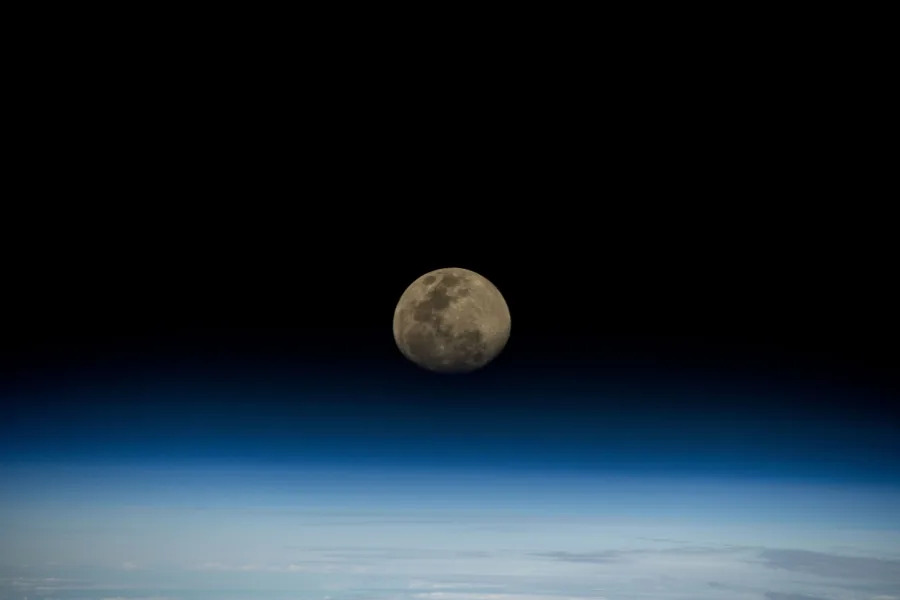
Photo from the ISS of the moon “rising” over the Earth’s atmosphere (Photo credit:NASA)
Visual Scale Comparisons
To make the scale even clearer, Ojha compared familiar space landmarks to the model: the international boundary of space (the Kármán line, 100 km) is 1 millimeter on his scale; the International Space Station's orbit (~400 km) is about the width of a finger; and the Moon sits roughly 1,000 times farther away than the ISS. He went on to note that the next nearest planet, Venus, is more than 100 times the Earth–Moon distance away on average—illustrating how quickly distances expand once you move beyond our immediate neighborhood.
“So we start to see the challenges that we are facing in directly exploring even our own solar system, let alone the universe,” Ojha said.
The demonstration highlights why crewed lunar missions are far more difficult and infrequent than trips to low Earth orbit: the distance, logistics, and energy requirements increase dramatically. Viewers praised the old-fashioned, hands-on approach for helping people grasp astronomical scales.
Public Reaction
Comments from attendees and online viewers included praise for the clarity of a physical demonstration and reflections on how hard it is to internalize astronomical distances. Many noted that seeing scale physically laid out—whether with string, globes, or a football-field-sized planet model—helps make otherwise abstract numbers immediately comprehensible.
Simple demonstrations like Ojha's remind us that while our knowledge of the cosmos grows, the basic arithmetic of distance still has the power to astonish. They also underscore the practical challenges of space exploration and the special human quality of wonder that drives us to explore.
Help us improve.





















