The Jerk is a new seismic detection method that senses horizontal, source-level displacements tied to underground magma movement and fracture openings. Deployed at Piton de la Fournaise in April 2014, it anticipated about 92% of recorded eruptions there over roughly a decade, with alerts ranging from minutes to 8.5 hours beforehand. About 14% of alarms did not lead to eruptions but still reflected real subterranean activity. Because it needs relatively little equipment, researchers plan to test the method at more volcanoes to broaden early-warning coverage.
New 'Jerk' Seismic Signal Could Transform Volcanic Eruption Forecasting
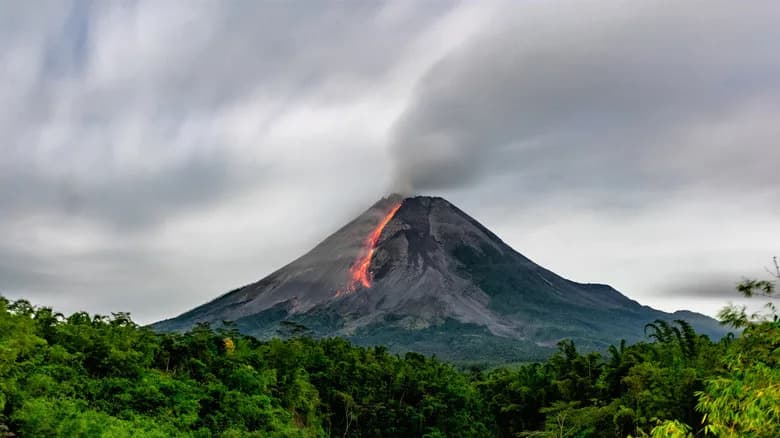
Lava flowing down from volcano - Gani Pradana Ongko Prastowo/Getty Images
Detecting signs of an impending volcanic eruption can give communities vital time to evacuate and prepare. Until now, early-warning systems have often been hampered by logistical challenges and the need for dense, complex sensor networks. Researchers from the Institut de Physique du Globe de Paris (IPGP) and the GFZ Helmholtz Centre for Geosciences have reported a promising new seismic indicator — dubbed the "Jerk" — that senses lateral, source-level ground displacement linked to underground magma movement and fracture openings.
What Is the Jerk?
The Jerk is a class of seismic signal that highlights horizontal displacement near the source of magma movement rather than vertical ground rise. In plain terms, it detects short-lived sideways jerks in the subsurface that are directly tied to evolving magma dynamics and subterranean fracture openings — signals that can precede an eruption.
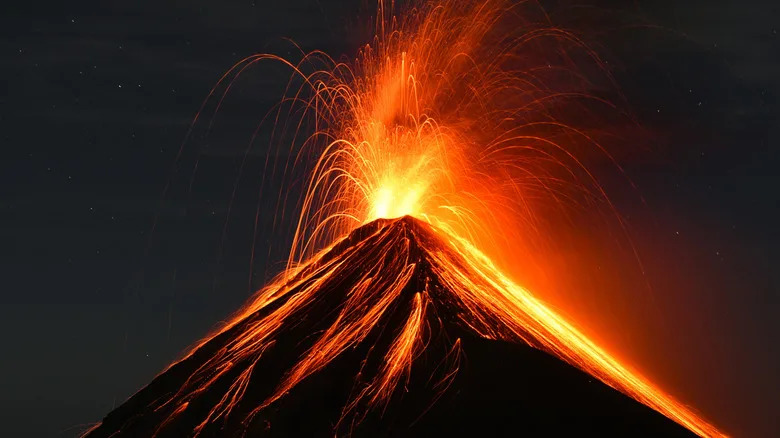
Volcano spewing lava at night - Gal_Rotem/Shutterstock
Field Results
First installed at IPGP's Piton de la Fournaise observatory in April 2014, the Jerk system produced encouraging results over roughly a decade of monitoring. According to the published study in Nature Communications, the technique correctly anticipated about 92% of recorded eruptions at that site. Lead times varied: some alerts came only minutes before an event, while others preceded eruptions by as much as 8.5 hours.
Not all alerts culminated in surface eruptions: roughly 14% of alarms did not correspond to an eruption. The research team emphasizes that these non-eruptive alerts still matched the same types of subsurface magma movement and fracture activity observed before eruptions, suggesting the signals identify real subterranean processes even when they do not reach the surface.
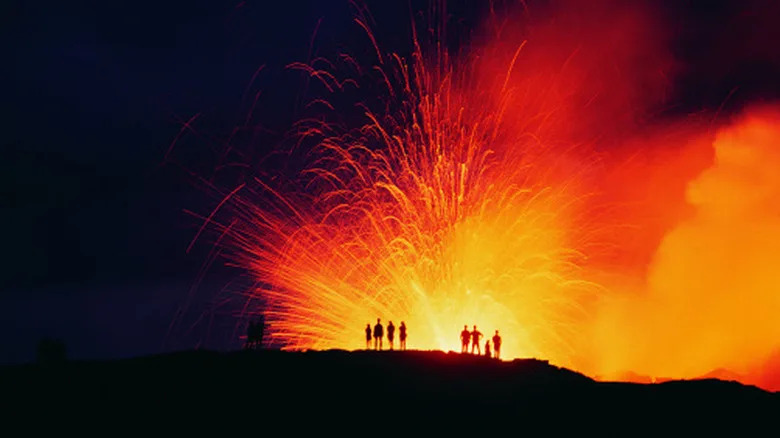
Group of people standing in front of volcanic eruption - Digital Vision./Getty Images
Why It Matters
One of the Jerk method's most significant advantages is its modest hardware footprint. It requires fewer and simpler instruments than many traditional monitoring networks, helping to overcome a central barrier to broader deployment at active volcanoes worldwide. Because it is less resource-intensive, the technique could be deployed more widely — improving early-warning coverage in regions where dense sensor arrays have been impractical.
Next Steps
Buoyed by the Piton de la Fournaise results and an expanding dataset, the research team plans to trial the Jerk at additional volcanoes to test its general applicability. The method is not a silver bullet: researchers caution that continued study of eruption initiation and volcano reactivation mechanisms remains essential. Combining deeper causal research with efficient detection methods like the Jerk could strengthen protections for communities living near active and potentially reawakening volcanoes.
Help us improve.