
The escalation following US-Israeli strikes on Iran has amplified mental-health distress in Israel, particularly among psychiatric patients and people with disabilities. Sirens, crowded communal shelters and disrupted routines trigger severe anxiety for patients like "Nili" and teens such as Rhea. Caregivers and medical staff confront ethical dilemmas and burnout while accessibility gaps and short warning windows complicate evacuations. Centres including Shalvata and Beit Issie Shapiro have set up hotlines and increased support to help vulnerable groups cope.
Air-Raid Sirens Deepen Trauma in Israel: Psychiatric Patients, People With Disabilities and Caregivers Struggle
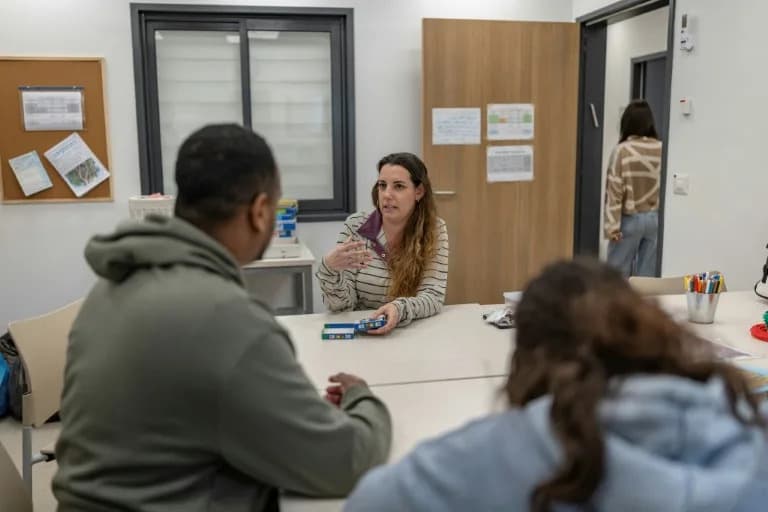
Therapist Shani Volovic Shushan plays cards with patients at the Shalvata Mental Health Centre (Ilia YEFIMOVICH)(Ilia YEFIMOVICH/AFP/AFP)
Acutely sensitive to loud noises because of childhood trauma, "Nili" — a name changed for this report — panics each time air-raid sirens push her into a crowded communal shelter. Her "internal war" collides with the conflict unfolding outside, underscoring how people with pre-existing mental health conditions are especially vulnerable amid the recent escalation triggered on February 28 by coordinated US-Israeli strikes on Iran.
The 21-year-old has been receiving treatment for nine months at the Shalvata Mental Health Centre in Hod HaSharon, a facility run by Clalit Health Services. "It's unpleasant and unfamiliar to be in a relatively small room with many people you don't know, men and women together, usually quite crowded," she told AFP. "We're in Israel, and there's a war outside. But there are also people who have been battling their own internal wars for many years."
Disability, Routine and Rising Anxiety
The anxiety of war also affects Israelis living with disabilities — roughly 1.32 million people, or about 13% of the population, according to a 2025 Central Bureau of Statistics report. For 16-year-old Rhea Azmanov, who has a cognitive disability, disruption to daily routines compounds stress. Her family does not have a reinforced safe room (mamad) at home in Raanana, so each alert means relying on the building's communal shelter — an environment she finds distressing.
"All kids with disabilities really need routine," said Rhea's father, Ziv Azmanov. "So when there is no normal routine, as in the current circumstances, it creates with her a lot of stress and anxiety."
Accessibility and Logistics Under Fire
People with limited mobility face intensified obstacles because wartime movements are accelerated and public information about accessible shelters is scarce. Yoav Braver, head of training at Beit Issie Shapiro, warns that even households with mamads can struggle to reach them within the short window — sometimes as little as 90 seconds — provided by longer air-raid warnings.
Caregivers often shoulder an outsized burden. Organizations such as Beit Issie Shapiro have opened hotlines to advise family members and professionals, but staff report mounting burnout as emergencies persist.
Ethical Dilemmas for Medical Staff
Medical teams at psychiatric wards face wrenching choices when sirens sound: ensure their own safety or stay with vulnerable patients who may refuse to move or be difficult to rouse. Merav Agsham, head nurse at Shalvata's psychiatric unit, described daily "ethical dilemmas" — for example, pleading with a patient having a psychotic episode to leave a shower and go to a shelter, then descending without them while fearing for their safety.
Director Shlomo Mendlovic said overnight evacuations are particularly fraught: medicated patients sleep deeply, and some are restrained to prevent violence, complicating any effort to move them quickly. Staff must weigh respect for patient autonomy against duty of care and personal safety.
Support and Coping
Despite the strain, centres such as Shalvata emphasize dialogue, encouragement and emotional support. Uri Nitzan, director of the depression and crisis intervention ward, said these relationships become vital in moments of crisis. NGOs and hospitals are expanding guidance, hotlines and practical measures to reduce risk and support caregivers and patients alike.
Key takeaways: siren-triggered anxiety is rising among psychiatric patients and people with disabilities; short warning windows and lack of accessible-shelter mapping hamper safe evacuations; caregivers face ethical dilemmas and burnout; specialised centres are offering hotlines and psychosocial support to mitigate harm.
Help us improve.





















