
The DHS funding stalemate appears close to a partial resolution: negotiators would fund most DHS operations while excluding immigration enforcement, which would be handled later via a Republican-led reconciliation bill. Major reforms Democrats sought are unlikely in the immediate deal, though they may obtain limited restrictions. Democrats seem to be trading short-term leverage for the political play of forcing Republicans into a potentially divisive reconciliation process ahead of the 2026 midterms.
DHS Deal Nears Resolution — Why Democrats May Be Trading Leverage for a Political Long Game
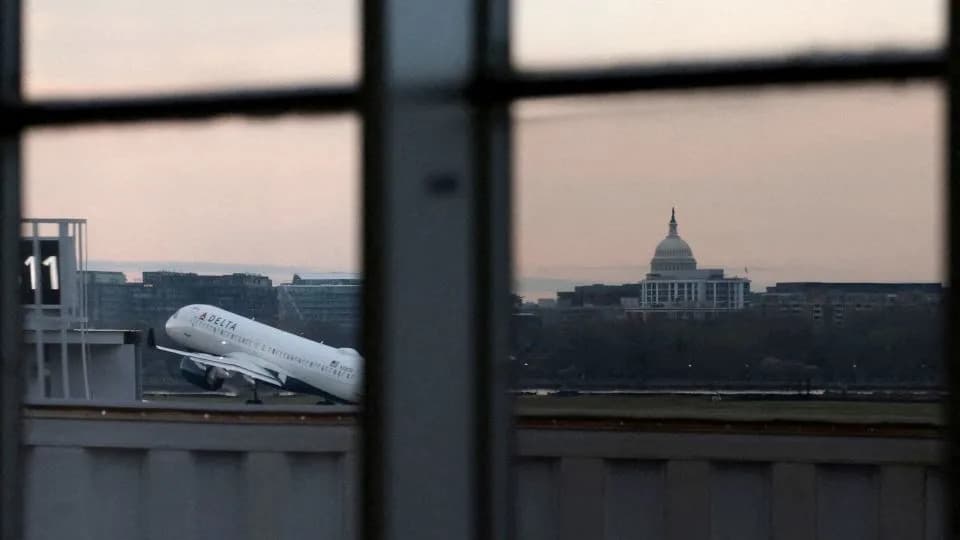
The US Capitol is seen in the distance as a plane takes off from Reagan Washington National Airport in Arlington, Virginia, on Monday. - Jonathan Ernst/Reuters
The impasse over funding for the Department of Homeland Security (DHS) looks close to being resolved as lawmakers move toward a tentative agreement driven in part by growing airport disruptions and mounting public pressure.
Details remain unsettled and nothing is final. Democrats, including Senate Minority Leader Chuck Schumer, say they want concrete concessions. Some Senate Republicans complain about elements of the plan, and President Donald Trump has a history of pulling deals at the last minute. Still, negotiators on both sides have reported meaningful progress and Mr. Trump has not yet rejected the current framework outright.
What The Deal Would Do
Under the emerging framework, Congress would fund most DHS components but carve out funding for immigration enforcement — effectively separating Immigration and Customs Enforcement (ICE) and related operations from the rest of the department. In exchange, Democrats may win a handful of narrower restrictions on enforcement practices; however, the larger reforms they sought — such as broad bans on agents wearing masks, a universal code of conduct for federal agents, or a requirement that agents secure judicial warrants before searching homes — appear unlikely to be included in the near-term package.
If approved, the excluded immigration-enforcement funding would be shifted into a separate bill that Republicans would likely try to pass through the budget reconciliation process. Reconciliation requires only a simple majority in the Senate, allowing Republicans to bypass the 60-vote filibuster threshold and move forward without Democratic support.
Why Democrats Might Accept It
Accepting the deal would mean Democrats surrender much of their immediate leverage to press for sweeping changes to immigration enforcement — the very leverage that motivated the DHS funding fight. That trade-off helps explain why some Democrats will be disappointed.

President Donald Trump takes questions in the Oval Office on Tuesday. - Chip Somodevilla/Getty Images
Yet there are clear strategic incentives. Passing the partial package would spare many Democrats from having to cast a direct vote to fund the administration’s immigration-enforcement operations — a politically risky vote for members in competitive districts. More broadly, Democrats may be betting that forcing Republicans to pursue reconciliation in an election year creates political exposure for the GOP, especially if that later bill contains controversial measures that are unpopular with voters.
"The political goal of a shutdown is to create pressure points that force concessions," one political aide said. In this case, however, the disruption — including long airport lines and missed flights — has not yet resulted in a decisive concession large enough for many Democrats.
Complications Ahead
The reconciliation path is itself fraught. President Trump has demanded that the so-called "SAVE America Act" — which would include voting-related changes like requiring proof of citizenship to register to vote — be attached to any DHS deal. Reconciliation, however, is limited by strict budget rules, and the Senate parliamentarian could rule that such voting measures are out of order. It’s unclear whether the president would accept that limit or derail the whole package over it.
Republican Sen. Mike Lee warned the SAVE Act would be “essentially impossible” to pass through reconciliation, and GOP unity could further fray if the reconciliation bill includes other contentious items — for example, an additional $200 billion reportedly sought by the White House for operations related to the war with Iran. With slim Republican margins in the Senate (53-47) and House (217-214), even a few defections could sink a reconciliation effort.
Political Upside — and Risks — For Democrats
Democrats may calculate that letting Republicans carry the political burden of defending an unpopular immigration-enforcement package offers campaign ammunition ahead of the 2026 midterms. This mirrors the calculation some Democrats made during last year’s broader shutdown fight, when they stepped back and let Republicans own the fallout over failing to extend enhanced Obamacare subsidies.
That strategy isn’t foolproof. Seven months is a long time in politics, and public focus can shift quickly. Still, Democrats may prefer to trade immediate, limited gains for the chance to make Republicans pay politically in a drawn-out reconciliation fight.
As always with high-stakes negotiations, nothing is certain until votes are cast. For now, both parties appear to have settled on a path forward — but major obstacles remain, and the final outcome could still change in the days ahead.
Help us improve.





















