
The James Webb Space Telescope has uncovered enigmatic objects called Little Red Dots (LRDs) with a distinctive V-shaped spectrum that were first thought to be accreting black holes. A new arXiv study suggests many LRDs could instead be globular clusters in formation, temporarily dominated by an extremely luminous, short-lived Supermassive Star. The model reproduces matches in number density (≈0.3 per cubic megaparsec) and redshift distribution but still struggles with spectral-transition details and atmospheric physics below ~7,000 K. Definitive confirmation will come from JWST spectroscopy that finds globular-cluster-like abundance patterns such as He/N enhancements or Na–O anti-correlations.
Are JWST's 'Little Red Dots' Baby Globular Clusters? A New Study Proposes a Surprising Alternative
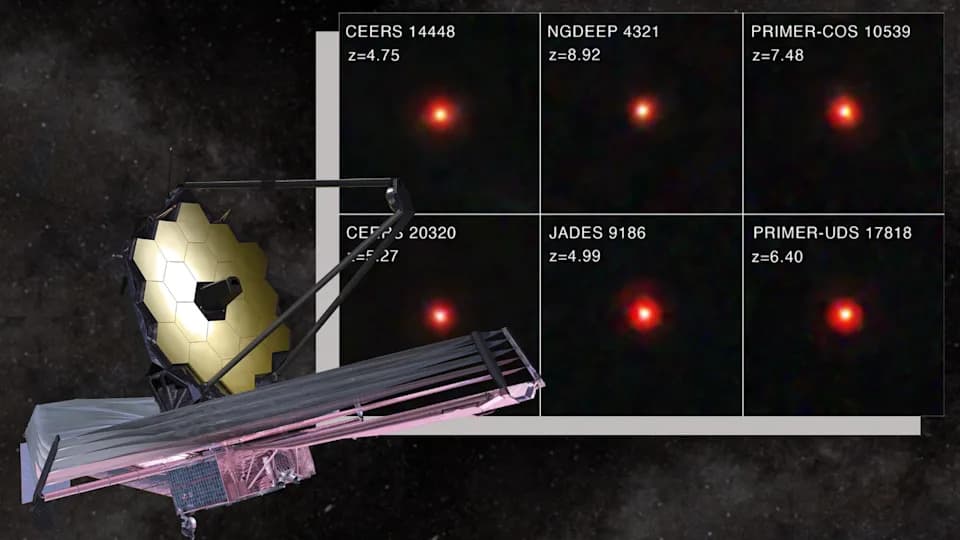
An illustration shows the JWST in space next to its observations of some of the earliest galaxies ever seen, the so-called "little red dots.". | Credit: NASA, ESA, CSA, STScI, Dale Kocevski (Colby College)/ Robert Lea (created with Canva)
The James Webb Space Telescope (JWST) has revealed a puzzling population of tiny, very red sources that astronomers have nicknamed the "Little Red Dots" (LRDs). These objects lie at extreme cosmological distances, so their light is stretched to longer, redder wavelengths by the expansion of the universe. Their unusual V-shaped spectra — a blue ultraviolet continuum that turns sharply into red optical emission — have prompted fresh debate about their nature.
Early speculation favored accreting black holes (active galactic nuclei) as the source of the compact, intense emission. But as more JWST data arrived, the LRDs showed systematic differences from known populations of accreting black holes, motivating alternative explanations.
Globular Clusters in the Act of Formation?
A new study posted to arXiv proposes a provocative idea: rather than infant black holes, many LRDs could be globular clusters caught during their formation. In this scenario, each LRD is a young, dense stellar system whose integrated light is dominated by a newborn stellar population and, crucially, by a short-lived, extremely luminous object called a Supermassive Star (SMS).
Supermassive Stars are hypothetical, very massive and very bright stars that would shine intensely but live only briefly. If present in a forming cluster, an SMS could shape the cluster's integrated spectrum and produce the distinct V-shaped profile seen in many LRDs.
Matches to Observations
The forming-cluster model offers several appealing matches to current observations. The number of LRDs observed at particular redshifts evolves into a present-day abundance similar to the populations of globular clusters seen around nearby galaxies. The authors estimate an integrated number density across cosmic time of roughly 0.3 per cubic megaparsec — a value comparable to the local space density of globular clusters.
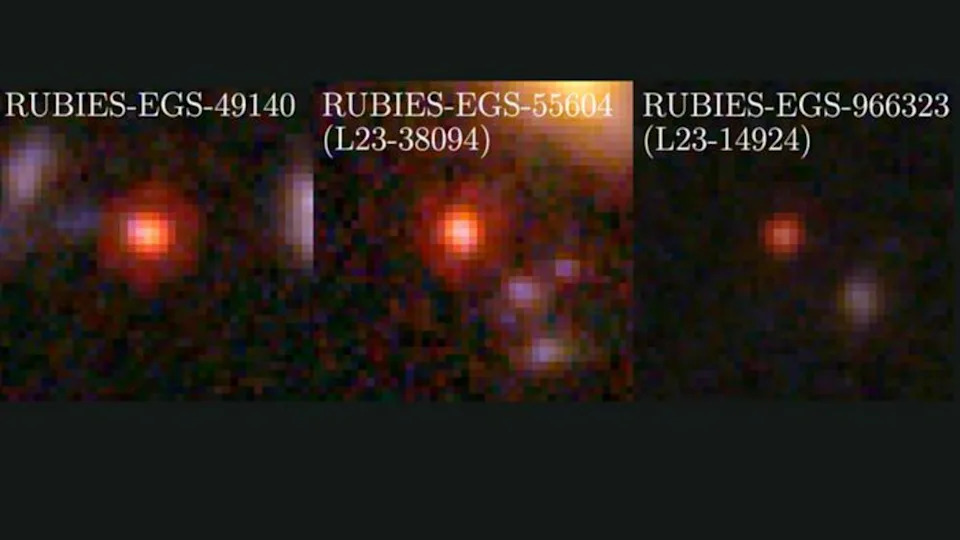
Mysterious objects or "little red dots" seen in the early universe by the JWST. | Credit: JWST/NIRSpec.
In addition, the redshift distribution of LRDs lines up with the age distribution of metal-poor globular clusters, which are commonly associated with the Universe’s earliest phases of structure formation. Those two points together make the hypothesis a strong and testable alternative to the black-hole interpretation.
Outstanding Challenges
However, the model does not yet reproduce every detail. The transition region of the V-shaped spectrum remains imperfectly matched, and the observed temperatures and luminosities of LRDs suggest powerful stellar winds and atmospheric physics that current SMS models do not fully capture. In particular, observed LRDs appear cooler and more luminous than the simplest SMS atmosphere models predict.
Refinements in theory are needed. Adding molecular opacities, extending atmosphere calculations to include stars cooler than roughly 7,000 K, and implementing more realistic wind physics could reconcile many of the remaining discrepancies.
How to Test the Idea
The clearest observational test is chemical forensics. High-quality JWST spectroscopy that reveals abundance patterns characteristic of globular clusters — for example, enhanced helium and nitrogen, anti-correlations between sodium and oxygen, or aluminum–magnesium anomalies — would provide strong evidence that LRDs are indeed forming globular clusters with multiple stellar generations.
If confirmed, LRDs would offer direct snapshots of cluster assembly, reveal new regimes of extreme stellar astrophysics, and potentially be visible even earlier in cosmic history, helping us study some of the universe’s first stellar generations. For now, LRDs remain promising cosmic time capsules whose full story will require improved models and targeted JWST follow-up.
Note: The arXiv study outlines a plausible and testable pathway but does not yet conclusively rule out accreting black holes for all LRDs. Continued observations and improved theoretical modeling are essential.
Help us improve.





















