
Iranian missiles struck the Negev towns of Dimona and Arad near Israel’s main nuclear research center, injuring more than 100 people and causing significant damage to residential buildings. Israeli authorities said they were unable to intercept the missiles; Magen David Adom reported at least 64 injured in Arad (7 serious) and about 40 in Dimona. The strikes followed an earlier airstrike on Iran’s Natanz enrichment site; the IAEA reported no abnormal off‑site radiation levels and is investigating. The attacks have raised international concern about escalation and the safety of nuclear materials.
Iranian Missiles Strike Dimona and Arad Near Israel’s Nuclear Research Center — 100+ Injured
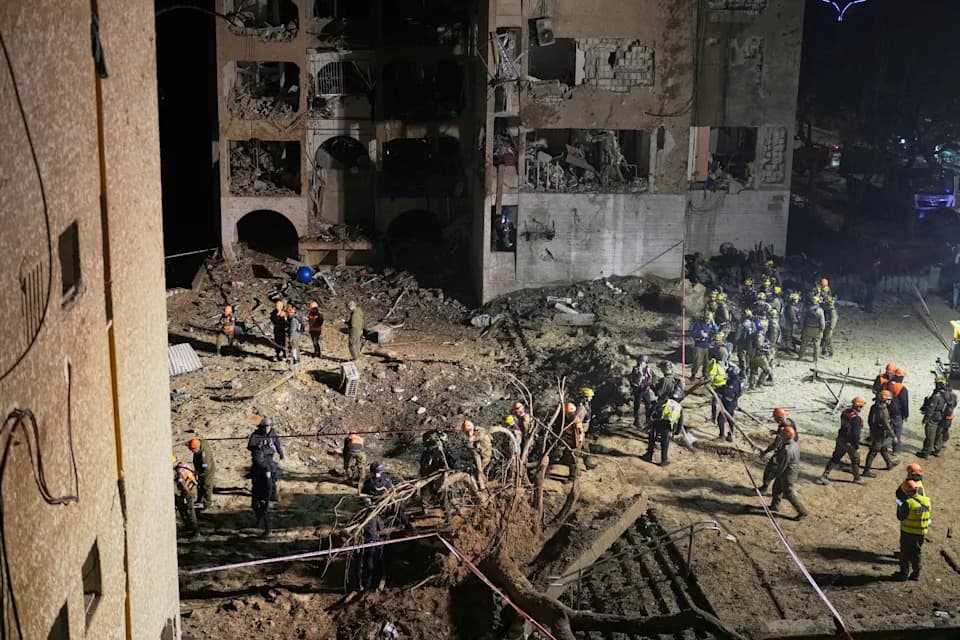
Israeli security forces and rescue teams work at the site struck by an Iranian missile in Arad, southern Israel, Sunday, March 22, 2026. / Credit: Ohad Zwigenberg / AP(Ohad Zwigenberg / AP)
Iran launched missile strikes that hit the southern Israeli towns of Dimona and Arad, injuring more than 100 people and marking the first time Israel’s primary nuclear research complex has been directly targeted since the war began three weeks ago.
Casualties and damage: Israel’s emergency service, Magen David Adom, reported at least 64 people were injured in Arad (7 in serious condition, 15 moderate, 42 mild) and about 40 were injured in Dimona. Rescue teams continued to search debris for additional casualties. Video and on-the-ground reports showed a large crater and widespread damage across at least 10 apartment buildings in Arad, with three structures badly damaged and at risk of collapse.
Military and political responses: Israeli officials said their air defenses were unable to intercept the missiles that struck both towns. Prime Minister Benjamin Netanyahu, speaking at the Arad strike site, said that the absence of fatalities was "due to luck" and accused Iran of intentionally targeting civilians. He called on world leaders to join Israel and the United States in confronting Iran, saying more international action was required.
A spokesperson for the Israel Defense Forces, Lt. Col. Nadav Shosh, condemned the strikes as reckless attacks that exposed the Iranian regime's disregard for civilian life. Iran’s Parliament Speaker, Mohammad Bagher Ghalibaf, wrote on social media that difficulties in intercepting missiles near the heavily protected Dimona area suggested the conflict had entered a new operational phase.
Nuclear safety and context: The attacks came hours after an airstrike damaged Iran’s Natanz uranium enrichment site; Iran reported no radiation leakage and Israel denied responsibility for that strike. The International Atomic Energy Agency (IAEA) said it had not received reports of damage to Israel’s research center or abnormal off‑site radiation levels. The agency is reportedly investigating the Natanz incident.
Natanz and other Iranian nuclear facilities have been struck previously during recent confrontations. The IAEA has noted that most of Iran’s estimated enriched uranium inventory is believed to be stored at other sites, including Isfahan, which sustained damage in past strikes.
International implications: U.S. media reports say the U.S. administration has been exploring options to secure or extract Iranian nuclear material, though no decision has been reported. The strikes have heightened fears of a broader escalation in the Iran–Israel confrontation and drawn renewed international attention to the risks posed to civilian populations and nuclear facilities.
The situation remains fluid: emergency responders are continuing recovery operations, and international agencies are seeking more information about both the Iranian and Israeli incidents.
Help us improve.





















