
Iran has said it will permit Japanese vessels to transit the Strait of Hormuz, signaling a shift toward a selective blockade rather than a full closure. Foreign Minister Abbas Araghchi told Kyodo News Tehran will allow passage for countries it does not consider enemies and is negotiating safe-route arrangements with Tokyo. Lloyd's List reports about 10 ships have used a coastal "safe corridor," while the IRGC is moving toward a formal vetting and registration system for transits.
Iran Offers Safe Passage For Japanese Ships Through Strait Of Hormuz, Signals Selective Blockade
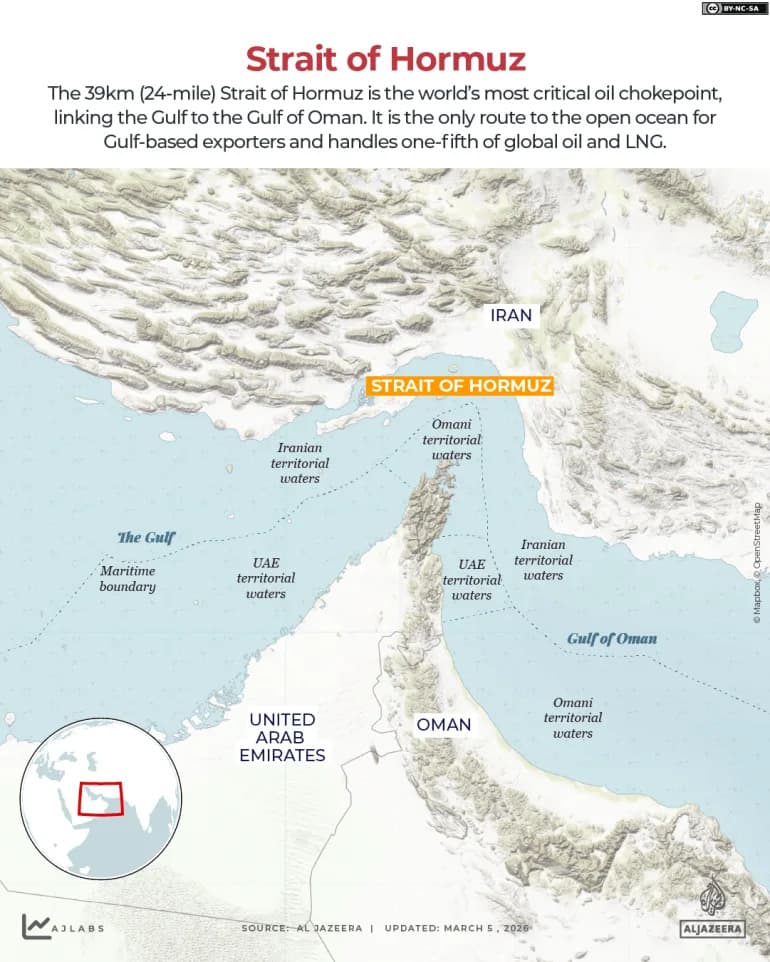
INTERACTIVE - Strait of Hormuz - March 2, 2026-1772714221
Iran has announced it will allow Japanese vessels to transit the Strait of Hormuz, an indication that Tehran is pursuing a selective — rather than total — closure of the strategic waterway.
“We have not closed the strait. In our opinion, the strait is open. It is closed only to ships belonging to our enemies, countries that attack us. For other countries, ships can pass through the strait,” Iranian Foreign Minister Abbas Araghchi told Japan’s Kyodo News.
Araghchi said Tehran is in discussions with Tokyo to arrange secure transit. “We are talking to them to find a way to pass safely. We are ready to provide them with safe passage. All they need to do is contact us to discuss how this route will be,” he added, according to an English transcript of the interview posted on his Telegram account.
Why This Matters
Japan sources more than 90% of its crude oil from the Middle East and relies heavily on shipments that pass through the Strait of Hormuz. Disruption to traffic through the strait has major implications for global energy markets and maritime trade.
Recent Developments
The waterway has been effectively disrupted since the strikes by the United States and Israel on Iran on February 28, after which the Islamic Revolutionary Guard Corps (IRGC) warned that it would target ships it deems hostile. Initial warnings prompted a near standstill in maritime traffic.
Over the past week Tehran has softened its public rhetoric, clarifying that the strait is closed only to countries it considers enemies. If talks with Tokyo are successful, Japan could join a small group of countries — notably China, India and Pakistan — whose vessels have recently been permitted to transit with Iran's approval.
Maritime intelligence service Lloyd’s List reported that 10 ships have transited by hugging Iran’s coastline, an approach being described as an emerging “safe corridor.” The most recent passage involved a Greek bulk carrier that sailed near Larak Island and broadcast the message: “Cargo Food for Iran.”
Lloyd’s List also says the IRGC is working on a more formal vetting and registration system to manage approvals, moving beyond ad hoc, case-by-case decisions.
Diplomatic Pressure And Next Steps
A number of countries, including U.S. allies and regional partners, have been urging Tehran to reopen the strait or permit safe passage for their vessels. Japan, France, Germany, Italy, the Netherlands and the United Kingdom issued a joint statement offering to help ensure safe transit through the Strait.
Araghchi’s remarks to Kyodo followed a call with Japanese Foreign Minister Toshimitsu Motegi, in which Tokyo expressed concern about many Japanese ships stranded in the Gulf, according to a Japanese readout of the conversation.
The situation remains fluid: approvals appear to be emerging through direct diplomatic channels while Iran develops formal procedures for vetting ships that seek to use the coastal corridor.
Help us improve.





















