
New JWST Observations Suggest a Sulfur-Dominated Exoplanet. Astronomers report evidence that L 98-59 d, a planet about 1.6 Earth radii orbiting a red dwarf 35 light-years away, has a sulfur-rich atmosphere and a partly molten, low-density interior. The likely presence of hydrogen sulfide points to a global magma ocean and planetary chemistry unlike known small-planet types. Though hostile to life, the finding broadens exoplanet classification and showcases JWST's atmospheric capabilities.
JWST Reveals a 'Sulfur World': L 98-59 d May Be a Rotten-Egg–Scented Magma Planet
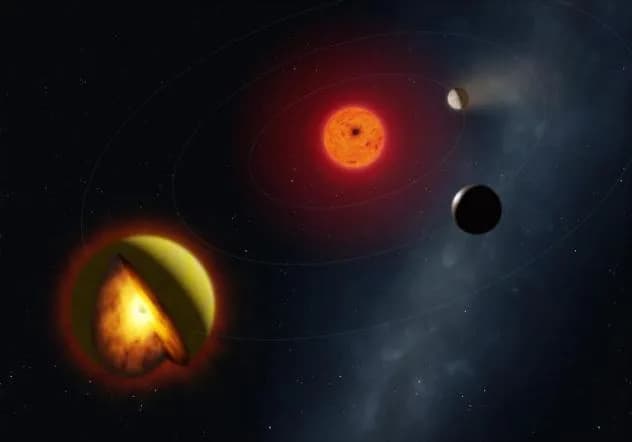
An artist’s impression of L 98-59 d. (Image Credit: Mark A. Garlick / markgarlick.com)
A newly identified exoplanet is giving astronomers a vivid reminder that planets beyond our solar system can be stranger than we imagined — and possibly smell awful. Using spectroscopy from NASA's James Webb Space Telescope, researchers report in Nature Astronomy evidence that L 98-59 d has a sulfur-dominated atmosphere and a partly molten interior.
A Strange Planet Close By
L 98-59 d orbits a small red dwarf roughly 35 light-years from Earth. At about 1.6 times Earth's radius, the planet's unusually low bulk density suggests its interior may not be fully solid. The study's authors propose that much of the planet could be covered by a global magma ocean rich in dissolved sulfur.

AccuWeather.com
Sulfur in the Air (and Below)
JWST's spectral data show signatures consistent with sulfur-bearing gases, including hydrogen sulfide (H2S). On Earth H2S is associated with volcanic vents and decaying organic matter and is known for its pungent 'rotten egg' odor. If hydrogen sulfide and other sulfur gases are truly abundant in L 98-59 d's atmosphere, the planet would be extremely hostile to life as we know it and would present a toxic, high-temperature environment.
"This discovery suggests that the categories astronomers currently use to describe small planets may be too simple," said study lead author Dr. Harrison Nicholls of the University of Oxford. "While this molten planet is unlikely to support life, it reflects the wide diversity of the worlds which exist beyond the solar system."
Why This Matters
Finding a world with dominant sulfur chemistry is important for several reasons: it expands the taxonomy of small exoplanets beyond the familiar rocky, icy or water-rich types; it offers clues about planetary formation and interior–atmosphere interactions; and it demonstrates JWST's ability to probe the chemistry of nearby alien atmospheres. The detection of sulfur compounds also helps scientists reconstruct how materials like rock and gas exchanged and evolved over billions of years on that world.
Looking Ahead
Although L 98-59 d is far too hostile for known life, the discovery highlights the variety of planetary outcomes possible in the galaxy. Future observations with JWST and other telescopes will test and refine the sulfur-rich interpretation, search for additional molecules, and look for more examples of unusual planet types — some of which may be visually strange or, as headlines suggest, pungently so.
Help us improve.





















