
L 98-59 d, a nearby exoplanet about 34 light-years away, is covered by a global magma ocean and enveloped in a hydrogen-dominated but sulfur-rich atmosphere that includes roughly 10% hydrogen sulfide. The molten layer constitutes an estimated 70–90% of the planet's interior radius, reaching depths of 2,775–3,565 miles (4,465–5,740 km). Surface temperatures exceed 1,500°C (2,732°F), driven by a runaway greenhouse, stellar irradiation and planetary interactions, making the world uninhabitable.
Nearby 'Hellscape' Exoplanet L 98-59 d: Global Magma Ocean Beneath a Sulfur-Choked Sky
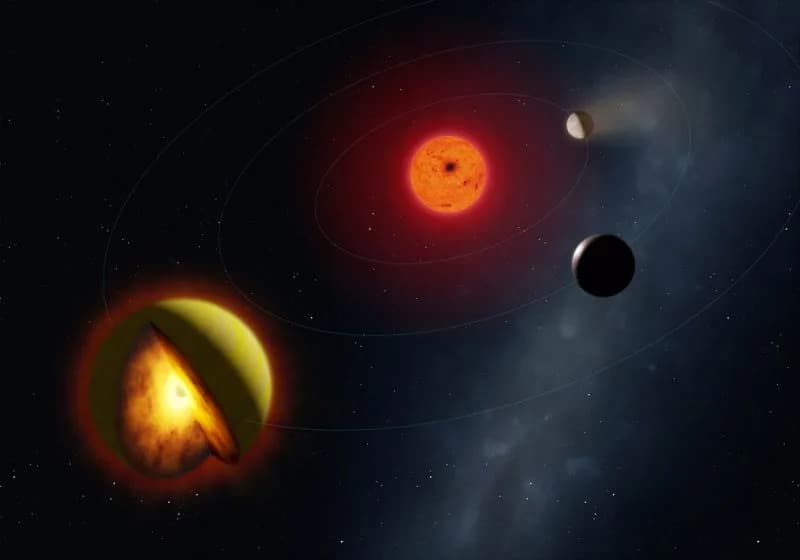
An artist’s impression of the exoplanet named L 98-59 d, shown with a cutaway to reveal its interior, orbiting a red dwarf star, with two of its sibling planets, seen in this image released on March 16, 2026. Mark A. Garlick/Handout via REUTERS
A team of astronomers has characterized an extraordinary nearby exoplanet, L 98-59 d, whose surface is a permanent ocean of magma and whose atmosphere is thick with sulfur-bearing gases. The planet presents an environment unlike any known world: a molten exterior under a hydrogen-dominated but sulfur-rich atmosphere that sustains a runaway greenhouse.
Size, Density and Location
L 98-59 d is more than 60% larger in diameter than Earth but has a mean density roughly 40% that of our planet. It orbits a red dwarf located about 34 light-years away in the southern constellation Volans. The host star has roughly 30% of the sun's mass and about 1% of its luminosity. L 98-59 d is the third of five known planets in this system.
Magma Ocean and Interior Structure
Researchers find that the planet lacks a solid crust and distinct mantle layers. Instead, a single, deep, "mushy" magma ocean dominates the outer interior. That molten layer likely contains small suspended crystals and extends to an interior radius fraction of roughly 70–90%, corresponding to a depth between about 2,775 and 3,565 miles (4,465–5,740 km). The metallic core appears relatively small by comparison.
Atmosphere and Chemistry
The thick atmosphere is hydrogen-dominated but unusually rich in sulfur compounds. Observations and modeling indicate roughly 10% of the atmosphere may be hydrogen sulfide (H2S) — a toxic, rotten-egg-smelling gas — which contributes to a powerful greenhouse effect that traps heat and keeps the surface molten. The high sulfur abundance in the atmosphere points to a sulfur-rich interior and a mineralogy likely different from planets in our solar system.
"The planet lacks distinct structure within its magma ocean, so there is no crust, upper mantle and lower mantle. The magma ocean is a single deep, mushy layer," said Harrison Nicholls, a postdoctoral researcher at the University of Cambridge Institute of Astronomy and lead author of the study.
Origins, Age and Observations
L 98-59 d was first discovered in 2019 and was observed by the James Webb Space Telescope in 2024, with further ground-based follow-up in 2025. The research team used advanced simulations to reconstruct the planet's evolution over nearly five billion years, making it somewhat older than Earth. In this case, the persistent molten state appears to result from a combination of factors: the sulfur-rich, heat-trapping atmosphere; continued heating from the host star; and gravitational interactions with neighboring planets.
Habitability
Surface temperatures exceed about 1,500°C (2,732°F), so L 98-59 d is far too hot to support life as we know it. "Your nose can smell hydrogen sulfide at concentrations of something like one part per billion, so this would be overwhelmingly stinky. But you wouldn't survive long enough in this hot atmosphere to notice," noted Raymond Pierrehumbert, a planetary scientist and co-author.
Why It Matters
Although more than 6,100 exoplanets have been cataloged, L 98-59 d stands out for combining a global magma ocean with a sulfur-laden envelope. Such extremes provide a natural laboratory for testing models of planetary formation, atmospheric chemistry and heat transport in regimes very different from the solar system.
Help us improve.





















