
Vietnam is holding National Assembly elections to fill 500 seats, though the legislature mainly ratifies decisions made by the Communist Party. Of 864 candidates, just 65 are non-party members, down from 74 five years ago. The new Assembly will confirm leaders chosen at January's party congress, and To Lam — already reaffirmed as general secretary — is widely expected to be approved as president. Analysts say the vote will produce few surprises, but personnel choices will shape the direction of ongoing reforms.
Vietnam Votes in One-Party Parliamentary Election as New Assembly Prepares to Ratify Top Leaders
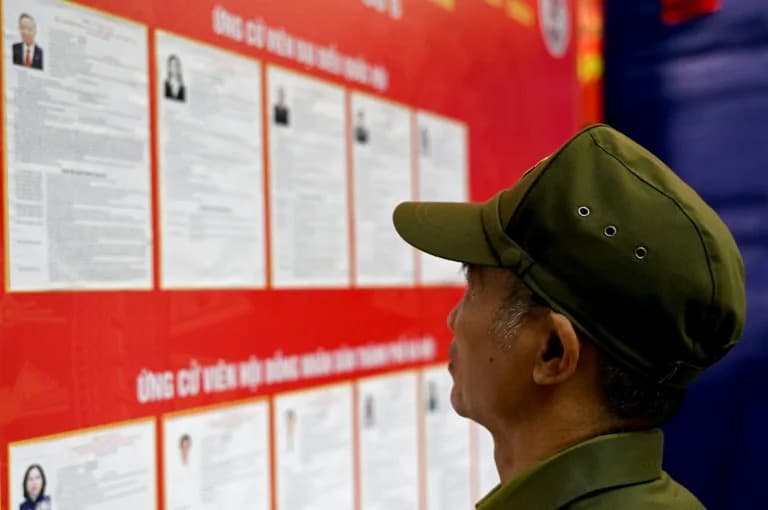
A man views the list of candidates for the upcoming National Assembly and local People's Council elections at a polling station in Hanoi (Nhac NGUYEN)(Nhac NGUYEN/AFP/AFP)
Vietnam is holding parliamentary elections on Sunday to choose members of the National Assembly, the country’s highest legislative body, which largely approves decisions made by the ruling Communist Party.
The Southeast Asian nation of about 100 million people has recorded strong economic growth — roughly 8% last year — even as it remains a one-party state that frequently cracks down on dissent. Of 864 candidates contesting 500 seats, just 65 are not members of the Communist Party, down from 74 five years ago.
In Hanoi, streets are draped with red-and-yellow banners promoting the vote as a "national festival" in which people "eagerly cast ballots." Yet many Vietnamese view the election with indifference because major policies and projects are decided by senior party cadres rather than by the legislature.
"I don't vote because I think my vote doesn't matter," said Phuong Anh, 25, who works in an administrative role in Da Nang. "People feel they have to accept whoever ends up in those positions because that's how the system functions."
Quynh Anh, 24 and based in Ho Chi Minh City, said she might vote this time out of curiosity: "I wouldn't say I'm very excited, but it's a new experience I haven't had, so I'm curious to try it and see what it's like."
No Surprises
One of the new Assembly's first tasks when it convenes next month will be to formally confirm top officials already selected by the Communist Party at its twice-a-decade congress in January. Top leader To Lam was reaffirmed as general secretary and is widely expected to be approved by lawmakers as president — a post that requires parliamentary confirmation.
"As more or less a window-dressing institution, there won't be any big surprises at the vote," said Nguyen Khac Giang of the ISEAS–Yusof Ishak Institute in Singapore. He added, however, that the selections for the presidency, prime minister and other senior posts will have important consequences for the direction of economic and political reforms.
During nearly two years at the party's helm, To Lam has pursued a rapid agenda: cutting bureaucratic red tape, pushing major infrastructure investments and seeking to sustain the economy's momentum. The January party congress endorsed his vision and elevated several of his allies to key decision-making roles, though the party did not publicly name every element of its collective leadership "pillars." If To Lam secures both the party and state leadership posts, he would be the first to have those top two roles chosen directly at a party congress rather than rising to one after a predecessor's death.
While the election is unlikely to change Vietnam's political direction in the short term, the composition of the new Assembly and its confirmation of senior personnel will matter for how boldly the country pursues economic reforms and large infrastructure projects. Public interest remains mixed, and domestic observers will watch turnout and the post-election appointments for signs of policy continuity or change.
Help us improve.





















