
SN 2024afav, a Type I superluminous supernova about one billion light-years away, showed four distinct post-peak brightness oscillations that accelerated over time. Astronomers modeled the pattern as energy from a newborn magnetar modulated by Lense–Thirring precession of a misaligned fallback accretion disk — a general-relativistic effect. From the light curve they infer a neutron star spin of ~4.2 ms and a magnetic field of ~1.6 × 10¹⁴ gauss, providing strong evidence that magnetars can power some superluminous supernovae.
Newborn Magnetar ‘Chirps’ Reveal Einsteinian Wobble in Superluminous Supernova SN 2024afav
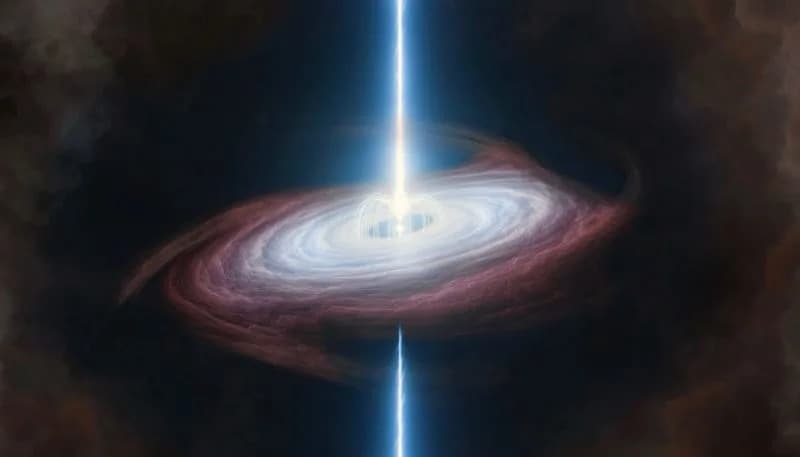
Artist’s conception of a magnetar surrounded by an accretion disk that is wobbling, or precessing, because of the effects of general relativity. Some models of magnetars suggest that high-speed jets of charged particles emanate from the magnetar along its rotation axis. (CREDIT: Joseph Farah and Curtis McCully/Las Cumbres Observatory)
When the supernova SN 2024afav flared into view roughly one billion light-years from Earth, its light behaved in an unexpected way. After reaching peak brightness, the supernova faded in a sequence of rhythmic pulses — four clear bumps (and possibly a fifth) — each arriving a little faster than the last, producing a tightening, chirp-like pattern.
Astronomers say this distinctive light curve provides the strongest direct evidence so far that some of the universe’s brightest stellar explosions are powered by newborn magnetars: highly compact, rapidly spinning neutron stars with exceptionally strong magnetic fields. The team’s results, published in Nature, also point to a role for general-relativistic frame dragging (Lense–Thirring precession) in shaping the visible light from a supernova for the first time.
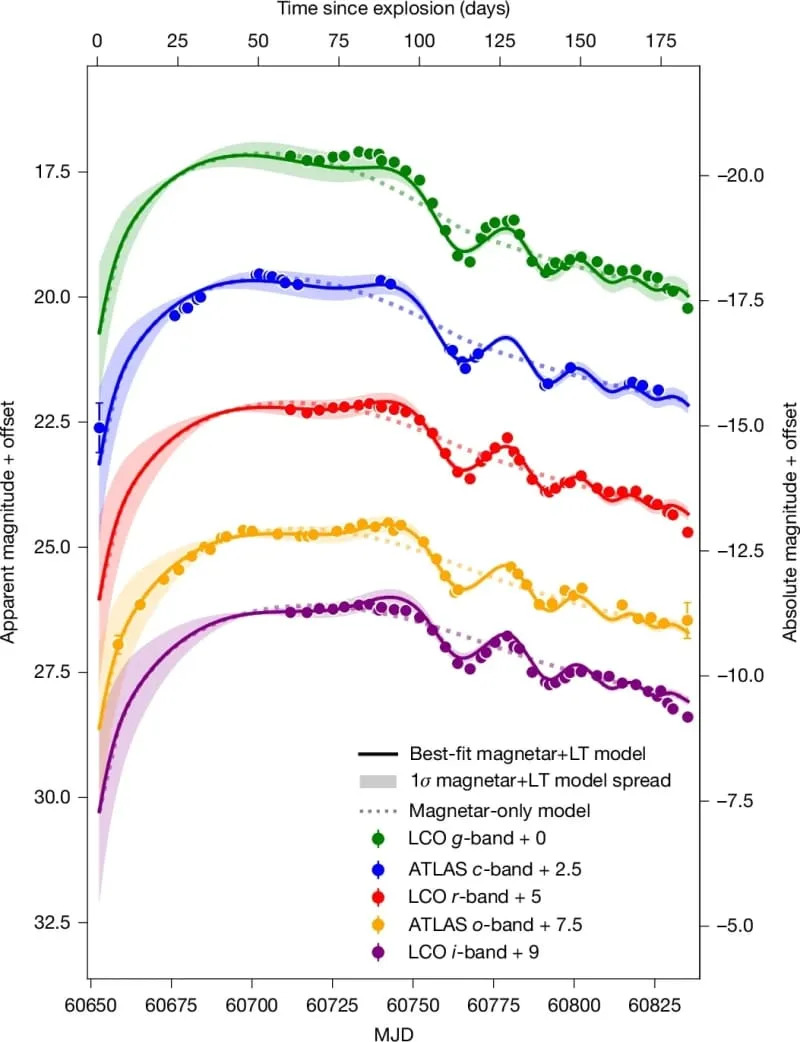
Multiband light curves of SN 2024afav. The combined LCO + ATLAS + KeplerCam light curves of SN 2024afav, from shortly after explosion to about 125 days post-peak. (CREDIT: Nature)
What the data show
SN 2024afav was discovered on Dec. 12, 2024, by the Gravitational-wave Optical Transient Observer collaboration and classified as a Type I superluminous supernova. Las Cumbres Observatory then monitored the object with its global network of 27 telescopes for about 200 days. The source lies at roughly 327 megaparsecs — nearly one billion light-years — from Earth.
Instead of the typical smooth exponential decline after peak brightness, the light curve showed four distinct modulations with steadily shortening intervals between pulses. Earlier superluminous events had shown one or two bumps at most, and without a clear trend of decreasing spacing.
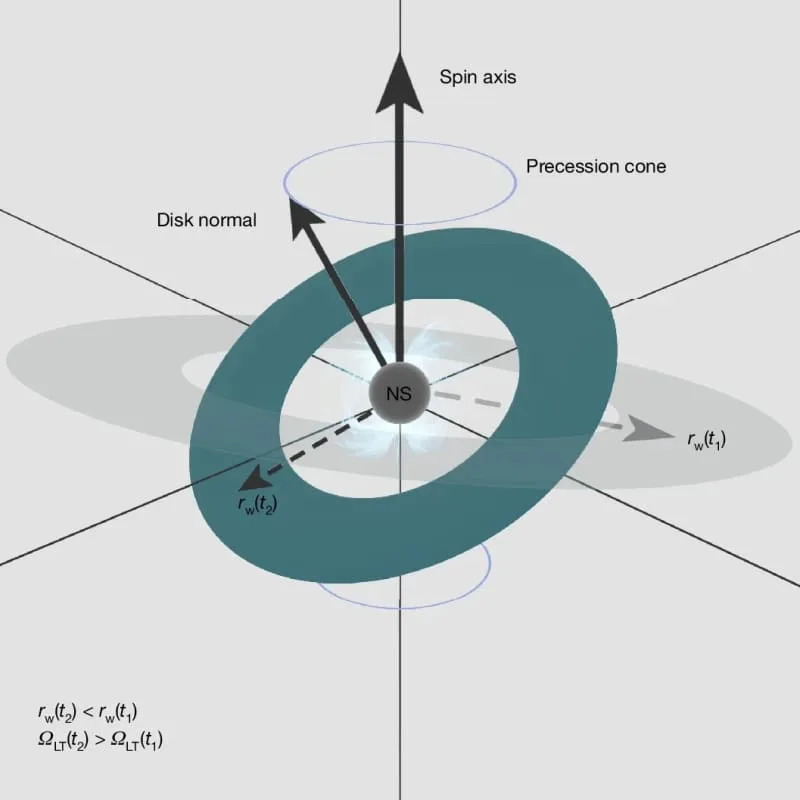
Diagram of disk infall and precession. Schematic diagram showing the physical picture motivating the magnetar+LT model. The magnetar is shown in the centre of the grid (grey sphere, NS), producing emission that is modulated along the observer’s line of sight by an accretion disk (blue annulus). (CREDIT: Nature)
How the team explains the chirps
Joseph Farah, a graduate student at UC Santa Barbara and lead analyst on the project, tested many possible explanations: simple Newtonian effects, magnetic-field-driven precession, interactions with circumstellar material, and others. None matched the observed timing and acceleration of the pulses as well as a model invoking Lense–Thirring precession, an effect predicted by Einstein’s general relativity in which a spinning massive object drags the local spacetime and forces nearby orbits to precess.
The proposed scenario is as follows. Some fraction of the supernova ejecta falls back and forms an accretion disk around the compact remnant — a newly formed neutron star (magnetar). If that disk is tilted relative to the magnetar’s spin axis, relativistic frame dragging causes the disk to wobble (precess). As the disk material spirals inward, the precession rate increases, producing progressively shorter wobble cycles. The changing orientation of the disk can intermittently block, reflect, or redirect energy from the magnetar, producing the observed visible-light chirps.
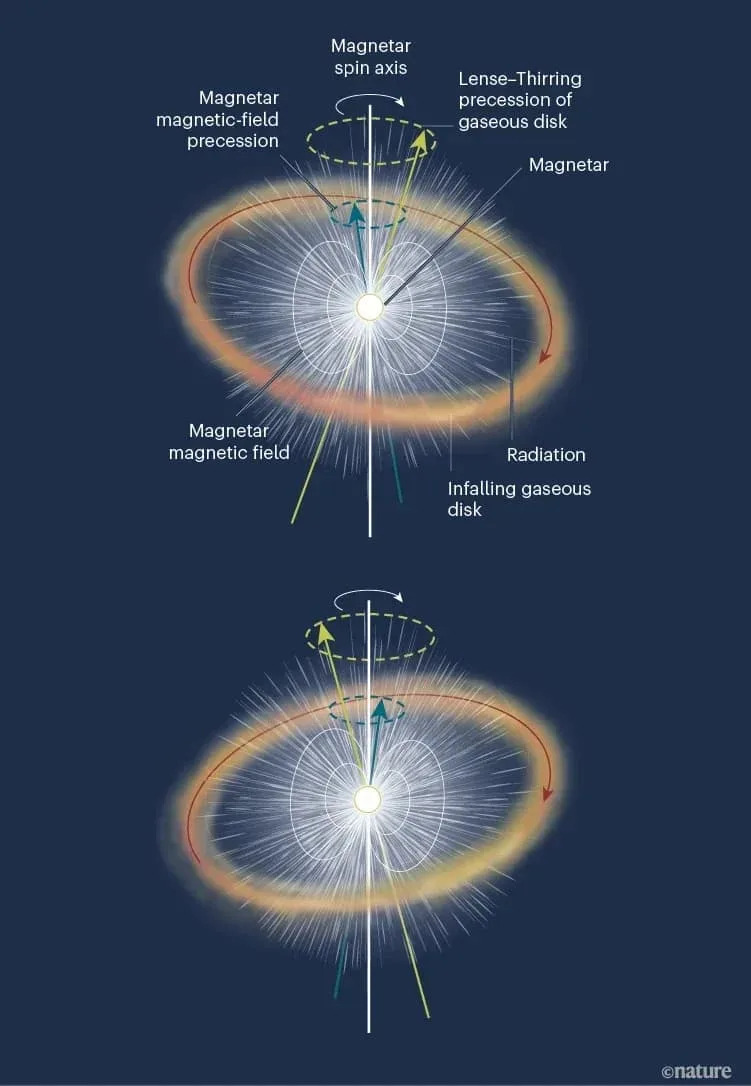
Precession around a spinning magnetar. Farah et al.2 report observations of 2024afav, an unusually bright supernova explosion, that indicate that it is powered by an ultra-magnetized neutron star known as a magnetar. (CREDIT: Nature)
“We tested many theoretical explanations... None matched SN 2024afav’s timing. The best match was Lense–Thirring precession,” said Farah.
Inferred magnetar properties
Fitting a combined magnetar-plus-Lense–Thirring model to the light curve, the team inferred a compact object spinning with a period of about 4.2 milliseconds and possessing a magnetic field near 1.6 × 10¹⁴ gauss — roughly 300 trillion times Earth’s field. These parameters are consistent with the idea that a nascent magnetar can inject sufficient energy to power a superluminous event.
Prominent coauthors emphasized the importance of the result. Dan Kasen (UC Berkeley), who earlier proposed magnetar-powered superluminous supernovae, said the data allow a firm conclusion that a significant magnetar component shaped the light. Andy Howell (Las Cumbres Observatory) called the discovery a “smoking gun,” and Alex Filippenko (UC Berkeley) described the observations as conclusive evidence of a magnetar formed in a core-collapse superluminous supernova — while noting not all such explosions must share the same engine.
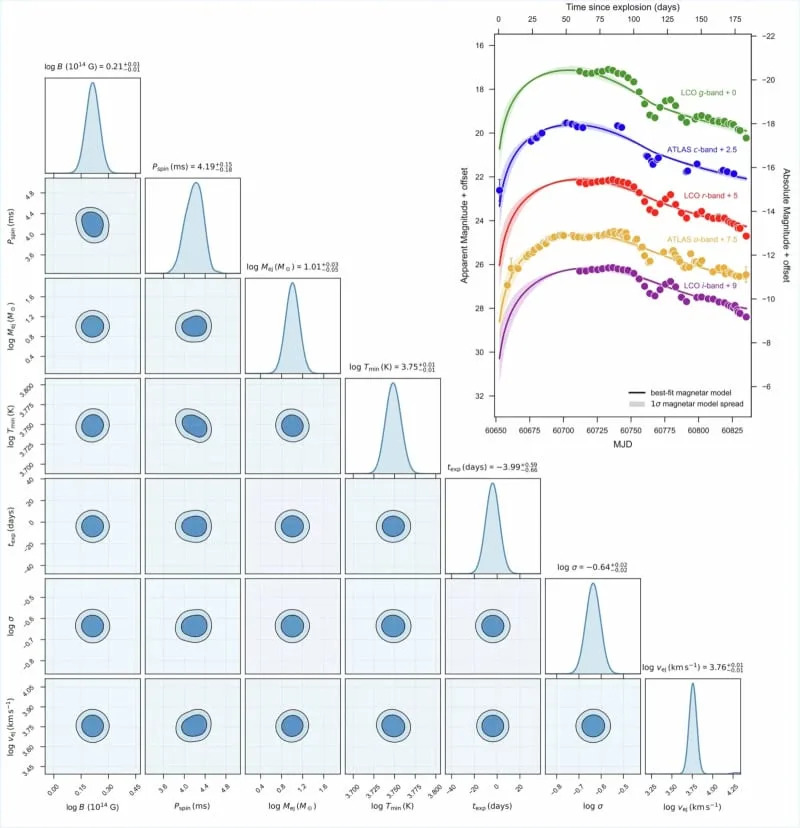
Fit to the magnetar-only model. Corner plot and posterior samples (inset) for the magnetar-only model fit to the light curve of SN 2024afav. The σ parameter (units of mag) is an extra systematic uncertainty that the model is allowed to vary to bring the fit reduced χ2 to 1. (CREDIT: Nature)
Caveats and context
The authors caution that other mechanisms can produce superluminous brightness in some events. Interaction between the supernova shock and surrounding circumstellar material (CSM) can also boost luminosity, and some core collapses may form black holes with different observational signatures. For SN 2024afav, the authors argue that reproducing four or more shrinking sinusoidal pulses via CSM interaction would require finely tuned conditions, making the central-engine (magnetar + precession) explanation simpler and more natural, though low-level CSM interaction is not ruled out.
Looking ahead, the start of the Vera C. Rubin Observatory’s full-sky survey should find many more supernovae like this one, offering additional opportunities to test magnetar models and to use chirping light curves as a tool for identifying newborn magnetars and probing relativistic effects near compact objects.
Publication: The research is published online in Nature.
Help us improve.





















