
Interstellar comet 3I/ATLAS — one of only three confirmed interstellar visitors — has been observed to contain an unusually high abundance of methanol. ALMA spectroscopic measurements taken during the comet’s close pass (when it exceeded 150,000 mph) show methanol levels far above what is typical for solar-system comets. The finding, reported on arXiv and awaiting peer review, may offer clues about the comet’s formation environment while follow-up observations, including imaging from ESA’s JUICE spacecraft, continue.
Interstellar Comet 3I/ATLAS Found Heavily Enriched In Methanol
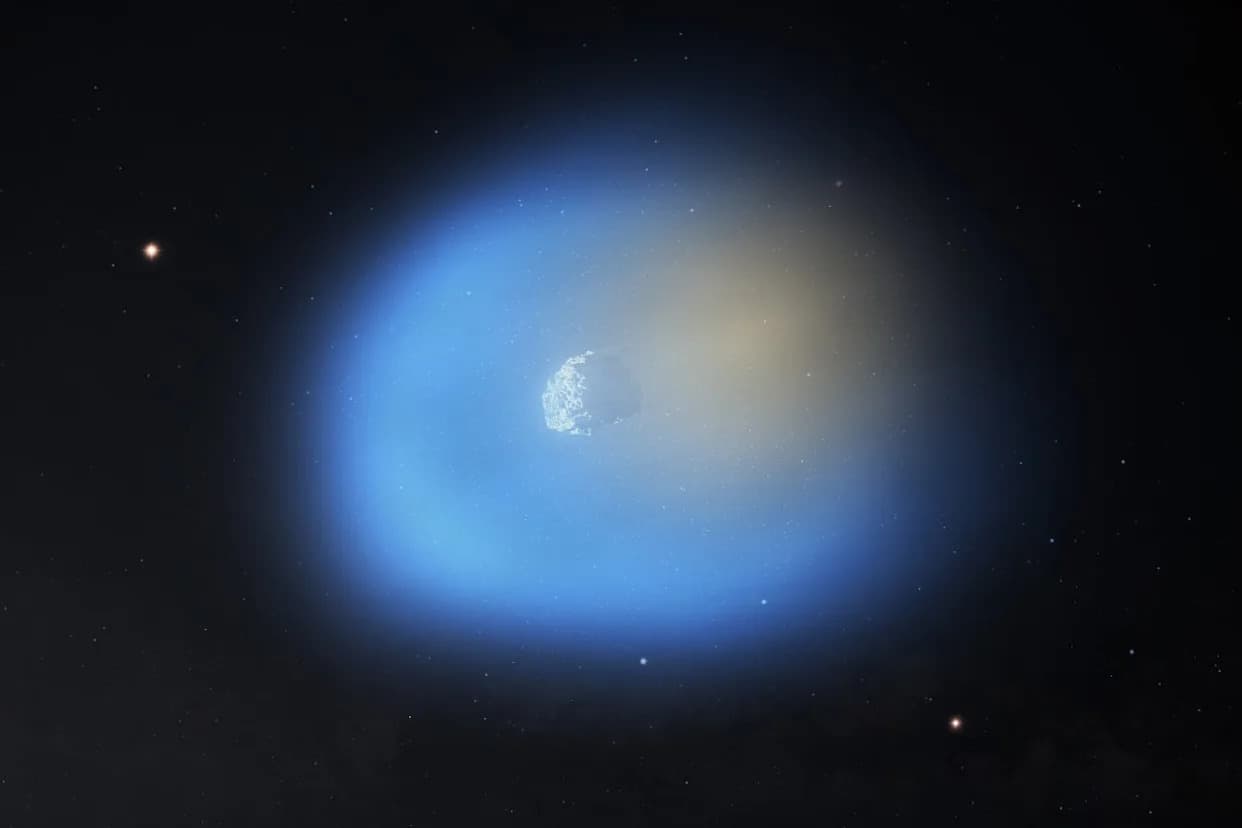
An artist’s impression of Comet 3I/ATLAS is shown as it passes near the sun.(NSF/AUI/NSF NRAO/M.Weiss)
Interstellar comet 3I/ATLAS — one of only three confirmed visitors from beyond our solar system — has been found to contain an unusually large amount of methanol, a simple alcohol-bearing molecule. Observations taken during the comet’s recent close approach to the Sun have given astronomers a rare opportunity to analyze material from another planetary system.
During perihelion last year the object sped past the Sun at more than 150,000 miles per hour, allowing ground-based telescopes to collect high-quality spectroscopic data. New measurements from the Atacama Large Millimeter/submillimeter Array (ALMA) in Chile show that 3I/ATLAS is "heavily enriched" in methanol compared with typical solar-system comets.
“Observing 3I/ATLAS is like taking a fingerprint from another solar system,” said Nathan Roth, a research assistant professor at American University. “The details reveal what it’s made of, and it’s bursting with methanol in a way we just don’t usually see in comets in our own solar system.”
Ordinarily, as comets warm near the Sun their ices sublimate and release gases such as carbon monoxide, methane and ammonia, with only modest methanol abundances. The unusually high methanol fraction in 3I/ATLAS could reflect differences in the conditions where the comet formed — for example, colder or more chemically active environments in its home system — or it could point to distinct chemical pathways during formation.
The analysis has been posted on the preprint server arXiv.org and has not yet completed peer review. Researchers stress that additional observations and modeling will be needed to pin down the comet’s birthplace and the processes that produced its distinctive chemistry.
Meanwhile, instruments in the Solar System continue to monitor the object. In February, the European Space Agency’s Jupiter Icy Moons Explorer (JUICE) returned a new image showing 3I/ATLAS, now receding from the Sun, appearing as a white, glowing, egg-shaped body as it traveled outward.
Why This Matters
Interstellar objects are rare and valuable: each one offers a direct sample of material from another star system. By comparing 3I/ATLAS’s composition with that of comets from our own system, astronomers can test models of planetesimal formation, chemical evolution in protoplanetary disks, and the diversity of planetary systems across the galaxy.
Help us improve.





















