
Iraq was quickly drawn into a regional war after US and Israeli strikes on Iran, with air raids hitting bases of Tehran-backed militias and prompting retaliatory attacks on US interests. Iran-aligned factions inside the Hashed al-Shaabi wield political influence yet often act independently and have vowed to target US bases. The Kurdistan Region, hosting US forces and Iranian Kurdish rebels, has seen repeated strikes while Baghdad and Erbil struggle to prevent escalation.
How Iraq Became a Battlefield in the Wider Middle East War
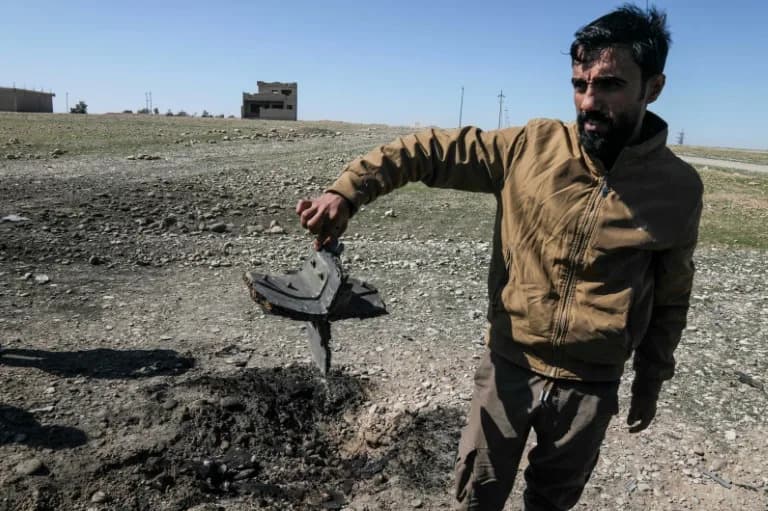
A man shows the remains of a drone at the airport in Iraq's Erbil (Safin HAMID)(Safin HAMID/AFP/AFP)
Iraq, which had begun to recover from decades of conflict, was rapidly pulled into a wider Middle East war after strikes on Iran by the United States and Israel. Within hours, warplanes and air strikes traversed Iraqi airspace, hitting bases that shelter Tehran-backed militias. Those militias then launched attacks on US interests inside Iraq, while Iran targeted Kurdish militants in the north.
Tehran-Backed Militias
Iran exercises significant influence in Iraqi politics and backs armed groups that the United States lists as terrorist organisations. Several of these factions have converted battlefield influence into political power, winning parliamentary seats and expanding their financial and institutional reach.
Many militias operate as brigades within the Hashed al-Shaabi (Popular Mobilisation Forces), a paramilitary coalition formed in 2014 to fight jihadists and later integrated into Iraq’s armed forces. Despite formal integration, some factions frequently act autonomously and coordinate under a looser umbrella often described as the Islamic Resistance in Iraq. Key groups include Kataeb Hezbollah, the al-Nujaba Movement, Kataeb Sayyid al-Shuhada and Kataeb Imam Ali. Since the conflict began, bases associated with these groups—especially those hosting Kataeb Hezbollah—have been struck multiple times.
Targets and Escalation
The Iran-aligned network has claimed numerous attacks on the “enemy” across Iraq and the region but often omits specific details. Repeated drone and rocket strikes have targeted Baghdad’s international airport, which houses a US diplomatic facility, and the US embassy in Baghdad was struck by rocket fire about a week into the fighting. Oil infrastructure in southern Basra and in parts of Iraqi Kurdistan has also been hit.
The semi-autonomous Kurdistan Region—home to US troops and a US consulate in Erbil—has been a particular focal point. Iraqi and coalition air defences now intercept drones near Erbil almost daily, and at least two hotels in the region have been targeted by unmanned strikes.
Kurdish Militants and Tehran
The Kurdistan Region hosts camps and bases used by Iranian Kurdish rebel groups that oppose the Islamic Republic, including the leftist Party of Free Life of Kurdistan (PJAK) and the Democratic Party of Iranian Kurdistan. These groups share a goal of change in Iran but differ on the desired political outcome. Some leaders have indicated pragmatic contact with US personnel in the area; for example, PJAK co-commander Amir Karimi said the group had held dialogue with Americans present in the region.
To avoid escalation, then-US President Donald Trump publicly warned against Kurdish attacks on Iran, saying he did not want to make the conflict more complex. Iran, in turn, has warned it could strike “all the facilities” in Kurdistan if militants cross into Iranian territory.
Iraqi Authorities Under Strain
Both Baghdad and Erbil insist Iraq must not be used as a launchpad for attacks on neighbouring countries, but the situation appears to be slipping beyond their control. Iraqi authorities condemned what they described as a “terrorist attack” on the US embassy, while drones have targeted Kurdish security forces amid unverified reports that the Kurdistan Region might support an incursion into Iran—claims local officials deny.
Note: Neither the United States nor Israel has publicly acknowledged conducting strikes inside Iraq, though both have been accused of doing so.
Help us improve.





















