
The conflict sparked by US and Israeli strikes on Iran has expanded beyond Iran to Cyprus, Sri Lanka, Turkey and Azerbaijan, raising fears of wider regional involvement. Reports of high‑level casualties — including unverified claims about Iran's leadership — remain disputed. Incidents include a reported sinking of an Iranian ship off Sri Lanka, drone strikes on Cyprus and Nakhichevan, and intercepted missiles toward Turkey. Analysts warn of "horizontal escalation" and potential disruptions to major maritime chokepoints.
Regional Conflict Widens After US‑Israeli Strikes on Iran — Fears of Horizontal Escalation
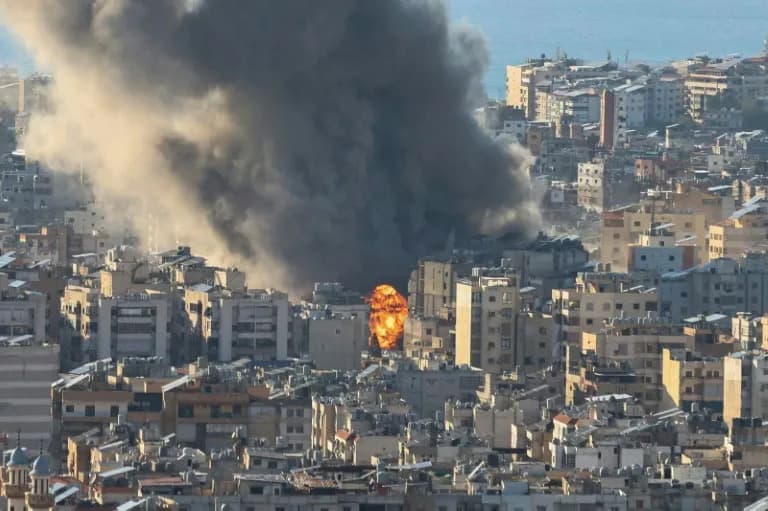
Israel bombed Beirut's southern suburbs on Monday, two days after launching strikes on Iran with the US (IBRAHIM AMRO)(IBRAHIM AMRO/AFP/AFP)
The conflict that began with US and Israeli strikes on Iran has rapidly broadened beyond Iran's borders, reaching locations as diverse as Cyprus, Sri Lanka, Turkey and Azerbaijan and raising growing concerns that additional states could become involved.
Initial reports say the strikes targeted senior Iranian figures; claims that Supreme Leader Ali Khamenei was killed remain unverified and have not been independently confirmed. Multiple sources describe the situation as a fast‑escalating, multi‑domain campaign that now includes conventional strikes, leadership‑targeting operations, economic pressure and threats to maritime traffic.
"The conflict has evolved into a high‑intensity, multi‑domain campaign with no immediate end in sight," the US‑based Soufan Center said, warning that the war has expanded well beyond direct military exchanges.
In a dramatic and contested development, several reports say a US submarine sank an Iranian warship off Sri Lanka, with Iranian authorities reporting at least 84 fatalities on board. The United States has not published independent confirmation of the incident. Iran's Foreign Minister Abbas Araghchi denounced the attack as "an atrocity at sea" and warned Washington it would "bitterly regret" setting such a precedent.
Iran has also struck targets beyond its immediate neighbourhood. An Iranian‑made drone reportedly struck a British military base in Cyprus, while NATO air‑defence systems intercepted a ballistic missile launched from Iran that was heading toward Turkey. Turkish Foreign Minister Hakan Fidan urged Tehran to avoid any actions that could broaden the conflict.
On another front, at least two drones that crossed from Iran attacked Azerbaijan's Nakhichevan exclave. Azerbaijan, an ally of Israel, vowed the incident "will not go unanswered." A European military source told AFP that Iran appears to be "striking out everywhere, targeting potential allies or potentially neutral countries" — possibly to raise the economic and political costs for the United States and its partners.
Iran‑backed Lebanese group Hezbollah has opened a second front with strikes on Israel. Israel's retaliatory strikes in Lebanon have, according to Lebanese authorities, killed dozens of people. Analysts describe the pattern as "horizontal escalation": widening the war by opening new battlegrounds and targeting critical chokepoints such as the Strait of Hormuz, through which roughly one‑fifth of global crude oil transits.
US Defense Secretary Pete Hegseth has downplayed the likelihood that the Turkey incident would automatically trigger a NATO Article 5 collective‑defence response. Nevertheless, several European countries — including Britain, Greece, France and Spain — have sent military assets or support to Cyprus amid the turmoil.
Paris has said it was drawn in after an attack on an Abu Dhabi base hosting French forces, and President Emmanuel Macron ordered the aircraft carrier Charles de Gaulle deployed to the Mediterranean. Washington has also publicly pressured allies: according to reports, US officials criticized initial hesitancy from some partners and pushed for access to regional bases.
Analysts warn that the conflict could widen further if Iran‑aligned groups such as the Houthis in Yemen take action to disrupt shipping through the Bab‑el‑Mandeb Strait or directly target other countries. "The next few days will indicate whether the Houthis will follow their ideology or turn inward," said Ibrahim Jalal of the Stimson Center.
Amid competing claims and rapidly evolving events, many incidents remain independently unverified. International observers and governments are urging restraint while calling for verification of reported strikes and casualties.
Help us improve.





















