
Elbridge Colby told the Senate that the strike killing Ayatollah Ali Khamenei was an Israeli operation and not part of the U.S. military campaign. President Trump publicly praised the strikes and claimed close cooperation with Israel, while Secretary Marco Rubio described the U.S. role as reactive. Colby said U.S. objectives concentrate on degrading Iran's missile and naval capabilities, not explicitly pursuing regime change.
Pentagon Says Israel Carried Out Strike That Killed Iran’s Supreme Leader; U.S. Seeks Distance
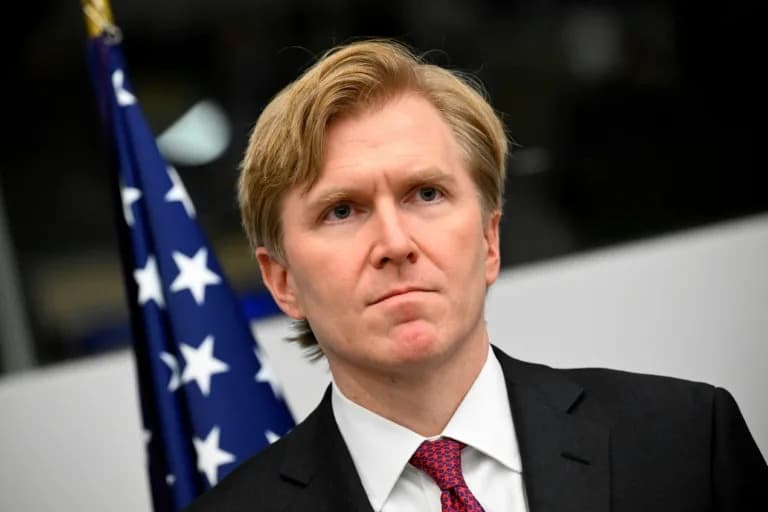
US' Under Secretary of Defense for Policy Elbridge Colby said the US objectives in Iran were 'scoped and reasonable' (JOHN THYS)(JOHN THYS/AFP/AFP)
Elbridge Colby, the Pentagon's policy chief, told the Senate Armed Services Committee that the strike which killed Iran's Supreme Leader, Ayatollah Ali Khamenei, and other senior Iranian figures was carried out by Israel and was not part of the U.S. military campaign.
Key Testimony
Testifying before senators, Colby emphasized that leadership-targeted strikes cited during the hearing were Israeli operations. When pressed by lawmakers about whether U.S. actions aimed at regime change, Colby repeatedly framed American objectives more narrowly, focusing on military capabilities rather than political outcomes.
"Those are Israeli operations," Colby told the committee, stressing that U.S. military goals are limited in scope.
Contrast With Presidential Rhetoric
President Donald Trump took a more celebratory tone following the strikes, publicly praising the operations and asserting close cooperation with Israel. In social media posts, Trump claimed that Khamenei could not evade U.S. intelligence and tracking systems and described the removals of leaders as a joint success.
U.S. Reaction And Policy Stance
Secretary of State Marco Rubio said Washington acted after learning Israel planned the strike, portraying the U.S. role as reactive rather than part of a coordinated offensive. Colby outlined the U.S. military campaign's stated aims as degrading Iran's ability to project military power — particularly its missile arsenal, the infrastructure for producing those weapons, and certain naval elements — and maintained these objectives are "scoped and reasonable."
Pressed by Sen. Jack Reed about how the killing of Iran's top leader fit those goals, Colby reiterated his focus on capabilities and repeated that the leadership strikes were actions taken by Israel.
Implications
The public divergence between senior U.S. officials highlights questions about coordination, messaging, and long-term aims in the region. While President Trump publicly encouraged Iranians to seize an "unprecedented opportunity" to topple their government, senior Pentagon officials emphasized that the U.S. military campaign is intended to reduce Iran's power-projection capabilities rather than to pursue explicit regime change.
Note on sourcing: These remarks reflect testimony and public statements made by U.S. officials; independent verification and additional official disclosures are necessary to fully establish the sequence and coordination of events.
Help us improve.





















