
Pakistani nationals fled Iran via the Mirjaveh–Taftan crossing after weekend strikes on Tehran, reporting missile launches, explosions and travel chaos. AFP reporters saw a steady stream of evacuees, long freight queues and soldiers guarding the isolated border. Pakistani embassy staff assisted evacuations while Prime Minister Shehbaz Sharif issued condolences and condemned the reported killing of Ayatollah Ali Khamenei. Transport disruption and reports of casualties prompted many to leave Tehran.
Chaos at Mirjaveh–Taftan Border as Pakistanis Flee After Weekend Strikes on Tehran
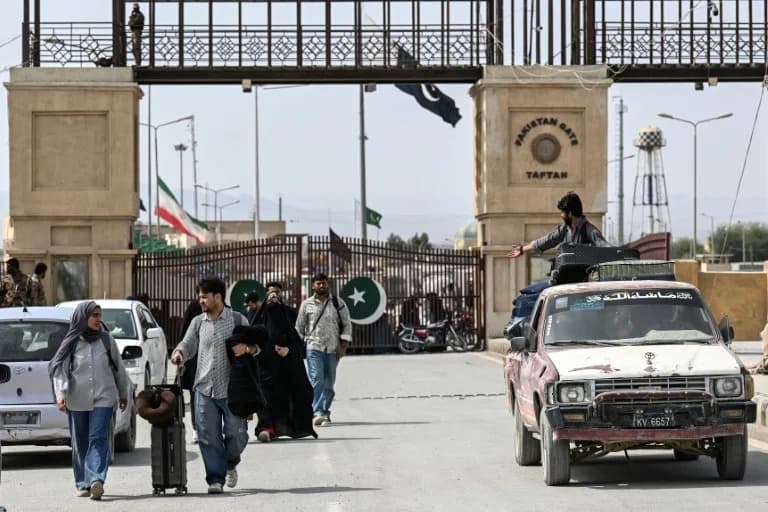
Pakistani nationals walk across the Taftan border after returning from Iran (Banaras KHAN)(Banaras KHAN/AFP/AFP)
Pakistani nationals streamed through the remote Mirjaveh–Taftan border crossing after weekend strikes rocked Tehran, reporting missile launches, explosions and chaotic travel as they fled neighbouring Iran.
AFP reporters observed a steady flow of people passing through large metal gates at the isolated frontier between Mirjaveh (Iran) and Taftan (Pakistan) in western Balochistan. Soldiers stood guard at the crossing and the Iranian flag was seen flying at half-mast.
Most arrivals pushed bulky luggage across the pedestrian gate while freight lorries formed long queues. The Taftan crossing lies roughly 500 kilometres (310 miles) from Quetta, Balochistan's capital and largest city.
Trader Ameer Muhammad, 38, told AFP: "All our Pakistani brothers who were in Tehran and other cities had started to leave and were arriving at the terminal, which caused a lot of crowd pressure. Due to the crowds, there were major transport problems."
Pilgrim Irshad Ahmed, 49, said he had been staying in a Tehran hostel near an army base when he saw missiles being fired. "There was an army base near the hostel, and we saw many missiles being fired. After that, we went to the Pakistani embassy so that they could evacuate us from there. They brought us here safely," he said.
A teacher at Tehran's Pakistani embassy who gave his name as Saqib told AFP that conditions seemed normal before the strikes but that attacks on Saturday night "pushed us to leave the city" and "caused precious lives to be lost," according to his account.
Pakistan's Prime Minister Shehbaz Sharif issued a strong reaction to the developments, condemning what he described in his statement as the killing of Ayatollah Ali Khamenei and calling it a "violation" of international law. He wrote on X that "the people of Pakistan join the people of Iran in their hour of grief and sorrow and extend the most sincere condolences on the martyrdom" — a formulation reflecting his response as reported.
Embassy staff and Pakistani authorities helped organise evacuations amid heavy crowding and transport disruption at the crossing, as evacuees continued to arrive seeking safety and onward travel arrangements.
Help us improve.





















