
Summary: President Trump’s recent disclosures—that he takes 325 mg of aspirin daily, underwent an October cardiovascular CT that the White House says was normal, and gets little sleep—have renewed scrutiny of his health. Dr. Sean Barbabella, named to oversee the president’s care in March, defends the testing and preventive strategy, saying Trump’s cardiovascular profile appears younger than his age. Independent experts warn that long-term full-dose aspirin increases bleeding risk, CT scans refine but do not "prove" heart safety, and screening cognitive tests like the MoCA do not measure overall judgment or fitness for office.
Aspirin, CT Scan and Little Sleep: Five Medical Questions Raised by Trump’s Latest Health Disclosures

President Donald Trump listens during a news conference with Israel's Prime Minister Benjamin Netanyahu at his Mar-a-Lago club in Palm Beach, Florida, on Monday. - Alex Brandon/AP
President Donald Trump has sought to deflect renewed public scrutiny of his health after recent disclosures about a high-dose aspirin regimen, an October cardiovascular CT and limited sleep habits. His comments and a Truth Social post claiming a perfect cognitive-test score have prompted fresh questions about his medical care and what the tests actually show.
Below are five key medical questions raised by the president’s latest disclosures, with context from physicians and specialists who reviewed the publicly available details.
1. Who Is Overseeing the President’s Medical Care?
The White House has identified Dr. Sean Barbabella, a Navy captain appointed in March, as the physician overseeing the president’s recent evaluations. Barbabella, who served in combat trauma and emergency medicine, has described the advanced imaging and a semiannual physical this year as routine screening. He is the latest in a series of physicians who publicly vouched for Mr. Trump’s health, including Dr. Ronny Jackson, Dr. Sean Conley and Dr. Harold Bornstein.

President Trump waves from the back of a car in a motorcade outside of Walter Reed Medical Center in Bethesda, Maryland, on October 4, 2020. Trump was admitted to the hospital after contracting Covid-19. - Alex Edelman/AFP/Getty Images
2. Why Is the President Taking a High Dose of Aspirin?
Trump told the Wall Street Journal he takes 325 mg of aspirin daily—about four times the low-dose preventive amount typically recommended—because he wants “nice, thin blood pouring through my heart.” Dr. Barbabella said the aspirin is being used for cardiac prevention, and the White House has noted the president has chronic venous insufficiency, a condition that can be managed in part with antiplatelet therapy in some cases.
Many cardiologists, speaking generally and not having treated the president, cautioned that long-term full-dose aspirin (325 mg) increases the risk of gastrointestinal and other bleeding. Experts typically recommend 81 mg daily for select preventive indications and reserve higher doses for people with specific, diagnosed cardiovascular conditions.
3. What Was the “Advanced Imaging” and What Did It Show?
The White House initially said Trump had an MRI; in a later interview he said the exam was a CT scan. Barbabella has said both MRI and CT were considered and that a cardiovascular CT was performed in October and returned normal results. A coronary CT can refine long-term heart-attack risk and detect significant blockages, but specialists emphasize that a normal CT does not "prove" a heart is entirely free of risk—it helps guide prevention and further testing as needed.
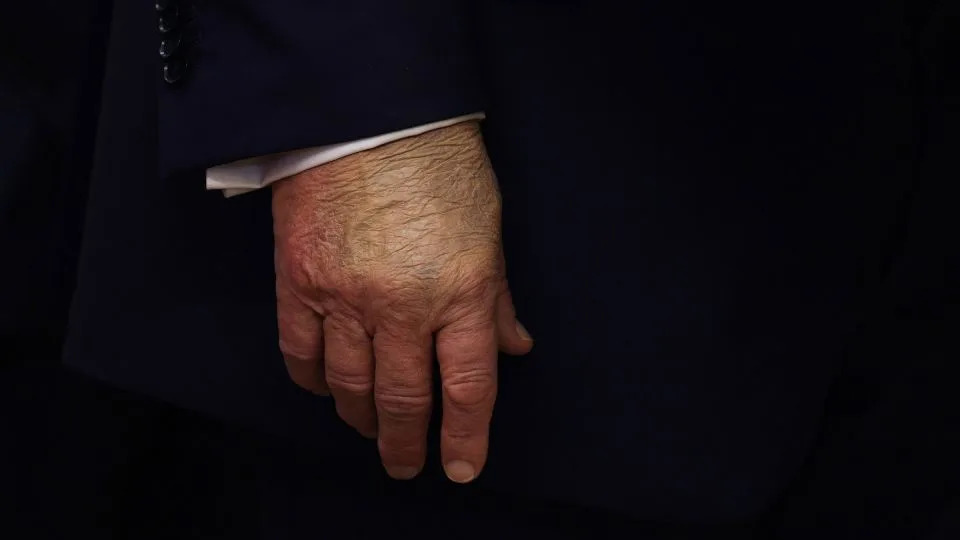
A detailed view of the hand of President Donald Trump as he speaks in the Oval Office at the White House in Washington, DC, on September 2. - Alex Wong/Getty Images
4. What Do the Cognitive Test Claims Mean?
Trump said on social media he scored “100%” on his third cognitive test, but the White House did not specify the exam. The president took the Montreal Cognitive Assessment (MoCA) in 2018 and reportedly scored 30/30 when retested in April 2025. Clinicians note that a normal MoCA indicates no obvious cognitive impairment on that screening tool, but the test does not measure intelligence, judgment, decision-making or overall fitness to serve.
5. How Do Sleep, Diet and Lifestyle Factor Into the Picture?
In interviews, the president said he gets little sleep, finds most exercise boring and has not changed a diet that includes fast-food items. Physicians warn that chronic poor sleep and an unhealthy diet can increase risks for cardiovascular disease, arrhythmia, stroke and other conditions—especially as people age. While genetics contribute to health, clinicians stress that lifestyle and environment play large roles in long-term outcomes.
Bottom line: The disclosures clarified some details—Dr. Barbabella is overseeing care, a cardiovascular CT was performed and officials describe the president as metabolically and cardiovascularly younger than his years—but they also left open important clinical questions. Experts say a single normal CT and a high MoCA score provide useful information but do not replace comprehensive, ongoing evaluation of cardiovascular and cognitive health, nor do they eliminate risks associated with high-dose aspirin or chronic sleep deprivation.
Reporting note: The article summarizes publicly disclosed statements from the White House and comments from independent clinicians who have not treated the president.
Help us improve.


