
Israeli Foreign Minister Gideon Sa'ar accused the Palestinian Authority of continuing payments that critics term "Pay‑for‑Slay" after a Palestinian attacker killed two Israelis in northern Israel. Analysts, including Kobi Michael, say PA statements about ending the payment system are largely performative and that funds may be rerouted to be less traceable. Tamkeen, a PA‑linked institution, denies the practice and says the prison‑linked payment mechanism has been abolished. Observers call for stricter donor oversight and transparency.
Israel FM Accuses Palestinian Authority Of 'Pay‑for‑Slay' Funding After Deadly Northern Israel Attack

Israel FM accuses Palestinian Authority of aiding terror with ‘Pay-for-Slay’ after deadly attack
JERUSALEM — Israeli Foreign Minister Gideon Sa'ar on Friday accused the Palestinian Authority (PA) of continuing a system of payments he says incentivizes violence after a Palestinian assailant killed two Israelis in northern Israel.
The victims were identified as Aviv Maor, 19, from Kibbutz Ein Harod and Mordechai Shimshon, 68, of Beit She'an.
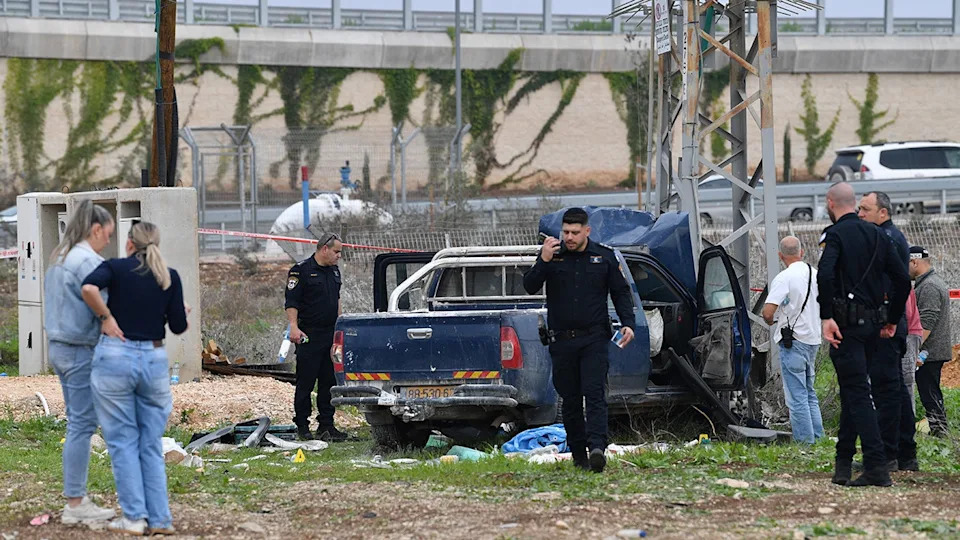
Israeli security forces inspect the scene where a vehicle was used by an assailant in a suspected terrorist attack involving a car ramming and stabbing that killed two people in Afula, northern Israel, on Dec. 26, 2025.
Accusations and Statements
Sa'ar wrote on X that the PA has not abandoned what critics call the "Pay‑for‑Slay" program and urged the international community not to accept assurances from Palestinian leadership. He said payments continue to be made to convicted attackers, their families, and released prisoners, and that some disbursements are being disguised as pensions for former Palestinian security personnel.
Gideon Sa'ar (on X): "Don't believe Mahmoud Abbas' lies. The Palestinian Authority's payments to terrorists and their families haven't stopped ... End 'Pay‑for‑Slay' now!"
Background And Reactions
The debate over payments to Palestinian attackers resurfaced publicly after the 2016 murder of Taylor Force, a U.S. veteran whose death prompted the U.S. Congress to pass the Taylor Force Act, signed into law in October 2018. The legislation conditions certain U.S. aid to the PA in response to payments to prisoners and their families.
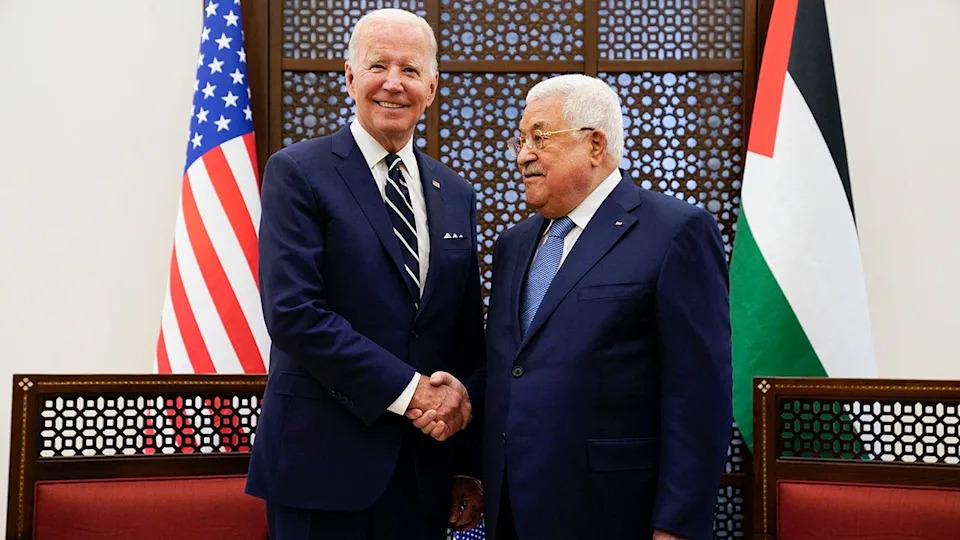
Palestinian Authority President Mahmoud Abbas meets with then-President Joe Biden in the West Bank town of Bethlehem, Friday, July 15, 2022.
Kobi Michael, a senior researcher at Israel's Institute for National Security Studies and a fellow at the Misgav Institute for National Security & Zionist Strategy, told Fox News Digital that PA declarations of reform are largely a "façade" and that there has been "no substantial change" in policy. He warned that the PA may route payments in less transparent ways, making monitoring by donors more difficult.
Michael described the PA's approach as treating those labeled "terrorists" as recipients of social welfare while continuing to allow incitement against Israel, and he called for stricter donor oversight.

A Palestinian terrorist from the Al-Aqsa Martyrs Brigades is seen carrying a weapon during a military parade in the Balata refugee camp, east of Nablus, in the northern West Bank.
PA Response
On Dec. 19, Tamkeen (The Palestinian National Economic Empowerment Institution), which is linked to the PA, disputed Israeli claims that the incentive payments persist. Tamkeen said it has "completely and permanently abolished" the payment mechanism tied to years served in prison and called assertions of its continuation deliberate misinformation.
Fox News Digital reported that it had contacted the Palestinian Authority and Tamkeen for comment but had not received substantive replies by the time of publication. The U.S. State Department and the American Embassy in Jerusalem also did not immediately respond to queries.
Implications
Analysts and Israeli officials say donor governments can increase financial transparency and place stricter conditions on aid to pressure the PA to end any support for attackers. Some critics also argue that diplomatic moves such as recognition of a Palestinian state without strong safeguards could reduce incentives for reform.
This article presents claims and counterclaims from Israeli officials, analysts, and a PA‑linked institution. Key facts — including the victims' names, the minister's accusations, the Tamkeen denial, and calls for greater donor oversight — remain central to ongoing debate and investigation.


