
California officials urge people to stop foraging wild mushrooms after 23 poisonings since Nov. 18 were linked to the death cap (Amanita phalloides). One person died; several were hospitalized, including one who received a liver transplant. Death caps contain amatoxin, a highly potent and sometimes fatal toxin. Authorities recommend avoiding foraging during this high-risk season and consulting trained mycologists rather than apps or social media.
Deadly 'Death Cap' Mushroom Cluster in California: Officials Urge Stop to Foraging
07:33 PM, 12/10/2025

One square centimeter of a death cap mushroom, also called Amanita phalloides, can contain enough toxin to be fatal. (Anne Pringle)
California health officials are warning residents to stop foraging wild mushrooms unless they are trained experts after a cluster of poisonings tied to the death cap mushroom (Amanita phalloides).
What Happened
Physicians in the San Francisco Bay Area have linked 23 poisoning cases to the death cap since Nov. 18, according to Dr. Craig Smollin, medical director of the California Poison Control System's San Francisco division. All affected people had independently foraged mushrooms in the wild and developed symptoms within 24 hours, including nausea, vomiting, diarrhea and abdominal pain.
Dr. Craig Smollin: 'All of these patients were involved with independently foraging the mushrooms from the wild.'
The cases include one death. Every patient was hospitalized at least briefly; five remain hospitalized, one has received a liver transplant, and another is on a transplant waiting list. Ages range from about 1½ to 56 years old. Several patients were part of groups who ate mushrooms from the same gathered batch; the largest such cohort numbered about seven people.
Why This Is Happening
Local mushroom hunters and mycologists report that death caps are more abundant this season in parts of California, which likely contributes to the surge in poisonings. Mike McCurdy, president of the Mycological Society of San Francisco, said variability in seasonal abundance is normal: some years a species is prolific; other years it is not.
The death cap is an invasive species that likely arrived from Europe in the 1930s with imported nursery trees. It commonly grows in association with oak trees (and sometimes pines) and is established across the West Coast, the Eastern Seaboard, and has been recorded in Florida and Texas.
Identification Challenges and Risks
Public health officials emphasize that death caps can easily be mistaken for edible mushrooms. Dr. Erica Pan, California's state public health officer, urged the public to avoid foraging during this high-risk season. Dr. Cyrus Rangan, a pediatrician and medical toxicologist, said a broad warning is necessary because most people lack the expertise to reliably distinguish safe from dangerous species.
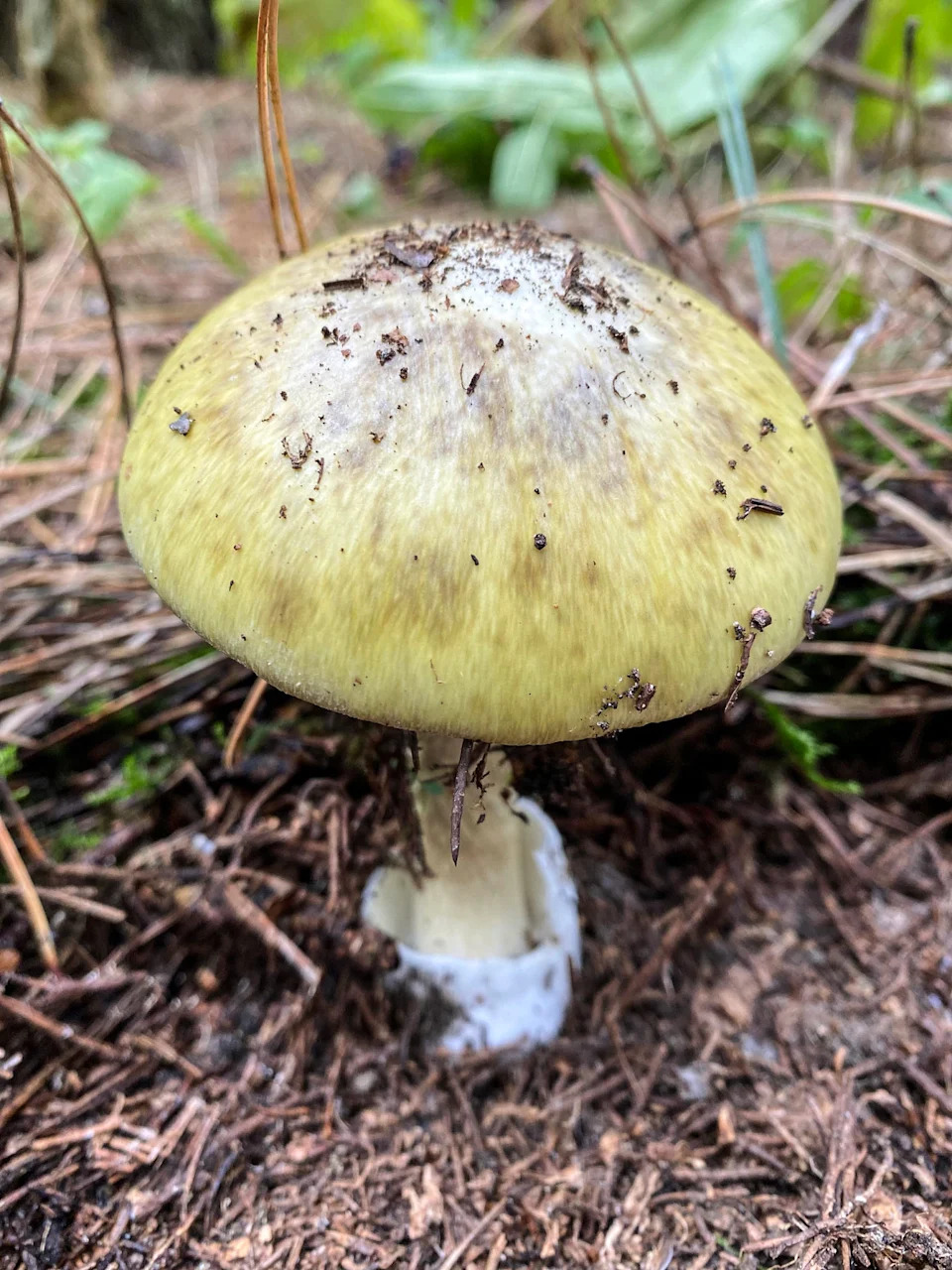
An Amanita phalloides mushroom in Hungary. The species originated in Europe and is invasive in the U.S. (Anne Pringle)
Experts note additional factors that increase risk: some affected people speak Spanish and may rely on foraging habits learned in other countries. Death caps resemble edible Amanita species common in parts of Central America, where death caps historically were rare; foragers with relevant experience elsewhere may not recognize local lookalikes in California.
Online tools — including social media, phone apps and AI-generated guides — have proliferated, but mycologists caution that these sources can misidentify dangerous species. Anne Pringle, a mycology professor at the University of Wisconsin–Madison, and others have seen unsafe or misleading identifications from apps and AI tools.
Toxin, Symptoms and Treatment
The death cap contains amatoxin, a potent compound that disrupts genetic transcription and protein synthesis, which can cause severe liver, kidney and gastrointestinal injury. Amatoxin poisoning can be fatal: experts estimate that amatoxins account for about 90% of lethal mushroom poisonings worldwide.
Amatoxin is highly potent — even a small amount can be dangerous. Heather Hallen-Adams, toxicology chair of the North American Mycological Association, has said that 'one cubic centimeter of a mushroom ingested could be a fatal dose.' Symptoms often begin within hours, may temporarily improve, then worsen over days as organ damage progresses. Diagnosis can be difficult and there is no single standardized treatment protocol.
Some clinicians have used silibinin — a compound derived from milk thistle — to treat amatoxin poisoning. However, silibinin remains experimental in the U.S., is difficult to obtain, and is primarily imported from Europe.
Prevention and Advice
- Do not forage wild mushrooms unless you are an expert or are guided by trained mycologists.
- Consult local mycological societies for reliable identification and education.
- Avoid relying solely on apps, social media, or unvetted AI guides for identification.
- If you suspect mushroom poisoning, seek emergency medical care immediately and contact your local poison control center.
Researchers continue to study the biology and spread of death caps. Anne Pringle's work shows that the species can reproduce both bisexually and unisexually, a trait that aids its spread and resilience. At present, there is no established method to eradicate death caps from invaded habitats.
This article is based on reporting originally published on NBCNews.com and statements from the California Poison Control System and regional mycological experts.
Similar Articles

Disease Detectives: How Scientists Track Fungi, Solve Strange Outbreaks, and Prepare for a Warming World
Disease detectives are tracing how fungi travel into new regions and spark outbreaks, often after disasters or via long-hidde...

LA County Removes Kratom After Six Deaths; Experts Call for Better Research and Regulation
Los Angeles County ordered kratom products red-tagged after kratom or the potent alkaloid 7-OH was found in six deaths from A...

Fusarium graminearum: The crop fungus tied to a smuggling case — what you need to know
Quick summary: Yunqing Jian, a 33‑year‑old University of Michigan plant scientist, pleaded guilty on Nov. 12, 2025, to smuggl...

Could Mushrooms Clean Up 'Forever Chemicals'? Merrimack Pilot Wins State Backing
Angela Graves has won preliminary New Hampshire DES backing for a 10‑sq‑ft mycoremediation pilot targeting PFOA contamination...

Fusarium graminearum: the crop fungus behind a scientist’s guilty plea — what farmers and consumers should know
Yunqing Jian pleaded guilty on Nov. 12, 2025, to smuggling Fusarium graminearum into the U.S.; she received time served and f...

Alarm Over FDA Memo: Top Vaccines Official Says 10 Children Reported Dead After Covid Shots — Experts Demand Evidence
Key Point: An internal FDA memo by Vinay Prasad claims at least 10 child deaths after Covid vaccination based on VAERS report...

Nature’s Psychedelic Tour: How Evolution Keeps Reinventing Mind‑Altering Molecules
Psychedelic compounds are widespread in nature: about 80 fungal species, at least 20 plants and one toad species produce psyc...

New Audio and Video Reveal Off‑Duty Pilot Tried to Cut Engines Midflight, Triggering Emergency Landing
New flight-deck audio and airport security footage show off‑duty pilot Joseph Emerson attempting to pull fuel‑cut handles on ...

Tick Bite Can Trigger a Meat Allergy — First Confirmed U.S. Death Highlights Alpha‑Gal Risk
Autopsy links a 47‑year‑old New Jersey pilot’s death to alpha‑gal syndrome (AGS), making it the first confirmed U.S. fatality...

FDA Investigates Possible Vaccine-Linked Deaths Across Age Groups After Senior Official’s Controversial Claim
The FDA has launched an investigation into whether deaths across multiple age groups could be linked to Covid-19 vaccines aft...

North Carolina Warns: Deer Attacks Rise After Fed Or Illegally Raised Deer Become Habituated
The North Carolina Wildlife Resources Commission reported a rise in deer attacks across six counties in 2025, often involving...

25-Year-Old Backpacker Dies and Dozens Fall Ill in Suspected Poisoning at Bali Hostel
Authorities in Canggu, Bali, are investigating after 25-year-old Deqing Zhuoga fell ill following a communal meal at a budget...

Photos Show USB, Bus Ticket and Pocketknife Found on Accused Killer Luigi Mangione — Federal Prosecutors Seek Death Penalty
New York prosecutors released photos showing items found on Luigi Mangione at his Dec. 9, 2024 arrest in Altoona, Pennsylvani...

31 Infants Hospitalized After ByHeart Formula; Recalled Cans Still Found on Store Shelves
Thirty-one infants in 15 states have been hospitalized with infant botulism after consuming ByHeart formula, with the latest ...

UCSB Freshman’s Fatal Dorm Fall Deemed Accidental by Police; DA Review Continues as Family Seeks Answers
UCPD concluded Elizabeth “Liz” Hamel’s February 2025 fall was accidental and sent findings to the Santa Barbara County Distri...