New images from Sol 4963 (July 23, 2026) show large holes and cracks in one of Curiosity's wheels after 14 years on Mars. NASA says the wear likely comes from driving across rugged southern terrain. Engineers first noticed wheel damage in 2013 but the rover has remained operational and productive, collecting 42 powdered rock samples and continuing science investigations, including a recent discovery of honeycomb-like polygons.
Curiosity's Wheels After 14 Years: New Images Reveal Holes, Cracks and Ongoing Resilience
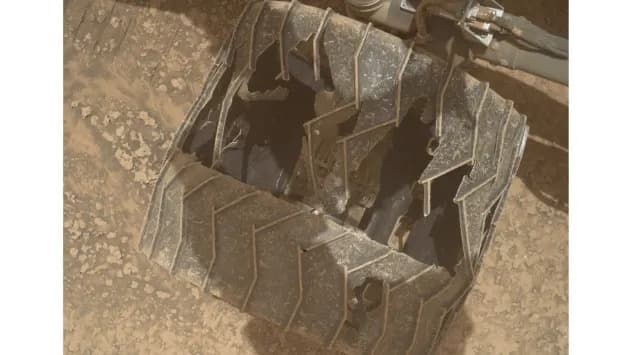
NASA's Mars rover Curiosity acquired this image using its Mars Hand Lens Imager (MAHLI), located on the turret at the end of the rover's robotic arm, on July 23, 2026, Sol 4963 of the Mars Science Laboratory Mission. (Image credit: NASA/JPL-Caltech/MSSS)
NASA's Curiosity rover is showing clear signs of long-term wear after 14 years exploring Mars: raw images posted July 23, 2026 (Sol 4963) reveal large holes and cracks in the outer skin of one wheel.
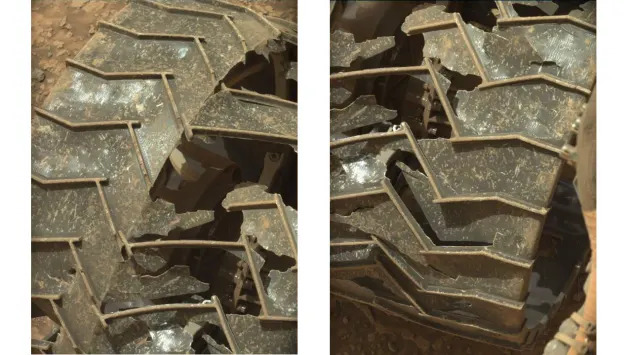
Images taken by Mast Camera (Mastcam) onboard NASA's Mars rover Curiosity on Sol 4963 on July 23, 2026. (Image credit: NASA/JPL-Caltech/MSSS)
What the Images Show
The photos, captured by the Mars Hand Lens Imager (MAHLI) on the end of Curiosity's robotic arm and documented by Mastcam, display splitting and missing sections of the wheel's outer material. NASA engineers say the deterioration was likely driven by extensive travel across rugged southern terrain—steep canyons, jagged rock outcrops and ancient volcanic landscapes.
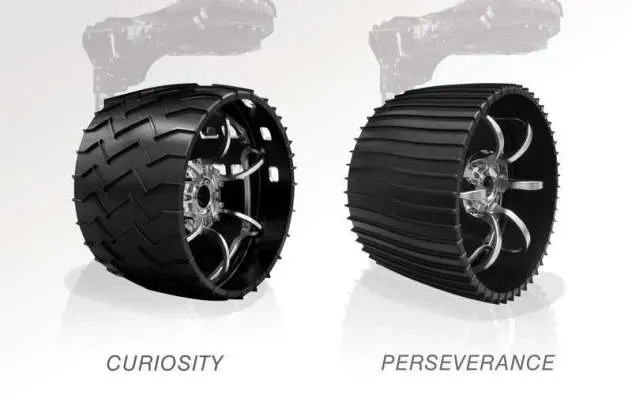
A NASA rendering shows the differences between the Perseverance and Curiosity rover wheels. (Image credit: NASA)
Damage Over Time—and Why Curiosity Keeps Going
Wheel problems are not new for Curiosity. Engineers first noticed damage in 2013, roughly a year after landing, raising early concerns about the rover's longevity. Periodic inspections—most recently including public images released after a 2024 check—show that, despite significant scarring, the wheels remain functional.
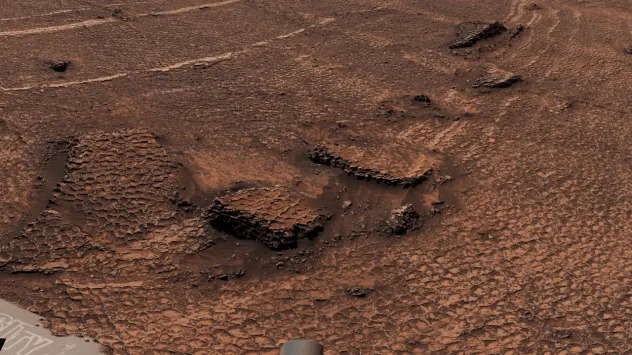
NASA's Curiosity rover captured an image highlighting the polygons and their honeycomb-like textures on June 19 and 20, 2026. (Image credit: NASA/JPL-Caltech/MSSS)
NASA: "The wheel is still holding up well despite taking some of the worst abuse from Mars."
Lessons Applied to Perseverance
Design lessons from Curiosity influenced the Mars 2020 rover, Perseverance, which landed in February 2021. Engineers made Perseverance's wheels narrower, larger in diameter and constructed from thicker aluminum to better withstand sharp rocks and abrasive surfaces.
Mission Context and Recent Discoveries
Curiosity touched down in Gale Crater on August 5, 2012, to investigate whether ancient Mars could have supported microbial life. About the size of a small SUV (roughly 10 feet long and nearly 2,000 pounds in Earth gravity), the rover has found mineral and chemical evidence of past habitable environments. It has powdered and cached 42 rock samples and continues to study the planet's geologic record.
On June 19–20, 2026, Curiosity also documented a concentrated field of polygonal, honeycomb-like surface features—the largest such cluster it has seen. Scientists are evaluating possible formation mechanisms, including temperature cycling, drying, sediment shrinkage, or compaction after burial.
Current status: Curiosity remains operational and continues science operations while teams on Earth monitor wheel condition and plan routes that balance science return with mobility risk.
Help us improve.