Special relativity links space and time so that moving clocks record less elapsed time than stationary ones. A photon, required to move at light speed, travels along a null (lightlike) worldline and therefore accumulates zero proper time between emission and absorption—even if observers measure the trip as billions of years. Experiments such as the Hafele–Keating flights and the daily operation of GPS confirm time-dilation and relativistic geometry; gravitational lensing can change a photon's coordinate travel time but not its zero proper-time interval.
How a Photon Can Cross a Billion Light-Years in “No Time” — The Relativity Behind It

A photon experiences no time while crossing space, a result that reveals how relativity connects light, motion and the flow of time. (CREDIT: Wikimedia / CC BY-SA 4.0)
A photon that travels across a billion light-years accumulates no proper time along its own path, even though observers on Earth measure the journey as taking a billion years. This startling result follows directly from special relativity and the geometric picture of spacetime: lightlike (null) worldlines have zero proper-time separation between emission and absorption events.

Physicists Joseph Hafele and Richard Keating flew cesium atomic clocks around the world, then compared them with identical clocks that remained on the ground to test Einstein's predictions about time. (CREDIT: Wikimedia / CC BY-SA 4.0)
Time, Motion, and the Light Clock
Special relativity ties space and time together, so clocks in motion register less elapsed time compared with clocks at rest in the same reference frame. A simple thought experiment—the light clock—makes the effect intuitive: a pulse of light bounces between two mirrors. At rest the pulse travels straight up and down; seen from a frame in which the clock moves, the pulse follows a diagonal, longer path. Because the speed of light c is invariant (about 299,792 km/s for every inertial observer), the pulse takes longer between ticks, so the moving clock appears to tick more slowly. Physicists summarize this with the Lorentz factor, γ (gamma).
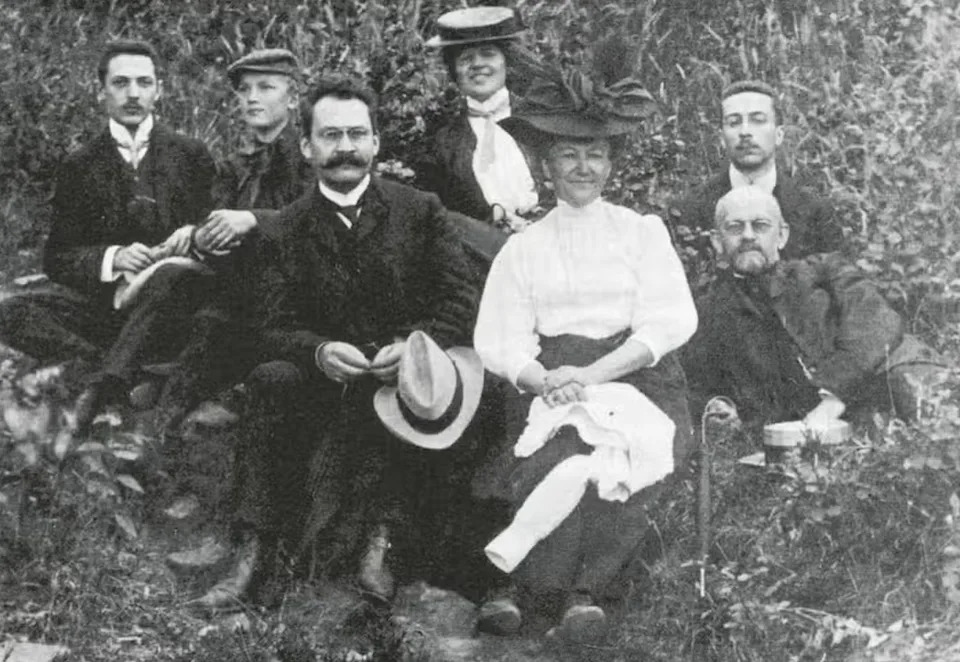
Hermann Minkowski (front left), the mathematician who introduced the concept of four-dimensional spacetime, transformed how scientists understand space, time, and Einstein's theory of relativity. (CREDIT: Wikimedia / CC BY-SA 4.0)
As velocity approaches c, γ grows without bound, and the passage of proper time along a timelike worldline tends toward zero.
Photons, Proper Time, and Null Paths
Photons are massless and travel at exactly c. The interval of proper time measured along a photon’s worldline is zero. That means: although observers separated by billions of light-years measure a long elapsed coordinate time for a photon’s trip, the spacetime interval along the photon’s path is null. This is a mathematical statement about geometry, not a claim that a photon has consciousness or an experience.
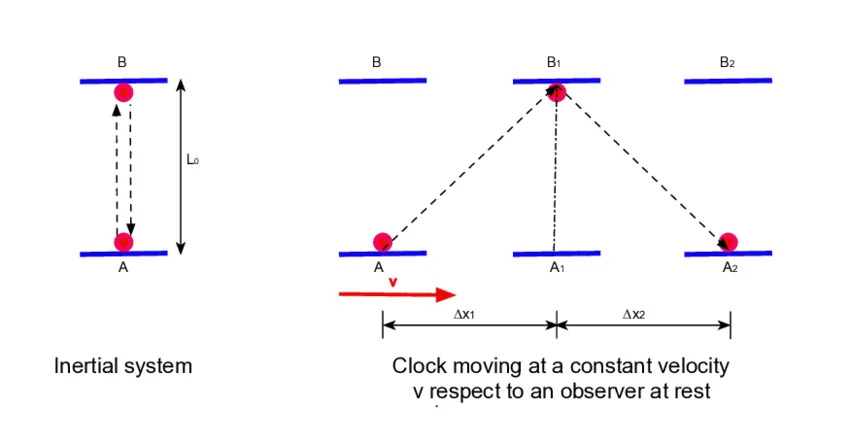
Einstein's light clock illustrates time dilation. Left: In the clock's own frame of reference, a pulse of light travels straight between two mirrors. Right: To a stationary observer watching the clock move, the light follows a longer diagonal path, causing the clock to appear to tick more slowly. (CREDIT: Marco Favaron et al., Research Gate)
Experimental Evidence and Practical Consequences
Relativistic time dilation is measurable. In 1971 Joseph Hafele and Richard Keating flew cesium atomic clocks around the world and compared them with identical clocks left on the ground; the observed differences agreed with Einstein’s predictions when both special- and general-relativistic effects were included. Modern atomic clocks can detect even tiny discrepancies caused by everyday motions.
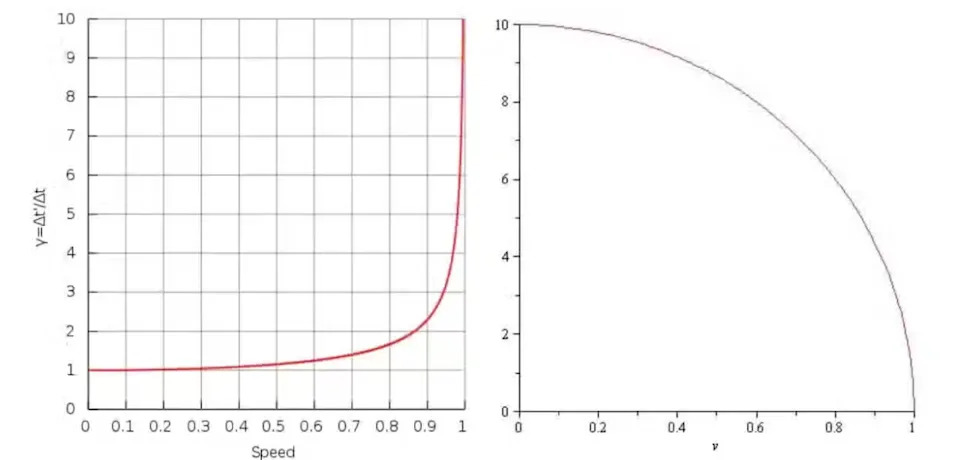
Time dilation (left) and length contraction (right) illustrate two key predictions of Einstein's special relativity: as an object approaches the speed of light, time passes more slowly and distances contract along its direction of motion. (CREDIT: Wikimedia / CC BY-SA 4.0)
These principles are essential to technology: GPS satellites orbit about 20,200 km above Earth and move at roughly 3.9 km/s. Their orbital motion causes onboard clocks to run slower by about 7 microseconds per day relative to ground clocks, while the weaker gravity at altitude makes them gain about 45 microseconds per day. The net relativistic correction is roughly +38 microseconds per day; without it, navigation errors would accumulate by many kilometers each day.
Gravity, Curved Spacetime, and Light Travel Time
Special relativity applies in flat spacetime. Einstein’s general relativity extends the picture to curved spacetime produced by mass and energy. Massive bodies bend light's path (gravitational lensing), and that bending can delay or advance arrival times as seen by distant observers because the coordinate path becomes longer or traverses regions with different gravitational potential. Even so, the light ray still follows a null worldline and its proper-time separation between emission and detection remains zero.
Why It Matters
These ideas change how we think about time: there is no single universal clock. Each object accumulates time along its own worldline according to its motion and the gravitational field it traverses. Light forms the boundary of causal influence—nothing with mass can reach it, and no information can travel faster than c. Along that boundary, proper time is exactly zero.
Note: Saying a photon has “no time” between emission and absorption is shorthand for the geometric fact that lightlike intervals have zero proper time. It should not be read as implying that photons have awareness or temporal experience.
Original story published in The Brighter Side of News.
Help us improve.