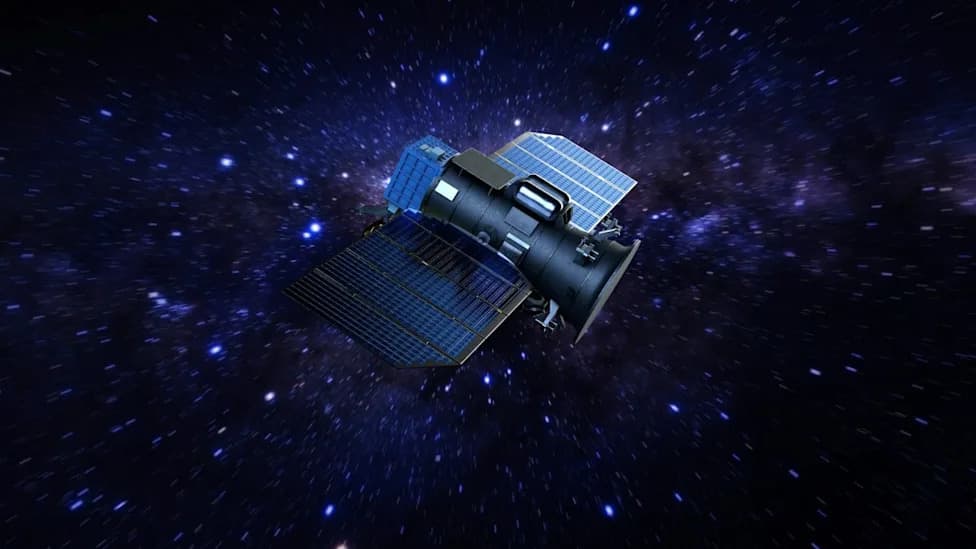
Reflect Orbital received FCC approval to test an 18‑metre mirror satellite, Eärendil‑1, after raising $20 million in May 2025 and plans to launch before year‑end. The satellite would reflect sunlight onto 5–6 km areas with adjustable intensity and could be sold for up to $5,000 an hour. Scientists and environmental groups — backed by more than 1,800 public comments and letters from international society leaders — warn of risks to aviation, astronomy, circadian rhythms and ecosystems and are calling for a full environmental review. The company proposes scaling to thousands of mirrors if the demonstration succeeds.
Space Mirrors Approved for FCC Tests — Could Light Cities at Night, But Scientists Warn of Big Risks
The Controversial Space Mirrors Designed to Boost Solar Power
Reflect Orbital, a California startup, has won permission from the US Federal Communications Commission (FCC) to test an experimental satellite fitted with an 18-metre-wide mirror designed to reflect sunlight back to Earth’s night side. The company — which raised a $20 million Series A in May 2025 — plans to launch the demonstration satellite, Eärendil-1, into low Earth orbit before the end of the year.
What the Project Would Do
Once deployed, Eärendil-1 will unfurl a thin-film reflector that acts as a mirror to redirect sunlight onto ground areas roughly 5–6 km wide. Reflect Orbital says the reflected beam’s intensity will be adjustable, "from full moon to full noon," and that the company could sell on-demand illumination to businesses or municipalities for up to $5,000 an hour — for applications such as lighting streets without local power or supporting solar farms after dusk.
Support and Company Position
The FCC called the proposal potentially "groundbreaking technology" that could strengthen American leadership in space. Reflect Orbital’s co-founder and CEO, Ben Nowack, says the pilot will gather data to verify safeguards and control over the beam. Nowack commented, "We're grateful to the FCC for recognising the importance of testing novel technologies in space." The startup has said it could scale to 1,000 mirror satellites by 2028 and as many as 50,000 by 2035 if the demonstration proves viable; later mirrors could reach up to 55 metres across.
Scientific and Environmental Concerns
The plan has drawn substantial criticism from scientists, astronomers and environmental groups. More than 1,800 public comments were filed with the FCC, and the presidents of four international scientific societies — representing roughly 2,500 researchers across 30+ countries — have formally asked the agency for a full environmental review and limits on satellite reflectivity and cumulative night-sky brightness.
Roohi Dalal, director of public policy at the American Astronomical Society, said: "It is clear that the activities that Reflect Orbital is proposing will have an impact on the Earth environment, including on human health, agriculture and wildlife, in addition to astronomy."
Experts warn concentrated reflected beams could present aviation hazards by momentarily blinding pilots, interfere with astronomical observations, and disrupt human and animal circadian rhythms — with potential knock-on effects for plant growth, seasonal cycles, migratory species and marine phytoplankton. The European Southern Observatory estimates a single reflected beam could appear about four times brighter than the full Moon in the illuminated area.
Broader Trade-Offs and Context
Supporters argue orbital mirrors could expand renewable-energy options and provide targeted, low-carbon illumination or power. Critics point out other costs: rocket launches needed to place thousands of satellites in orbit generate carbon emissions, and adding large numbers of bright reflectors could worsen light pollution and create new environmental pressures.
The proposal arrives amid broader ambitions for orbital infrastructure. For example, SpaceX has suggested launching up to 1 million satellites for orbital computing and solar-powered data centres — plans that have already collided with concerns about congestion in low Earth orbit as Starlink approaches nearly 10,000 satellites.
What Comes Next
The FCC’s authorization enables a limited demonstration, not full commercial deployment; the test is intended to collect data about performance and impacts. Scientists and advocacy groups are pressing for a comprehensive environmental assessment and limits on brightness and reflectivity before larger-scale rollouts proceed.
Bottom line: The Reflect Orbital test could advance novel uses of space-based sunlight, but substantial scientific, regulatory and environmental questions remain — especially if the company follows through on ambitious plans to scale to thousands of reflective satellites.
Help us improve.