Reform U.K., led by Nigel Farage, reported Green Party leader Zack Polanski to police over an Instagram collaboration post that included a guillotine T‑shirt and the caption "We're only making plans for Nigel." The post was a shared collaboration that Polanski did not create and later unshared; the Metropolitan Police said it was "conducting enquiries." Critics say using criminal probes to police offensive political imagery contradicts Reform U.K.'s prior free‑speech stance and risks empowering state censorship. The episode follows a recent fatal attack on a Reform U.K. spokesperson and has renewed debate over uneven enforcement of online‑speech laws.
Farage's Reform U.K. Reports Green Leader Over Guillotine T‑Shirt Post — Free‑Speech Debate Intensifies
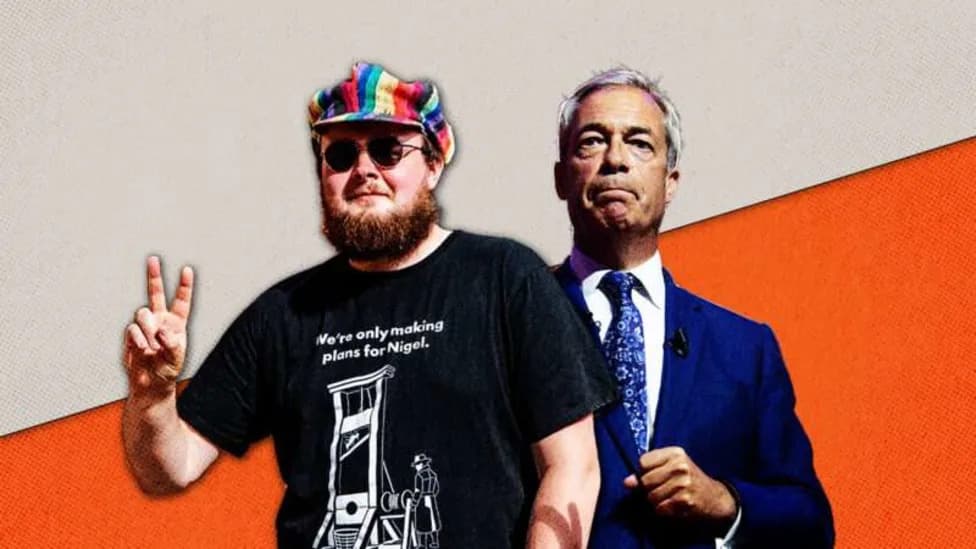
Justin Ng / Avalon/Newscom Illustration: Fatima Ruiz
Great Britain is grappling with a tense free‑speech debate after reports indicate more than 12,000 people were arrested for online speech offences in 2023. The controversy has intensified this week after Reform U.K., led by Nigel Farage, referred Green Party leader Zack Polanski to police over an Instagram "collaboration" post that included an image of a man wearing a T‑shirt depicting a guillotine and the caption: "We're only making plans for Nigel."
What Happened
The item in question was an accepted collaboration post containing several photographs from a Green Party event and was therefore shared to Polanski's account, which has roughly 713,000 followers. Polanski did not create the image himself and, according to the Green Party, unshared it once it was brought to his attention. The Metropolitan Police said it was "conducting enquiries into the matter."
Responses And Context
Nigel Farage reposted a screenshot of the post on X, arguing that if he had shared something comparably provocative he would expect to be arrested. Supporters of Reform U.K. say the episode highlights perceived uneven enforcement of online‑speech laws; critics say using police processes to punish offensive political imagery is inconsistent with the party's past defence of broad free expression.
The incident comes amid heightened sensitivities after a recent fatal attack on a Reform U.K. spokesperson earlier this month that police have described as a targeted act; counterterrorism officers are reported to be investigating whether it was politically motivated.
Relevant Past Cases
Reform U.K. and Farage have previously protested what they describe as overreach in policing of speech. They have cited the 2024 jailing of Lucy Connolly, who received a custodial sentence after posting a violent, racially charged tweet following a high‑profile murder case, and have also publicly defended comedian Graham Linehan, who faced arrest over online posts about transgender people. Those cases are often invoked by Reform to argue that enforcement is selective and politically biased.
Claire Fox, member of the House of Lords and director of the Academy of Ideas, told Reason: "I empathise with those shouting for action. I get it. Call the police. Give those leftist identitarian activists a taste of their own medicine. But what a disaster for free speech."
"If it's wrong for the state to criminalise our speech, it's equally wrong to criminalise [theirs], even in the name of fair treatment and retribution. All this does is institutionalise a censorious climate and consolidate government power to shut us all up."
Why It Matters
Observers say the episode underscores a difficult balance: condemning rhetoric that appears to normalise political violence while protecting the principle that the state should not be the arbiter of all offensive speech. Many commentators argue the image deserved public condemnation, not necessarily a criminal investigation, and warn that escalating reliance on police responses to heated political imagery risks narrowing space for dissent and public debate.
Note: This article has been edited for clarity, flow and to correct typographical errors in the original account while preserving the factual claims that have been reported publicly.
Help us improve.