NASA's Perseverance rover, using its SHERLOC instrument, has detected macromolecular carbon (MMC) in mudstones at Jezero Crater's Bright Angel outcrop, including the Cheyava Falls sample. Raman analysis indicates the material is amorphous carbon with spectral similarities to both biological and abiotic Earth samples, but the team cannot claim a biological origin. Possible sources include meteorite delivery, abiotic in situ processes, or (unproven) ancient biology; resolving the origin requires Mars samples returned to Earth.
Perseverance Detects Complex Macromolecular Carbon in Jezero Crater — A Major Step in the Search for Life
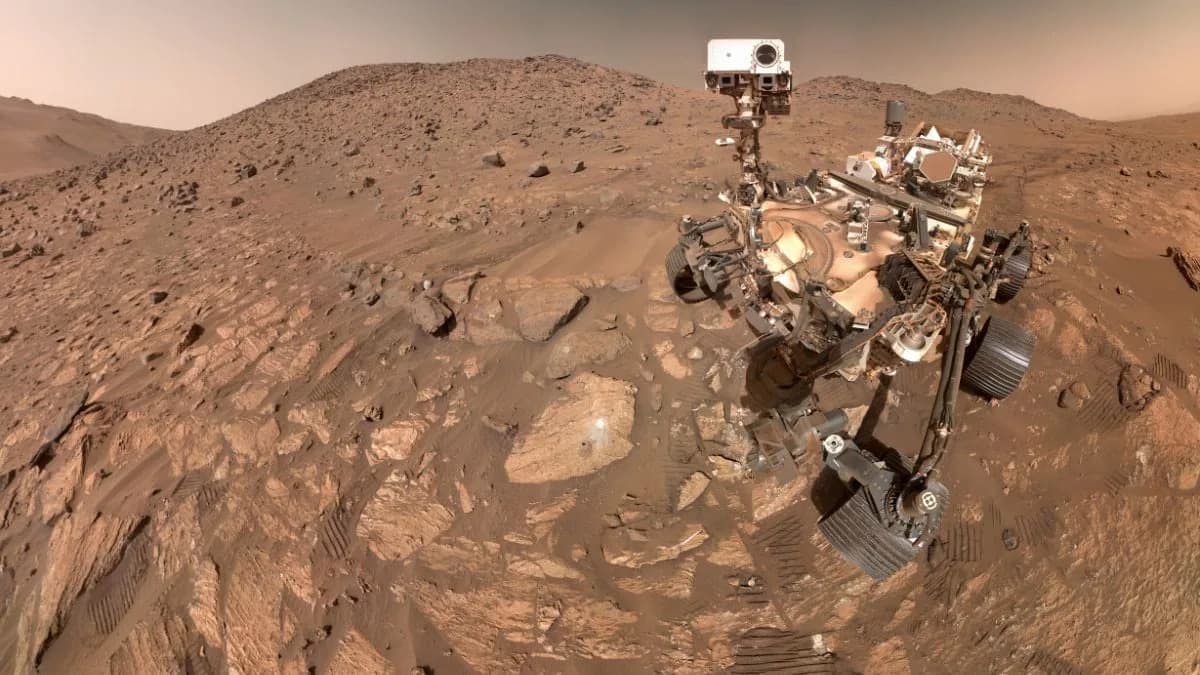
NASA's Perseverance rover snaps a selfie with the "Cheyava Falls" rock that has inspired discussions about potential life signs on Mars. (NASA/JPL-Caltech/MSSS)
NASA's Perseverance rover has detected complex carbon-bearing material in rocks from Jezero Crater, renewing questions about Mars' ancient chemistry and its potential to have supported life. The discovery, reported in Science Advances, comes from analyses by the rover's SHERLOC instrument and reveals macromolecular carbon (MMC) in mudstones at the Bright Angel outcrop, including the spotted Cheyava Falls sample.
What the Team Found
SHERLOC's Raman mapping identified spectral signatures consistent with amorphous carbon. The MMC was observed on the dust-cleared, unprepared surface of Cheyava Falls — the shallowest detection of organic matter on Mars to date — suggesting either recent exposure or protection by photoprotective minerals.
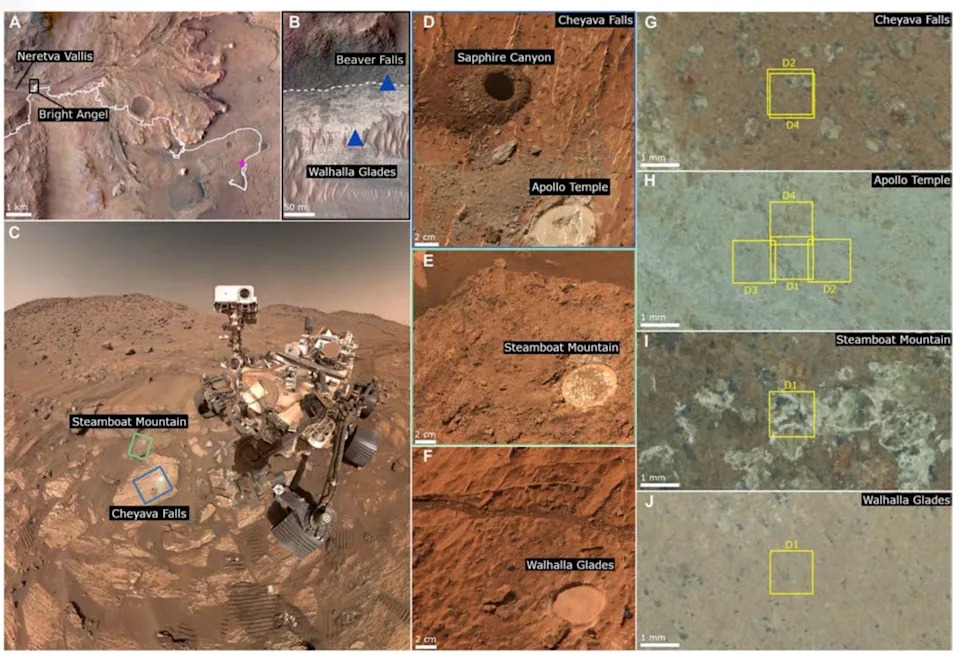
The location and close-up images of the rocks sampled by NASA's Perseverance rover. (Murphy et al.,Science Advances, 2026)
Kyle Uckert, an astrobiologist and SHERLOC instrument scientist at JPL, noted the significance of the shallow detection and the potential for mineral shielding.
Context and Comparisons
The macromolecular carbon complements other organic-relevant minerals in the same rocks, such as carbonates, sulfates and phosphates. Compared with simpler organics previously detected on Mars (for example, alkanes found in the Cumberland mudstone by Curiosity), the MMC appears more structurally complex. The discovery at Bright Angel is also notable because it lies more than 3,500 km from Curiosity's Gale Crater findings, implying that organic-bearing rocks may have been widespread across early Mars.
Interpretation and Limits
Using the Raman G-band parameters, researchers concluded the MMC is amorphous carbon. Ashley Murphy (Planetary Science Institute) emphasized that the G-band peak position and bandwidth overlap with many reference materials — both biotic (e.g., microbial mats, coals) and abiotic (e.g., meteorites, hydrothermal alteration products). Because of spectral overlap and SHERLOC's in situ limitations, the team cannot attribute the MMC to a unique origin or claim it is evidence of past life.

Subscribe to ScienceAlert's free fact-checked newsletter
Possible Origins
The authors outline several plausible sources for the MMC:
- Exogenous delivery by interplanetary dust or meteorites.
- Abiotic in situ synthesis via volcanic, hydrothermal, or electrochemical processes.
- — Not demonstrably supported by this work — biological synthesis that occurred in situ long ago.
Definitive determination of origin requires high-sensitivity laboratory analyses only possible on returned samples. A coordinated Mars sample return campaign, therefore, remains critical to resolving whether any of these organics preserve biosignatures.
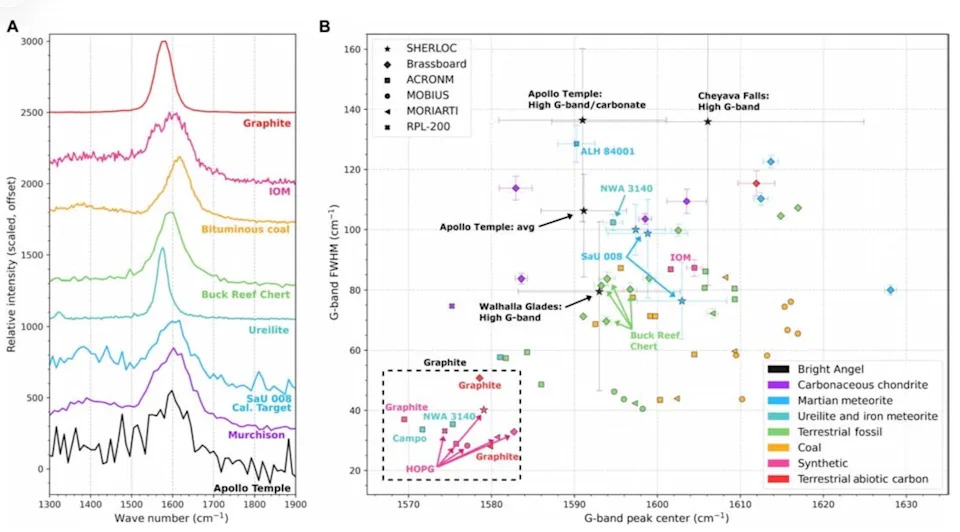
The sampled rock's spectral properties compared with those of meteorite or terrestrial samples. (Murphy et al.,Science Advances, 2026)
Why This Matters
Finding complex organics in Jezero's lakebed deposits strengthens the view that early Mars hosted chemically favorable environments for organic synthesis and preservation. While the presence of MMC does not prove life, confirming an independent origin of biology on Mars would be transformative for understanding life in the Universe.
Publication: The study is published in Science Advances.
Help us improve.