Researchers decoded Richard Feynman’s late-1970s notes on a dining decision and proved his time-varying threshold rule optimal under the problem’s assumptions. An online experiment with 2,520 participants found people instead use a simpler heuristic — a high starting bar that decreases by a fixed amount each night — capturing about 90% of optimal value. The results support the resource-rational view of cognition and have implications for AI design.
Feynman’s Forgotten Lunch Problem Decoded: How to Know When to Stop Exploring Restaurants
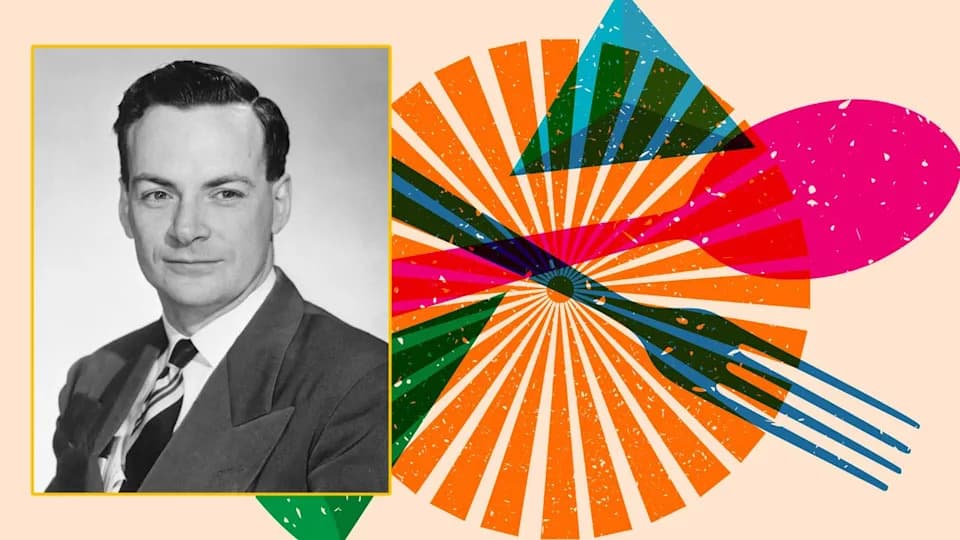
Manhattan Project physicist Richard Feynman (photographed in 1954, inset) couldn't get through lunch with his friend without trying to optimize their orders with math. Now, researchers have finally deciphered his long-illegible "restaurant problem". | Credit: Getty
In the late 1970s, physicist Richard Feynman — already famous for his work on the Manhattan Project and for popularizing physics — turned a friend’s lunchtime indecision into a mathematical puzzle. Over a meal in Glendale, California, Feynman sketched a rule for when a diner should stop trying new restaurants and return to a reliably good choice. His cramped notes proved unreadable for decades.
Researchers recently reconstructed the problem from those notes and published a formal proof of Feynman’s rule on June 1 in Proceedings of the National Academy of Sciences. The formal problem belongs to a class of decision tasks called optimal stopping problems: you have a fixed number of opportunities (nights) and must choose each night either to try an unknown option or to return to the best option found so far, with the aim of maximizing total enjoyment across the trip.
What Feynman Proposed
Feynman’s solution prescribes a time-dependent quality threshold: accept a restaurant only if its revealed score exceeds a minimum bar that starts high and steadily declines as the trip progresses. This threshold balances exploration and exploitation to maximize cumulative reward — not merely to find the single best place.
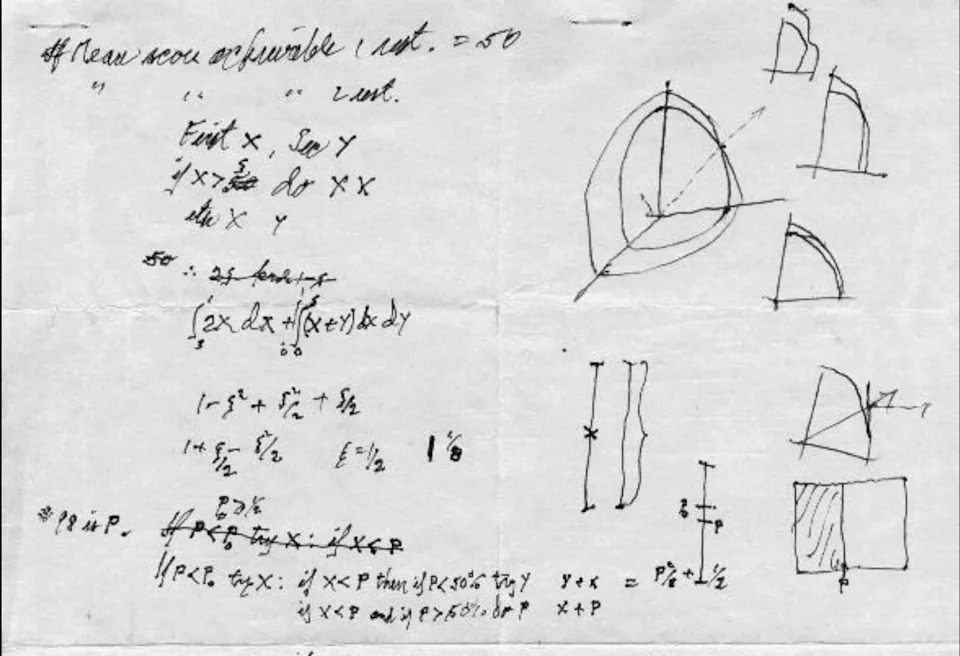
A page of Feynman’s handwritten notes on the Restaurant Problem. | Credit: Caltech / The Feynman Lectures on Physics
The Experiment
To test whether people follow Feynman’s optimal curve, Brian Christian (University of Oxford) and Tom Griffiths and their colleagues reconstructed the formal model and ran an online experiment with 2,520 participants. Players navigated a simulated grid of restaurants, each with a hidden quality revealed only on first visit. Participants had a fixed number of nights and tried to maximize their total score over one playthrough.
Instead of matching Feynman’s precise threshold curve, participants adopted a far simpler heuristic: they set a high initial quality bar that dropped by a fixed amount each night, independent of trip length or the underlying distribution of restaurant qualities. Participants adjusted where to set the initial bar depending on the environment they encountered, but the rate of decline was remarkably consistent.
Key Results
- The simple, fixed-decay rule captured roughly 90% of the theoretical optimum.
- People do not compute Feynman’s exact optimal curve in practice, but they use a robust, near-efficient heuristic.
- Behavior supports the resource-rational view of cognition: humans use simple rules that make effective trade-offs given limited time and computational capacity.
Why It Matters
Beyond a charming anecdote about a lunch conversation, this work links mathematical decision theory to real human behavior. It suggests that predictable, low-cost heuristics can approach optimal performance in complex tasks, a fact that has practical implications for modeling human choices and designing AI systems that interact with people. Many AI models assume perfectly rational agents; incorporating human-style heuristics may improve human-AI coordination.
People "don’t do the perfect thing, but they make nearly perfect use of their constrained resources," said Brian Christian — a reminder that near-optimal heuristics can be powerful.
Feynman never published this lunchtime analysis; he died in 1988. More than 40 years after he scrawled the idea on a scrap of paper, researchers have reconstructed and validated his insight — and shown how it illuminates everyday decision-making.
Help us improve.