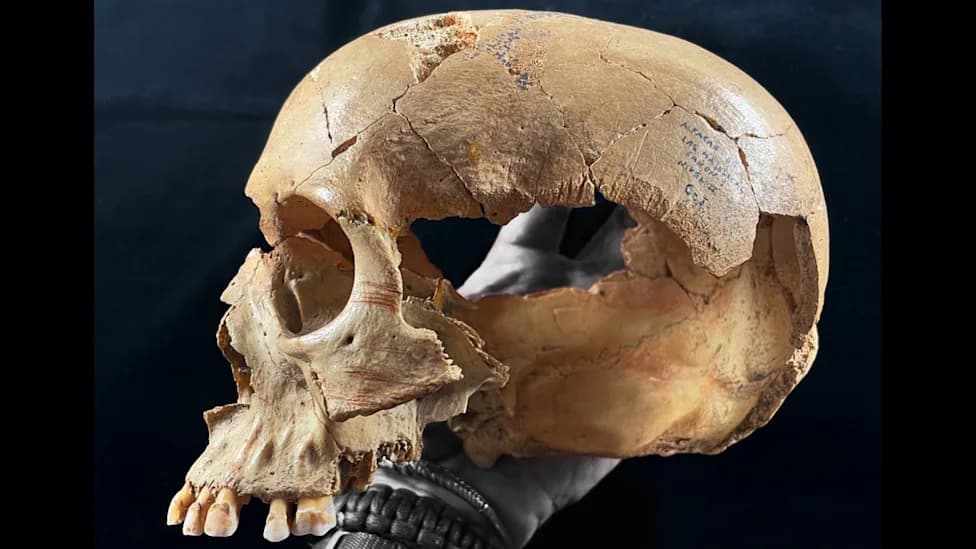
The 2022 Vráble excavation in Slovakia recovered at least 78 Neolithic burials; 77 adult skeletons were missing skulls. A recent study suggests the skulls were removed carefully and intentionally, consistent with ritual practice rather than mass violent decapitation. The settlement — part of the Linear Pottery culture and occupied c.5250–4950 BCE — contains outlines of over 300 houses. Ongoing cut‑mark, isotope and ancient DNA analyses aim to clarify age, sex, diet, origins and kinship among the buried individuals.
77 Headless Neolithic Skeletons Found at Vráble, Slovakia — Skulls Likely Removed as Ritual, Not Mass Decapitation
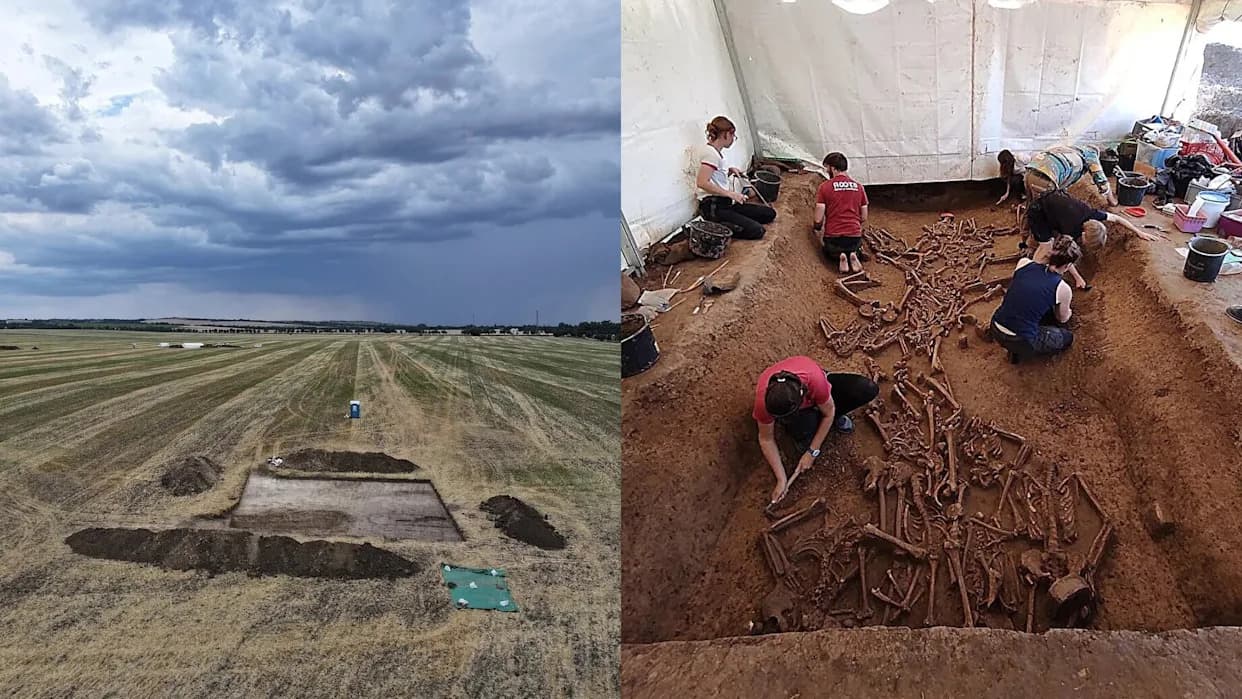
LEFT: Drone footage of the excavation site. In the foreground, an area is visible that has just been stripped open by an excavator and waits to be excavated. This spot was chosen because it exhibits an opening through the ditch, where further depositions of human skeletons were expected. In the background, two further trenches are shown, one with the mass deposition RIGHT: While the excavation of the mass deposition was concentrated on the eastern area starting in 2022, the western section has been under excavation since 2024. The tent above the trench protects the excavation from rain and sun.
The 2022 excavation near Vráble, Slovakia uncovered at least 78 Neolithic burials at the entrance to a large Linear Pottery culture (LBK) settlement. Remarkably, 77 adult skeletons were missing their skulls, while a single child skeleton retained its cranium. A new paper in the Proceedings of the Prehistoric Society argues that the skulls were removed carefully, consistent with ritualized treatment rather than violent mass decapitation.
Context and Significance
The LBK was one of Europe's earliest farming cultures (c. 5500–4500 BCE). The Vráble settlement — occupied roughly between 5250 and 4950 BCE — contains the outlines of more than 300 houses across three neighborhoods, one of which was surrounded by a ditch interpreted as a boundary. The unusual burial assemblage at the settlement's entrance provides a rare opportunity to study Neolithic mortuary behavior and social practices during the transition to agriculture.
What the Team Found
Archaeologists from Kiel University (Germany) and the Slovak Academy of Sciences (Nitra) report that the remains were placed in a jumbled arrangement and initial observations indicate burial occurred soon after death. Biological anthropologist Dr. Katharina Fuchs notes the bones exhibit 'intentional manipulation' and that first analyses favor skilful removal of skulls rather than traumatic decapitation by foes.
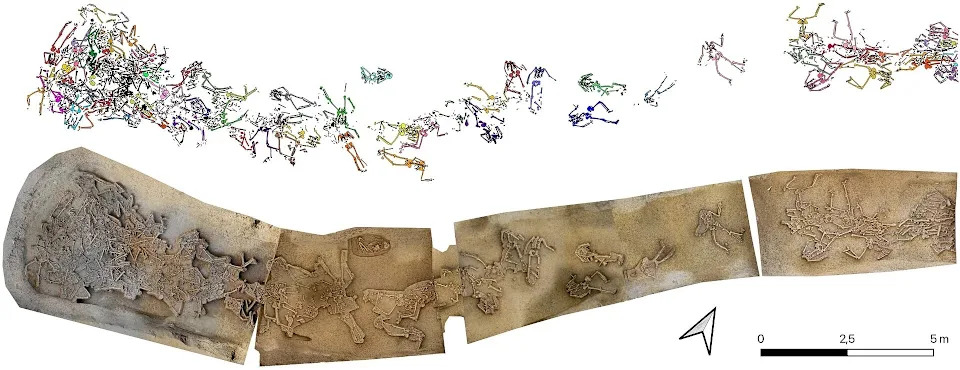
The mass deposition at the ditch. Below: photos; above: a tracing of the skeletons in various colours. Most of the individuals are found to the far left, where the ditch ends and the entrance to the settlement was located.Image: Katharina Fuchs, Agnes Heitmann, Nils Müller-Scheeßel, Till Kühl.
Interpretations and Ongoing Analyses
One plausible interpretation is that skulls were curated or stored separately — a custom known from other prehistoric contexts, though practices vary widely between groups. Researchers emphasize that removal and treatment of skulls may have been part of a broader ritual or social system whose meanings differ from modern expectations.
Current work includes sorting skeletal remains to determine age-at-death and biological sex, detailed analyses of cut marks, and forensic studies of decomposition and trauma. Planned isotope and ancient DNA analyses aim to reveal individuals' geographic origins, diets and kinship relationships.
Why it matters: The Vráble assemblage may shed light on how Neolithic communities understood death, the body and social ties in early farming societies.
While interpretations remain tentative, Vráble is already regarded as an exceptional site that can inform debates about ritual practices, violence and social organization in Neolithic Central Europe.
Help us improve.